After writing a blog about the lady who ran the Ship Inn recently, I became interested in a smaller beerhouse that used to be next door, the Lord Nelson, I wondered what happened to it, so I started a little research to go back in time to find out.
A WARNING THAT THIS BLOG STORY CONTAINS CONTENT AND GRAPHIC DETAILS ABOUT A SUICIDE.
The first information I found was on the website: ClosedPubs.co.uk
The Lord Nelson was situated at 18 Queen Street. This beer house closed in 1911(note: it was 1913 not 1911) after the local Justices, based in Sleaford thought the number of licensed premises in the village was excessive and set up a committee to determine which premises were the most suited. The structural condition of the building, the accommodation for the public, and the facilities. The Lord Nelson was little more than a cottage, and being next to the larger Ship Inn did not do much trade. In addition, the Police found the cottage hard to supervise as a back entrance allowed troublemakers to escape onto the street.
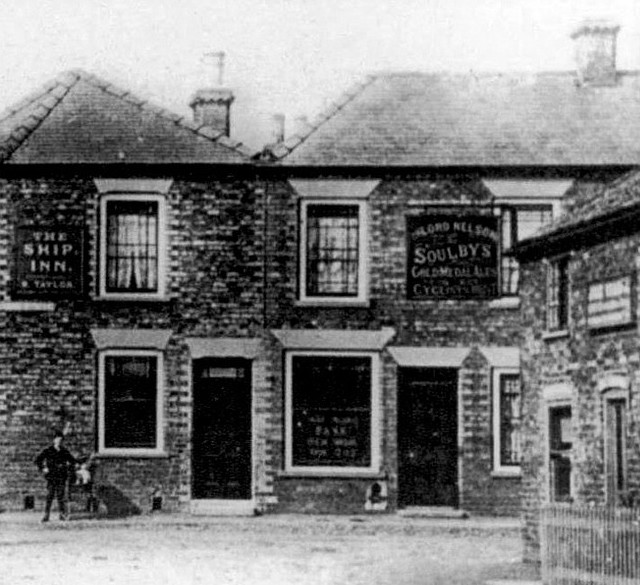
As you can see from the above photo it was run, just before its closure, by Soulbys, Son and Winch. But what about before and after this photo, what was its history?
I decided to start with the 1911 census to see who the landlord was before its closure. The Lord Nelson wasn’t mentioned on the census which was a bit frustrating so I turned to the Newspaper Archives and found out that there were numerous mentions of the pub and its landlord John Sharpe, so going back to the census records I traced John Sharpe and his family as you can see here below, his occupation is an Innkeeper. His wife Rachel (Hufton) and two of his children Charles, a Butcher’s apprentice and daughter Nellie, are here also.
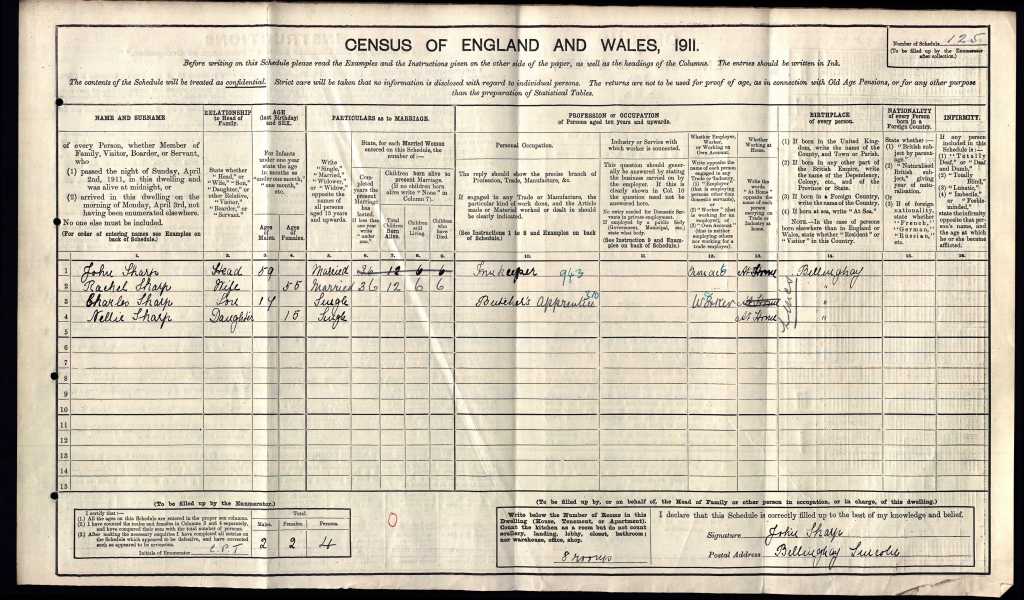
Again because of the reports in the newspapers, I knew that John Sharp/e was the landlord for many years, here’s the 1901 census where John Sharpe is a Beer House Keeper, the Lord Nelson, is not mentioned.

Next, we have the 1891 census below and finally the Lord Nelson has a mention! John Sharp/e occupation is a Cordwainer & Beer House Keeper.

Getting back to the 1881 census, John Sharp has only been married to Rachel since 1874 and states he is a Bootmaker, so he is not involved with the Beer trade at all.

In the 1882 White’s Directory and the 1885 Kelly’s Directory John Sharp is just a Boot Maker/Shoe Maker and still in Kelly’s 1889 he is a Shoe Maker. We know by 1891 via the census above that John is running the Lord Nelson and in the 1892 copy of Kelly’s he is described as a Shoe Maker and Beer Retailer.
So I think this was a new venture by whoever owned it and this was when the Lord Nelson was born 1890-91. John Sharpe was quite possibly the first landlord. I do wonder, again from various newspaper reports if Mr Edmund Nelson, the Solicitor who represented many local companies, including breweries, around this time regarding their licenses and other matters was the one to employ him for the Lord Nelson.
From all the newspaper reports through the years he certainly put his heart and soul into running it, the Lord Nelson Beer House held various meetings for different committees and clubs there, here’s just one example below from 1902.
Sleaford Gazette – Saturday 06 September 1902. SPORTS: At a meeting held at the Lord Nelson Billinghay, on Saturday, it was decided to hold sports on October 14th, and to offer £37 in prizes for cycle, foot, and horse races. The cycle and foot races will be under the rules. The Committee consists of Messrs. J. B. Marshall (Chairman), F. S. Blakeman (Vice Chairman), F J Baily (treasurer). A. Olive, J. Benton, A. Mastin. C. W. Wallis, C. B. Benton. J. Sharp. G.Turner. J. Wood. J. South. R. W. Dickinson, J. Maplethorpe and W. S. Hilton (secretary). A suitable field has been secured, and there should be some very good sport.
John obviously looked after the place well and was well respected as was his wife Rachel, a good team. The couple had married in 1874 and they had 12 children, only 6 living into adulthood according to the 1911 census.
The next newspaper report was when John had a nasty accident while painting.
Sleaford Gazette – Saturday 07 May 1910. A nasty accident befel Mr John Sharpe, landlord of the Lord Nelson inn on Friday last. He was engaged lime washing the beer cellar, when the ladder on which he was standing slipped, precipitating him with a heavy crash onto the brick thrall. Dr Chambers was immediately sent for and found Mr Sharpe to have sustained a fractured rib, besides numerous bruises and contusions. We are glad to be able to state that the patient is progressing favourably.
John must have recovered from this but did it leave him incapacitated? Then my research uncovered a shocking tragedy, not to John and his family but to a weekend lodger, the local Butcher.
AGAIN A WARNING THAT THIS STORY CONTAINS CONTENT ABOUT A SUICIDE:
Lincoln Leader and County Advertiser – Saturday 20 January 1912. SHOCKING TRAGEDY AT BILLINGHAY, The “Boston Butcher” Commits ~ Suicide.
FOUND IN THE STABLE WITH HIS THROAT CUT. Quite a sensation was caused in Billinghay, on Saturday morning, about 9.30 o’clock when it became known that Mr. John Coles, known at the “ Boston butcher,” had committed suicide by cutting his throat. For the greater part of 20 years Messrs. F. and T. Ryans, butchers, in Boston, have had a branch shop at Billinghay. John Coles was the man in charge of weekends. Several months ago he took over a butcher’s business at Swineshead, and we understand that Messrs. F. and T. Ryans gave Coles the goodwill of the Billinghay branch to go with the present one at Swineshead. This he carried on most successfully until last week, having spent weekends at Billinghay for nearly eight years. He was most respected and always obliging, and had a good trade to all appearance by the meat he exhibited from time to time. The news of his untimely end came as a great surprise to all who knew him. His mother, sister and brother arrived later in the day and were very much distressed at the occurrence.
The inquest was held on Tuesday morning at the County police station, Billinghay, by Dr Cragg, Coroner for the Sleaford district. The following were sworn on the jury: Messrs. George Carr (foreman), Ed. Wiflowc, Jumes Farbon, A. Benton, John A. Stevenson, Wm. R. Sawyer, Thos, P. Gilbert, Juno. Taylor, Jos. B. Marshall, Saml. Dickenson, Jno. Poucher, and Fredk. Hickling.
Inspector Deccan, police officer, Billinghay, identified the body as that of John Coles, aged 29, late butcher of Swineshead. He was called, he said, on January 13th, to the Lord Nelson beerhouse, about 9.45 and from what he was told he went into the stable and there found the body of the dead man lying face downwards in a standing or stall. Turning the body over he found the knife (produced). This was a butcher’s knife, generally used in the trade, and was found lying underneath the body: The throat of the deceased was cut, and to all appearance, he was quite dead. The throat was cut through to the windpipe. He searched the body and found in the pockets £4 16s 4½d, a watch, purse, two knives, and a telegram referring to horse racing. He had made enquiries about the deceased and caused enquiries to be made at Swineshead, and the only thing that he could find, explaining the occurrence, was drink. The deceased had always been more or less addicted to drink.
*In another newspaper the Lincolnshire Chronicle – Friday 19 January 1912 it contradicts this statement and says that Inspector Deccan said “Deceased was in his shirt sleeves, and his blue coat was hanging on the wall. The inspector had made inquiries. but could find nothing wrong financially, and could discover no motive. At Swineshead, however, he had gathered the information that since Christmas the deceased had been very strange in his appearance, but not in his actions. He was not a habitual drinker“. Who was right? Drink or no drink?*
Cont…The Foreman: Was the body cold when you found it? Inspector Deccan: Oh, no. The throat was gashed in three places, and the cuts extended from under the left ear. Both arteries were severed. 1t was evident that it had been done by the man himself. Frederick Dickenson, an errand boy, was the next witness, He said he worked for Mr. Coles and lived at Billinghay. On Saturday he gave the horse a feed in the stable at the Lord Nelson, and turning round to come out, he saw the feet of a man lying in the next stall. He found it to be that of Mr. Coles. He at once went to the house and told Mrs Sharp, the landlady. He knew Mr. Coles had no business to be lying there. As a rule, he went into the stable at about 9 o’clock. Witness had previously that morning been round the town to look for deceased. Witness fed the horse, and Mr Coles had nothing to go into the stable for before 9 o’clock. The Foreman: Have you noticed anything strange in Mr Coles’ conversation ‘—No, he said he had to get some oil from Mr Willows, and candles, Inspector Deccan: He arrived usually about 6 p.m. on Fridays, but this time it was 9 o’clock or after, Witness, continuing, said he had never known deceased to be late before during the whole three years he had been with him. The shop door was unlocked, which showed the deceased had gone in there before the sad end occurred. Mr. J. B. Marshall (a Juryman): Could you say whether Coles left Swineshead as usual or not? ‘ Inspector Deccan: I could not say. Mrs. Rachel Sharpe, wife of John Sharpe, and landlady of the Lord Nelson Inn, said that Mr. Coles had lodged with them for eight or nine years during the weekends, from Friday to Saturday night. She had never seen any difference in him. He had always been able to manage his own business without any trouble and always appeared cheerful and pleasant. He had a drop of drink on Friday night and was not quite sober on Saturday morning. He got up about 8.30, and when she served him with a cup of tea, he looked almost beside himself. He was wild-looking and seemed excited about something. His eyes seemed as if they would belt out of his head. He said, “Thank you, Mrs Sharpe,” for the cup of tea, and then went out of the house into the shop, as usual. She never saw him any more. Sometime after, the boy Dickenson came to her in the house, and said, “Oh, Mrs Sharpe, I have found the butcher, and he is dead; can I go home?” The lad seemed terrified, so at once they called for assistance. : Inspector Deccan: On Friday night, did he arrive as usual? Mrs Sharpe: I think he was rather late. I noticed nothing different about him previous to Saturday morning. Inspector Deccan: Did he usually have breakfast before he went out? ‘ Mrs. Sharpe: Between 9 and 10 o’clock. About that time 1 began to be suspicious about him. and, therefore, to a certain extent, I was not surprised. Inspector Deccan: He has not at any time spoken to you about his business. He has always appeared to do a good trade? Mrs. Sharpe: Yes, he has. Mr Gilbert: Could you say what drink, if any, he had on Friday night? Mrs. Sharpe: Not any. Mr Benton: Did he have his supper that night before he retired? Mrs, Sharpe: No, he had had it before he came to Billinghay. Mr Willows: Did you know anything about the horse running away towards Boston? Mrs Sharpe: No, I heard nothing to that effect.
Henry Alfred Coles, 39, Kingston-road, Coventry, brother of the deceased, was questioned by the Coroner as to whether his father or any relatives had been in an asylum? He replied not to his knowledge. 1o thought his brother would have been the last person to do such a thing as he did. They were at home together at Christmas, during the holiday, and he seemed quite cheerful at that time ~ The Foreman: Did you notice anything different at all at Christmas? Witness: No, 1 did not. Inspector Deccan said he had made inquiries at Swineshead as to what time the deceased started for Billinghay on Friday, and from what he gathered, it was about 3.30. he seemed to make no effort to get away, and there seemed no apparent reason for the delay. He was noticed to be very wild about the eyes.
The Coroner: Well, gentlemen. I think you will find no difficulty in deciding the verdict. Continuing, he said he (the deceased) was determined about his suicide. He would have cut his head off, by all appearances. There was more than one cut on the throat, It was clear from the evidence, that he was seriously upset, and there seemed to be no reason why he was late in starting from Swineshead. He felt sure that they could come to no other verdict than that the deceased took his own life by cutting his throat whilst in a fit of temper. The jury subsequently returned a verdict of suicide whilst temporarily insane. The Foreman, on behalf of the jury, expressed deep sympathy with the parents, and all concerned.
The Coroner asked the Press to make a note of the regret and sympathy felt towards the mother and father through their sad bereavement.
The funeral took place at the Billinghay Cemetery at 2 o’clock on Tuesday afternoon, The service was conducted by the Rev. W. C. Ambrose (Vicar). A large number witnessed the ceremony. The coffin was borne to the grave with the aid of the hand bier. Messrs. Robt. Taylor, A. P. Mastin, J. B. Marshall, and Robt. Burrows were the bearers, and besides the relatives, the following joined in the funeral cortege:—Mr. and Mrs Toynbee Benton, Mrs Sharpe, Mrs A. P. Mastin, Messrs. S. Dickinson, Jno. Taylor, Albert Palmer, Arthur Harrod, Chas. Sharpe, and Fred Dickenson. Wreaths were sent from: “His Sorrowing Father and Mother” “Brother and Sister” and “Mr. and Mrs. Toynbee Benton.” Mr Geo. Carr carried out the funeral arrangements.
Sometime between this awful tragedy in January 1912 and October 1912 John Sharpe gave up the Lord Nelson and moved to Lincoln, was it the tragedy that prompted his ill health or both.
Sleaford Gazette – Saturday 19 October 1912: Billinghay—Transfer Mr E. Nelson, Sleaford, applied for the transfer of the Lord Nelson beerhouse, Billinghay, from Mr John Sharpe to Mr Benjamin Brooks, carrier. Supt. Reed stated that during the time Brooks kept a public house at Billinghay no conviction was recorded against him, but be thought it was his duty to call the attention of the Bench to the fact that Mr and Mrs Brooks were on very jealous terms, and had separated owing to some disturbance. What would happen if they lived together in a public house he could not say.— Mr Nelson admitted that Brooks and his wife had suspected each other of infidelity, but they had made it up and were now both satisfied that there was absolutely no truth in the allegations they made against each other. Brooks had been employed by Mr. Bembridge and had also been a carrier for 7 years.—Inspector Taylor having given evidence, the Bench declined to grant the transfer.
The courts refused to approve the transfer to Mr Benjamin Brooks, so the Lord Nelson now had no approved landlord.
Then by February 1913 the Lord Nelson’s license was refused, by this time the Lord Nelson was being run by the brewery Soulby, Son and Winch, this could also have been a factor for John, that the Lord Nelson changed hands so John Sharpe left.
Reported in the Lincoln Leader and County Advertiser – Saturday 15 February 1913. I am, Gentlemen, Your obedient servant, FRANK REED Superintendent The Chairman announced that all the licenses would be renewed, with the exception of the Lord Nelson, Billinghay (Soulby, Son and Winch), which would be adjourned.
The brewery applied for compensation to cover their costs and the costs of their tenant landlord Mr Albert Haw.
Grantham Journal – Saturday 28 June 1913
The first dealt with was the “Lord Nelson,” Billinghay, owned by Messrs. Soulby, Son, and Winch, and tenanted by Mr Albert Haw. It was stated that the house last year sold 85 barrels and 185 dozen bottled beer, while Mr W. H. Brown, auctioneer and valuer, Ruskington, fixed the value for compensation as £772 175., with £10 depreciation of fixtures. Mr Nelson, who appeared for the owners, intimated that they intended to pay the tenant £20. The authority allowed £467 as compensation and £7 10s. for depreciation.
There was no going back, I think John Sharpe was the Lord Nelson, no one else would do, so the inevitable happened the premises were put up for sale by auction and bought for £172 10s, almost £25,000 in today’s money, not a lot really.
Boston Guardian – Saturday 02 August 1913
SALE OF BILLINGHAY PROPERTY. At the Lord Nelson Inn, Billinghay, on Monday evening, Messrs. Killingworth and Dunn offered for sale auction, the Lord Nelson Inn, Billinghay, with building and yards, occupied by Mr A. Haw. The property was sold to Mr. E. Willows, of Billinghay, for £172 10s. —The solicitors concerned were Messrs. Millington, Simpsons and Giles, of Boston and Sleaford.
John Sharpe 1852-1914
Lincolnshire Standard and Boston Guardian – Saturday 19 December 1914. On Saturday last (12 Dec 1914) the remains of a well-known resident of this village were laid to rest in the Billinghay Cemetery, in the person of Mr. Jno. Sharpe, late of the Lord Nelson Inn. Deceased was at one-time chief engineer to the Billinghay Fire Brigade, which he relinquished some few years ago, owing to feeble health. he was also a member of the Ancient Order of Foresters, holding the office for many years as a trustee, and a strong supporter of Mr. Henry Chaplin when in the Sleaford Division. Deceased, with his wife and family, left for Lincoln about two years ago, he being a brother of the late Mr. A Sharpe, city stables, Lincoln. The Rev. W. C Ambrose conducted the funeral service, while the arrangements were in the hands of Mr. G., Carr. The deceased was conveyed on the handbier by Messrs. David Sumpter and T. R. Sharpe, followed by the wife and relatives, Mr Jno. Sharpe (son) and Mrs Sharpe, Mr Charlie and Miss Nellie Sharpe, Mr and Mrs, H. Kinnersley, Mr. and Mrs, Fred Bailey, Mr and Mrs Toynbee Benton, Mrs Burrows and Mr Sharpe, Mr Chas. Sharpe, Lilac House, Misses Mary and Sarah Sharpe, Mr Marshall Sharpe (The Fen), Mr, and Mrs Thos. Robinson, Mrs Ab. Sharpe, Mrs, Ed. Taylor, Mr, A. P. Mastin, and others. Two floral tributes were sent from the members of the family. Deceased was 62 years of age, and leaves a widow, two sons, and three daughters.

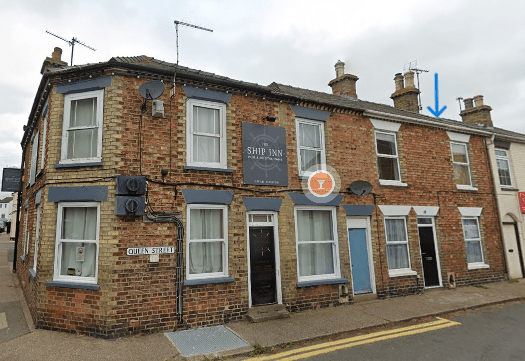
Although from what I’ve found it says that the Lord Nelson pub was at 18 Queen Street in the early photo above, from the pitches of the roof it looks like it was also where the blue door is now? Next door to the Ship Inn. So maybe at one time that was all number 18 and that first part now belongs to the Ship Inn. I’m sure someone will let me know if that is the case. Please comment here on my blog, or at jackocats2@gmail.com thank you.
Are you related to John Sharp/e? Are you a descendant? I’d love to hear from you if you can add more information. Contact me at jackocats2@gmail.com

 familyhistorystories.blog