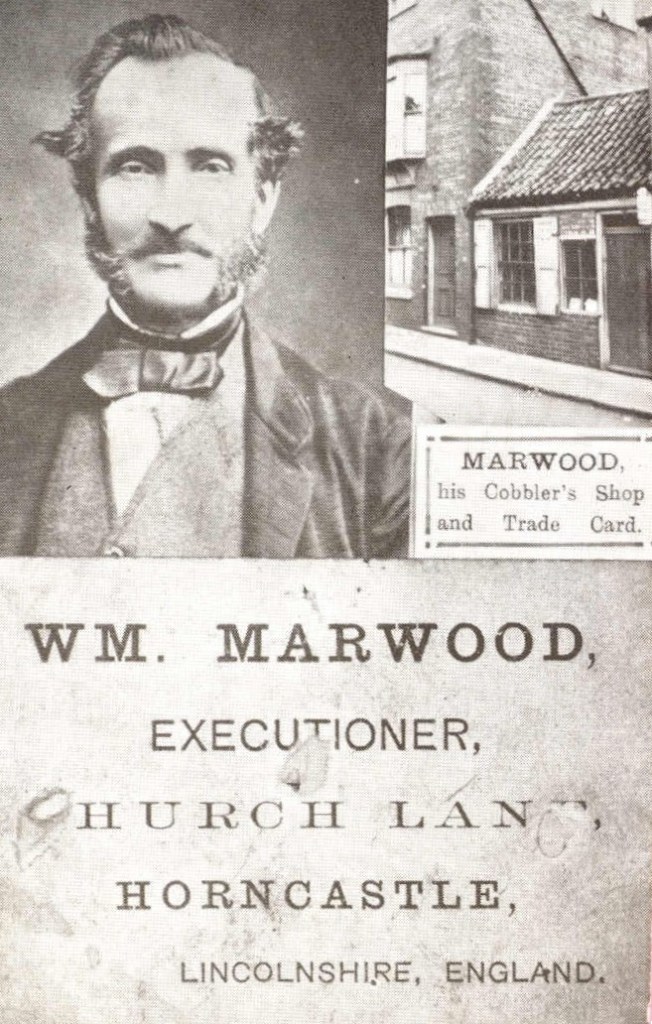
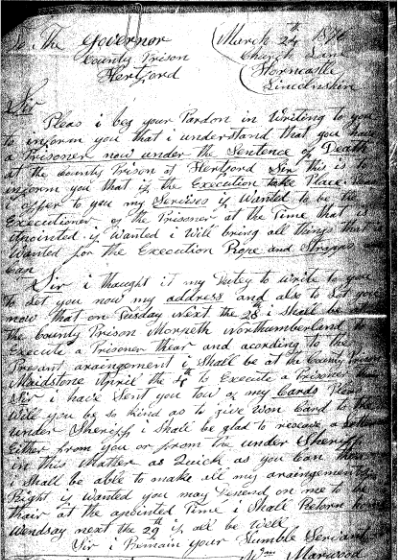
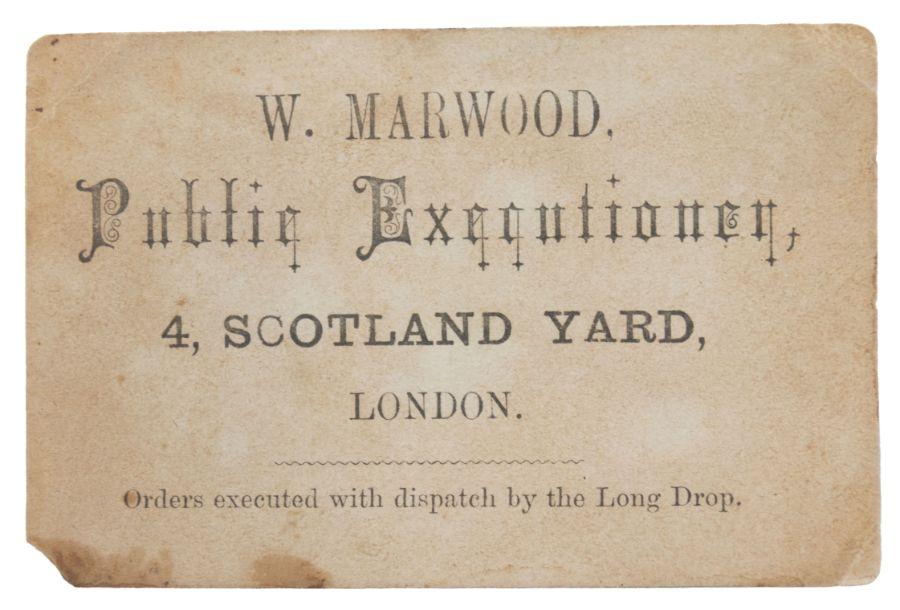
I came across a mention of William Marwood a while ago when researching someone else in the Newspapers on the British Newspaper Archives website. He would have been part of local life in and around the Horncastle area in the 1870s and 1880s where my ancestors lived and worked, just as Jack the Ripper was talked about in the London area during 1888 and beyond. He definitely seemed to enjoy his new profession. This is from Bill Greenwell’s website, the link is at the end of the Blog: “He had calling cards printed, reading ‘Wm. Marwood Executioner’. No doubt they were eagerly snapped up by the various audiences he drew at Horncastle’s horse fairs, and similar events further afield. At these, he would show off the ropes, gimlets, straps and various mementoes of his trips, and much enjoyed discussing his late-found trade“.
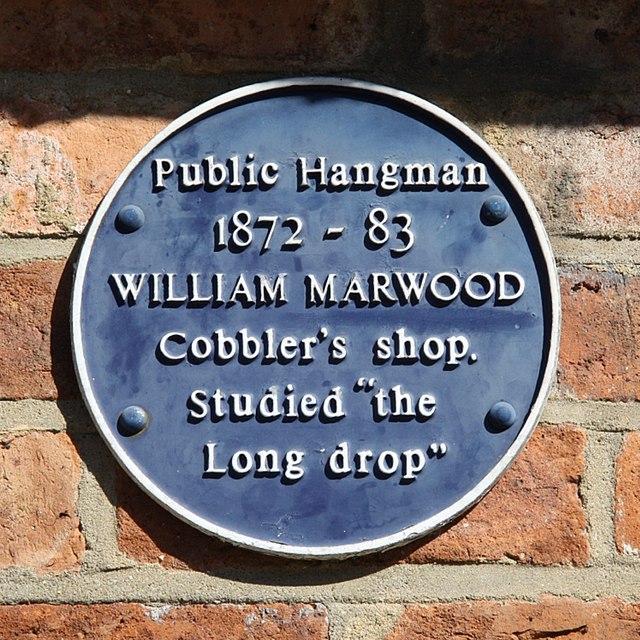
If you were living in Billinghay or Anwick or any of the surrounding towns and villages you couldn’t have failed to be aware of William Marwood the Hangman. He lived in Horncastle about 15 miles away. He was rather a strange type of celebrity and his business cards were printed with “William Marwood Public Executioner, Horncastle, Lincolnshire” and also the words “Marwood Crown Office” over the door of his cobbler’s shop.
William Marwood Family History.
William Marwood was born in 1818 and baptised on 8 November 1818 in Goulceby, Lincolnshire, his father was William, a Shoemaker and his mother was Elizabeth.
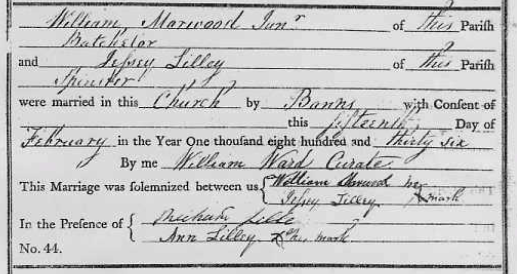
He married Jessey Lilley on 15 February 1836 in Goulceby, Lincolnshire when he was just 18 years old, Jessie was a spinster but was 30. I am unable to find any children for the couple. Jessie was born on 4 Nov 1805 in Horncastle, Lincolnshire.


William’s occupation on both these censuses is a Master Cord Wainer/Shoe Maker. Jessie died of Bronchitis on 5 Jul 1867.

William didn’t wait long before he married Ellen Andrews (Langdale) a widow, on 13 October 1867 in Horncastle, Lincolnshire. Ellen had previously been married to Joseph Andrews 1804-1864.

Joseph 42 years old was a widower when Ellen Langdale, age 22 married him on 11 April 1846 in Sandiacre, Lincolnshire. I have not found any children born to Joseph and Ellen as yet but Joseph had two children from his first marriage to Martha Eliza Webster, a daughter Eliza Winifred born in 1840 and a son William Paul born in 1842. After Joseph and Ellen married we find them living in Stoke Damerel, Devon with the two children and Joseph’s occupation is a ‘Warder for Chelsea out pensioners’ the family were living in at Stoke Damerel Prison.
On the 1861 census, the couple were still at Stoke Damerel Prison but now Joseph Andrews was the ‘Senior Warder in Military Prison.’ Joseph’s two children had left home and his daughter Eliza was now married with two children of her own living in East Stonehouse, Devon. Eventually as far as I can see Eliza had 11 children with her husband George Truscott. Joseph Andrews was born in Essex in 1804 and died in Stoke Damerel in 1864. Ellen made her way back up north from Devon after his death and married William Marwood in Horncastle, Lincolnshire 3 years later.

At last, we have a number for where William was living in Foundry Road as before there were no house numbers noted on the 1861 and 51 censuses. William was still a Shoe Maker.

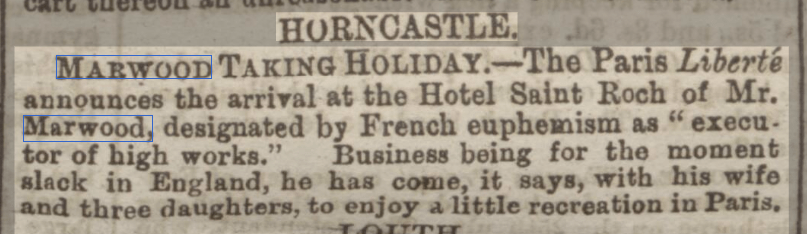
This newspaper article is a puzzle to me as I’ve found no children of the couple and as you can see it clearly says with his wife and 3 daughters? So who were they? Maybe Ellen’s family, nieces?
William Marwood died on 4 September 1883 in Horncastle, Lincolnshire, at the age of 65, and was buried there. His wife Ellen died on 12 October 1883 just 5 weeks later.



It seems that despite putting his money into buying a few houses he was virtually Bankrupt at the time of his death and it certainly took a while to sort out his affairs as this newspaper report is dated 1890. Later I found another report where he was actually found Bankrupt after his death as there was not enough to pay debtors.

The life of William Marwood as a Hangman.
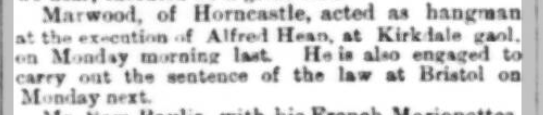
I read in one report that he apparently didn’t tell his wife Ellen that he had become a Hangman at first, but was recognised by someone living locally who attended a hanging and so had to tell her and after that he also became very well known locally as word got around. His work was reported in the local newspapers of the time, even if just a couple of sentences like this one below in 1875.

He apparently had always been interested in hanging and how it was conducted and thought he could do a better job of it and when he was 54 he persuaded the governor of Lincoln prison to allow him to conduct an execution. Over nine years as a hangman, William Marwood executed 178 people.
William Marwood’s Executions. Compiled by Robert Pendell on the excellent Horncastle History & Heritage Society website, direct link here to the full article: Famous people. William Marwood
“Note: The exact total was 178, far less than the often quoted figure of 350 to 400. This list with ages, dates and prison locations, illustrates the extent of his travels and reminds us of the personal tragedies he confronted on a regular basis. Every individual who faced Marwood in their last seconds undoubtedly had a tale to tell”.
Between the original list, I have added pictures and other information I came across while I was researching, that you might find interesting including a little about the most well-known people that William Marwood hanged and of course the people he hanged in Lincoln. The Lincoln hangings are at the end.
1872. April 1st 1872 – Lincoln – William Frederick Horry (28) William Marwood’s first Execution.

1873. August 26th 1873 – Omagh – Thomas Hartley Montgomery
1874. January 5th 1874 – Durham – Charles Dawson, Thomas Corrigan, Edward Gough
June 29th 1874 – Newgate – Francis Stewart (49)
August 10th 1874 – Exeter – John Macdonald
August 24th 1874 – Usk – James Henry Giggs
August 31st 1874 – Liverpool – Henry Flanagan (22), Mary Williams (40, female)
October 13th 1874 – Horsemonger Lane – John Walter Coppen (37)
November 16th 1874 – Winchester – Thomas Smith
December 28th 1874 – Durham – Hugh Daley
December 29th 1874 – Stafford – Robert Taylor (21)
1875. January 4th 1875 – Newgate – James Cranwell (59)
March 24th 1875 – Sligo – James McDaid
March 29th 1875 – Chelmsford – Richard Coates
March 30th 1875 – Maidstone – John Morgan (19)
April 9th 1875 – Clonmel – John Russell
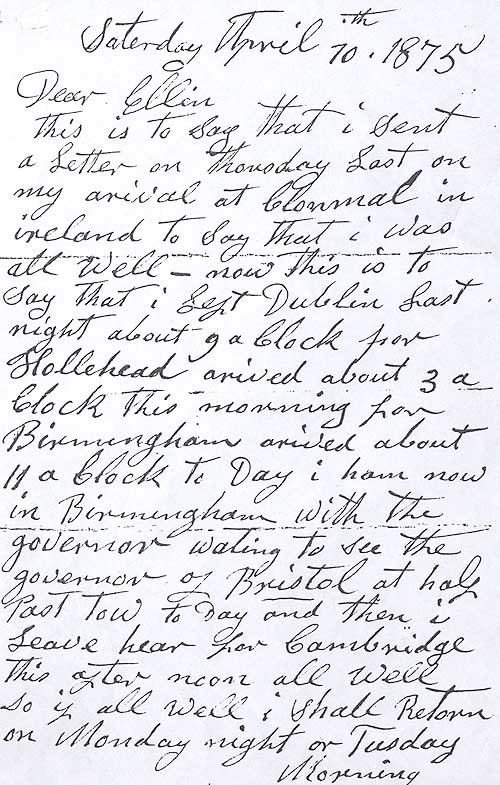
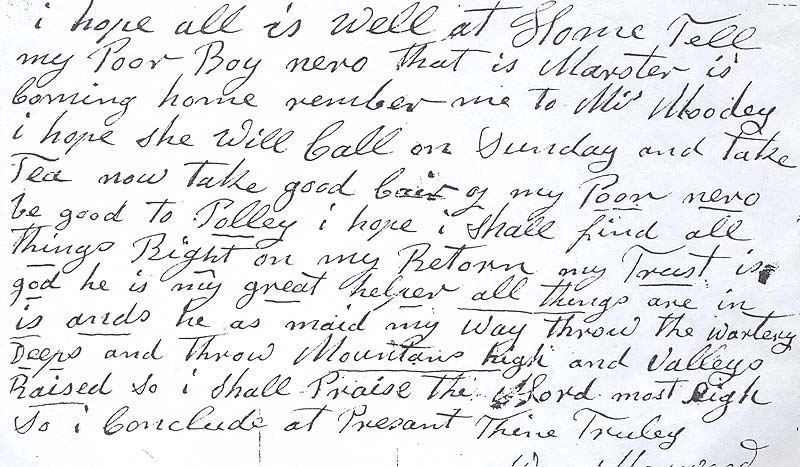
The way William speaks is enlightening he seems to believe he is doing God’s work. Oh, and Nero was his Dog just in case you weren’t sure.
April 19th 1875 – Liverpool – Alfred Thomas Heap
April 26th 1875 – Bristol – William Hale
July 27th 1875 – Warwick – Jeremiah Corkery (20)
August 2nd 1875 – Durham – Michael Gillingham (22), William McHugh, Elizabeth Pearson (32, female)
August 9th 1875 – Lincoln – Peter Blanchard
August 11th 1875 – Jersey – Joseph Phillip Le Brun
August 16th 1875 – Lancaster – William McCullough (36), Mark Fiddler (24)
September 6th 1875 – Liverpool – William Baker, Edward Cooper (33)
October 5th 1875 – Glasgow – Patrick Docherty (21)
October 19th 1875 – Dumbarton – David Wardlaw
December 21st 1875 – Newgate – Henry Wainwright (37)
Henry Wainwright murdered his mistress Harriet Lane in September 1874 and buried her body in a warehouse he owned. When he was declared bankrupt in September 1875, he dug the body up and was arrested attempting to rebury it.
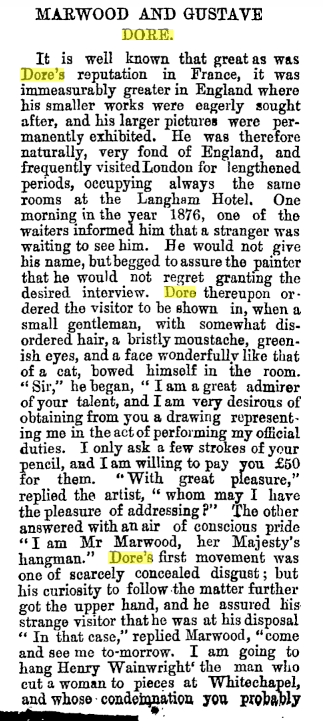
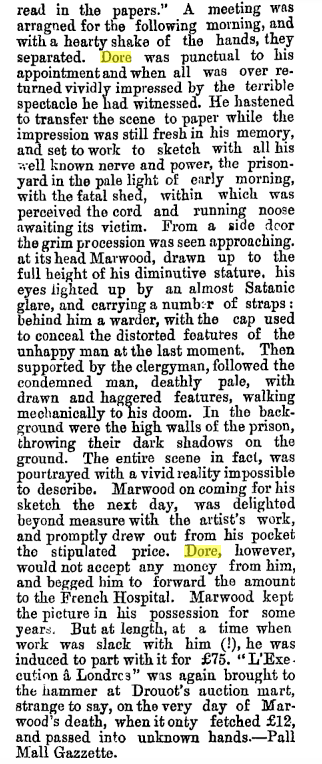
The above article was from the West Coast Times, Issue 4655, 30 June 1884, Page 4.
Gustave Dore was an amazing artist, especially of life in London when he visited, he was a French printmaker, illustrator, painter, comics artist, caricaturist, and sculptor. I wonder what happened to the picture after it was sold following William Marwood’s death?
December 22nd 1875 – Newcastle – John William Anderson
December 23rd 1875 – Morpeth – Richard Charlton
Courtesy of Madame Tussauds London
1876. March 28th 1876 – Morpeth – George Hunter (23)
April 4th 1876 – Maidstone – Thomas Fordred (48)
April 10th 1876 – St. Albans – George Hill
April 24th 1876 – Bristol – Edward Deacon
April 25th 1876 – Cardiff – Joseph Webber (63)
April 26th 1876 – Belfast – John Daly (47)
May 23rd 1876 – Newgate – Giovanni Caccaris (Mutineer), Pascaler Caladis (Mutineer), Matteo Corgalis (Mutineer), George Kadi (Mutineer)
May 31st 1876 – Glasgow – Thomas Barr
July 14th 1876 – Liverpool – William Fish (26)
July 26th 1876 – Durham – John Williams (37)
August 1st 1876 – Maidstone – James Parris (27)
August 14th 1876 – Liverpool – Richard Thompson (22)
August 21st 1876 – Armagh – Steven McKeown
August 25th 1876 – Cork – Christos Emanuel Baumbos, Thomas Crowe (63)
August 29th 1876 – Newgate – John Ebblethrift
December 11th 1876 – Newgate – Charles O’Donnell
December 14th 1876 – Cambridge – Robert Browning (25)
December 19th 1876 – Horsemonger Lane – Silas Barlow
December 20th 1876 – Leicester – John Green (41)
December 21st 1876 – Manchester – William Flanagan (35)
1877. January 2nd 1877 – Horsemonger Lane – Isaac Marks (23)
March 12th 1877 – Reading – Henry Tidbury (24), Francis Tidbury (27)
March 26th 1877 – Lincoln – William Clark
March 27th 1877 – Manchester – John McKenna (25)
April 2nd 1877 – Chester – James Bannister
April 17th 1877 – Warwick – Frederick Edwin Baker
July 31st 1877 – Leicester – John Henry Starkey (28)
August 13th 1877 – Chester – Henry Leigh (23)
August 14th 1877 – Horsemonger Lane – Caleb Smith (38)
August 21st 1877 – Liverpool – John Golding, Patrick McGovern
October 15th 1877 – Newgate – John Lynch (26)
November 12th 1877 – Newgate – Thomas Benjamin Pratt
November 19th 1877 – Exeter – William Hassell
November 20th 1877 – Norwich – Henry Marsh (50)
November 21st 1877 – Nottingham – Thomas Grey
November 23rd 1877 – Dolgelly – Cadwaller Jones (25)
November 27th 1877 – Leicester – James Satchell (28), John William Swift (19), John Upton (32)
1878. February 4th 1878 – Manchester – George Piggott (29)
February 11th 1878 – Winchester – James Caffyn
February 12th 1878 – Liverpool – James Trickett
February 13th 1878 – Nottingham – John Brooks
April 1st 1878 – Oxford – Henry Rowles (26)
April 15th 1878 – York – Vincent Knowles Walker (48)
May 31st 1878 – Edinburgh – Eugene Marie Chantrelle (44, female)
July 29th 1878 – Chelmsford – Charles Joseph Revell (25)
July 30th 1878 – Durham – Robert Vest
August 12th 1878 – Nottingham – Thomas Cholerton
August 15th 1878 – Bodmin – Selina Wadge (female)
October 3rd 1878 – Cupar – William McDonald
October 8th 1878 – Wandsworth – Thomas Smithers (31)
November 12th 1878 – Northampton – John Patrick Byrne (38)
November 18th 1878 – Usk – Joseph Garcia (21)
November 19th 1878 – Manchester – James McGowan (55)
November 25th 1878 – Huntingdon – Henry Gilbert (30)
1879. January 10th 1879 – Limerick – Thomas Cunceen
February 4th 1879 – Maidstone – Stephen Gambrill (28)
February 10th 1879 – Worcester – Enoch Whiston (21)
February 11th 1879 – Lancaster – William McGuiness (40)
February 25th 1879 – Leeds – Charles Frederick Peace (46)
Charles Frederick Peace killed a policeman in Manchester and fled to his native Sheffield, where he became obsessed with his neighbour’s wife, eventually fatally shooting her husband. Settling in London, he carried out multiple burglaries before being caught in the prosperous suburb of Blackheath, wounding the policeman who arrested him. He was linked to the Sheffield murder and tried at Leeds Assizes. Found guilty, he was hanged at Armley Prison, Leeds.
March 24th 1879 – Newgate – James Simms (43)
May 12th 1879 – Gloucester – Edwin Smart (35)
May 20th 1879 – Manchester – William Cooper (42)
May 26th 1879 – Taunton – Catherine Churchill (55, female)
May 27th 1879 – York – John D’Arcy (22)
May 28th 1879 – Liverpool – Thomas Johnson (20)
July 29th 1879 – Wandsworth, the only woman to be hanged there – Catherine/Kate Webster (30, female)
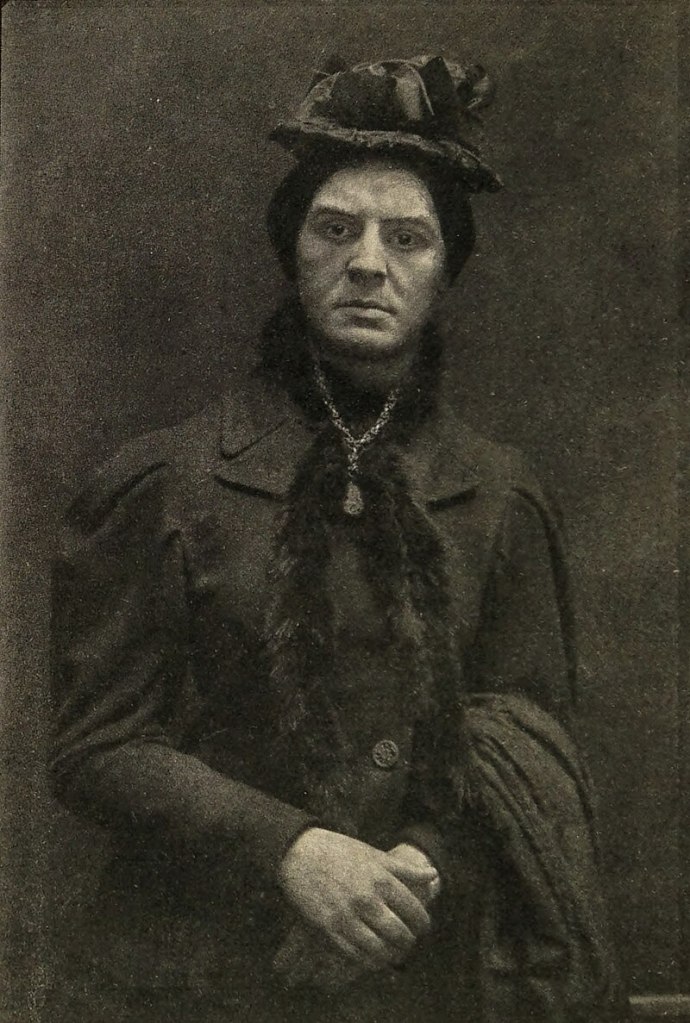
Catherine/Kate Webster murdered Julia Martha Thomas, a widow living in 2 Mayfield Cottages (also known as 2 Vine Cottages)on Park Road in Richmond, London on 2 March 1879, Kate was a maid to Julia and disposed of the body by dismembering it, boiling the flesh off the bones, and throwing most of the remains into the River Thames. Part of Julia M Thomas’s remains were recovered from the river. Her severed head remained missing until October 2010, when the skull was found during building works being carried out for Sir David Attenborough.

August 11th 1879 – Exeter – Annie Tooke (female)
August 25th 1879 – Newgate – James Dilley (41)
August 26th 1879 – Warwick – John Ralph (28)
December 3rd 1879 – Ipswich – Henry Beddingfield (46)
1880. January 5th 1880 – Newgate – Charles Surety (29)
January 16th 1880 – Galway – Martin McHugo
February 17th 1880 – Manchester – William Cassidy
March 2nd 1880 – Liverpool – Hugh Burns, Patrick Kearns
March 22nd 1880 – Newgate – John Wingfield (34)
April 14th 1880 – Omagh – Peter Conway
May 10th 1880 – Aylesbury – William Dumbleton
May 11th 1880 – York – John Henry Wood
July 27th 1880 – Maidstone – Thomas Berry (37)
August 16th 1880 – Derby – John Wakefield (28)
November 16th 1880 – Durham – William Brownless (22)
November 26th 1880 – St. Albans – Thomas Wheeler
November 27th 1880 – Bristol – William Joseph Diston (35)
December 13th 1880 – Newgate – William Herbert (44), George Pavey (29)
1881. February 21st 1881 – Chester – William Stanway
February 28th 1881 – Derby – Albert Robinson (20)
May 1st 1881 – Liverpool – Joseph Patrick McEntire (42)
May 17th 1881 – Maidstone – Albert Moore (23)
May 23rd 1881 – Leeds – James Hall (53)
August 15th 1881 – Nottingham – Thomas Brown
August 23rd 1881 – Maidstone – George Durling (36)
November 24th 1881 – Derby – Alfred Gough (34)
November 28th 1881 – Manchester – John Aspinall Simpson (23)
November 29th 1881 – Lewes – Percy Lefroy Mapleton (22)
Percy Lefroy Mapleton murdered Isaac Fredrick Gold on a train on the Brighton Line so that he could steal Gold’s watch and some coins. He was arrested almost immediately but managed to escape from custody before being arrested again, convicted and finally hanged at Lewes prison.

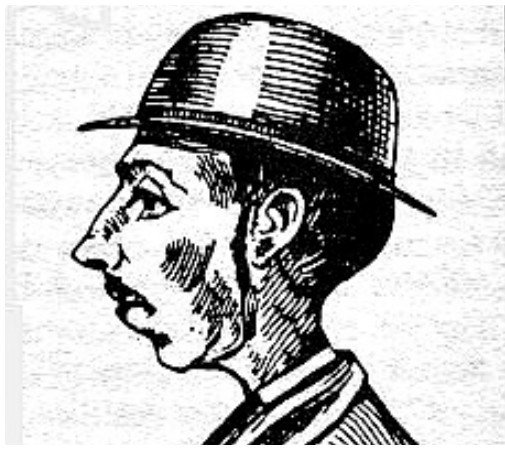
Two portraits of Percy Mapleton, AKA Percy Lefroy
1882. January 31st 1882 – Devizes – Charles Gerrish (70)
February 13th 1882 – Manchester – Richard Templeton (36)
April 28th 1882 – Wandsworth – George Henry Lamson (29)
Dr George Henry Lamson was tried at the Old Bailey in March 1882 before Mr Justice Hawkins and a jury, he was found guilty of murdering Percy Malcolm John (his wife’s brother)to secure his share of the family trust fund, some £3,000 which Percy would have inherited on coming of age. He poisoned 18-year-old Percy with aconitine in a cake, a substance which Lamson had learned about from Professor Robert Christison at Edinburgh University. Christison had taught that aconitine was undetectable, but forensic science had improved since Lamson’s student days and the poison was easily identified, as well as Lamson’s purchase of it from a London pharmacist.

The picture above: (V0041662 Scenes from the trial of Dr. G. H. Lamson. Credit: Wellcome Library, London. Wellcome Images. Scenes from the trial of Dr. G. H. Lamson (the Wimbledon Poisoner) at the Central Criminal Court in 1882. Wood engraving. Published: – Copyrighted work available under Creative Commons Attribution only licence CC BY 4.0 http://creativecommons.org/licenses/by/4.0/)
May 16th 1882 – Durham – Thomas Fury
May 22nd 1882 – Norwich – William George Abigail (19)
May 23rd 1882 – Leeds – Osmond Otto Brand (27)
August 21st 1882 – Liverpool – William Turner
September 11th 1882 – Limerick – Francis Hynes
September 22nd 1882 – Galway – Patrick Walsh
November 13th 1882 – Bodmin – William Meager Bartlett
November 28th 1882 – York – Edward Wheatfall
December 4th 1882 – Liverpool – Bernard Mullarkey (19)
December 12th 1882 – Wandsworth – Charles Taylor
December 15th 1882 – Galway – Patrick Casey, Miles Joyce, Patrick Joyce
Note the increase in Irish executions
1883. January 2nd 1883 – Maidstone – Louisa Jane Taylor (37, female)
January 15th 1883 – Galway – Patrick Higgins (55)
January 17th 1883 – Galway – Michael Flynn, Thomas Higgins
January 23rd 1883 – Tralee – Thomas Barrett, Silvester Poff
February 12th 1883 – Manchester – Abraham Thomas (24)
February 19th 1883 – Lincoln – James Anderson
April 30th 1883 – Cork – Timothy O’Keefe (20)
May 7th 1883 – Lincoln – Thomas Garry
May 8th 1883 – Chester – Patrick Carey
May 14th 1883 – Dublin – Joseph Brady
May 18th 1883 – Dublin – Daniel Curley (31)
May 21st 1883 – Taunton – Joseph Wedlake, George White
May 23rd 1883 – Glasgow – Henry Mullen, Martin Scott
May 28th 1883 – Dublin – Michael Fagan
June 2nd 1883 – Dublin – Thomas Caffrey
June 9th 1883 – Dublin – Timothy Kelly
August 6th 1883 – Durham – James Burton (33)
Also from the Horncastle History & Heritage Society website: “The efficient way in which he conducted the hanging of William Frederick Harry (or Horry) without a hitch on 1 April 1872 assisted him in being appointed hangman by the Sheriffs of London and Middlesex, for which he was paid a retainer of £20 a year plus £10 per execution.
William Marwood developed the “long drop” technique of hanging, which ensured that the prisoner’s neck was broken instantly at the end of the drop, resulting in the prisoner dying of asphyxia while unconscious. This was undoubtedly kinder than the slow death by strangulation caused by the “short drop” method, which was particularly distressing to prison governors and staff who were required to witness executions at a close distance following the abolition of public executions in 1868“.
It’s a strange thing I would think at the time to have someone like this in your midst, living locally, someone that our ancestors not only knew of but likely saw or even spoke to at the time, he must have been a subject of much gossip as local people would have heard of his many hangings through the years from the newspapers.
Of these, 5 male hangings were conducted locally at Lincoln and 8 were female prisoners, I’ve highlighted those above.
Local hangings in Lincoln by William Marwood.
April 1st 1872 – Lincoln – William Frederick Horry (28)He was hanged in Lincoln Castle and his body was buried in the Castle grounds.
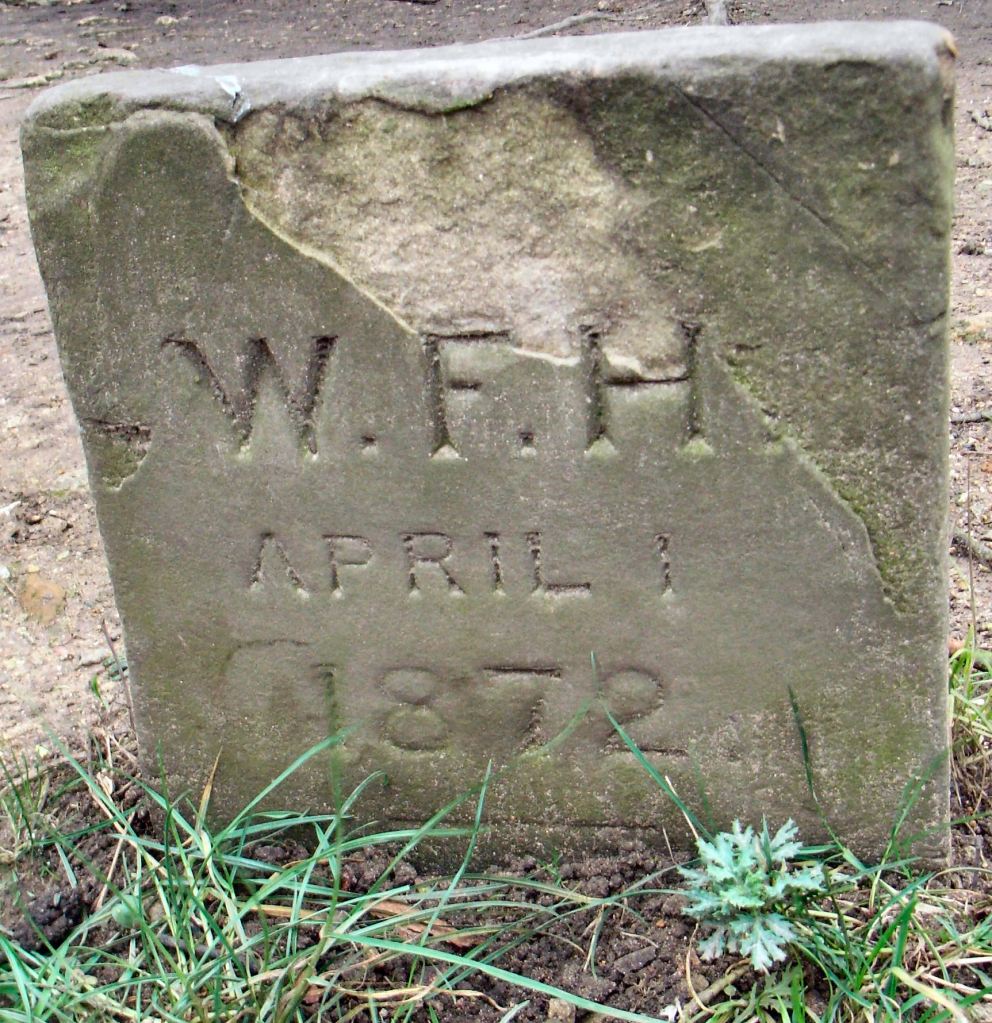
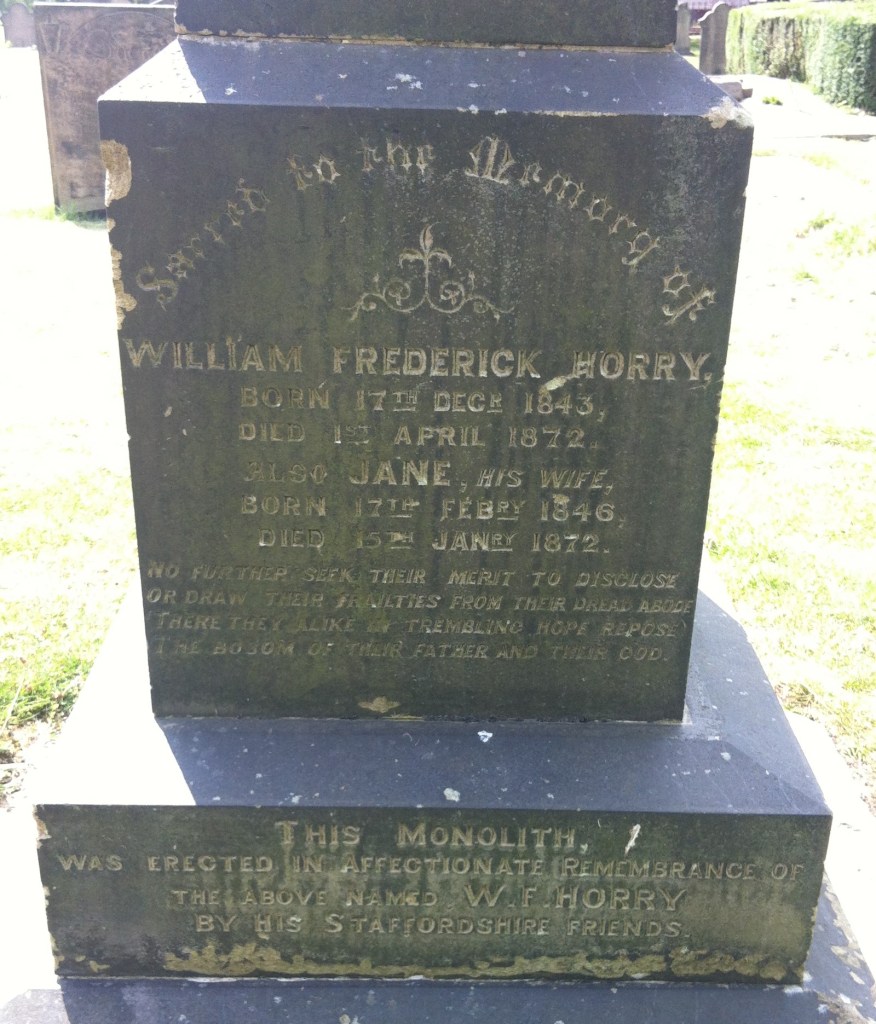
As a permanent memorial to Fred a granite obelisk was subscribed for by his Staffordshire friends who erected it above his empty grave.
August 9th 1875 – Lincoln – Peter Blanchard
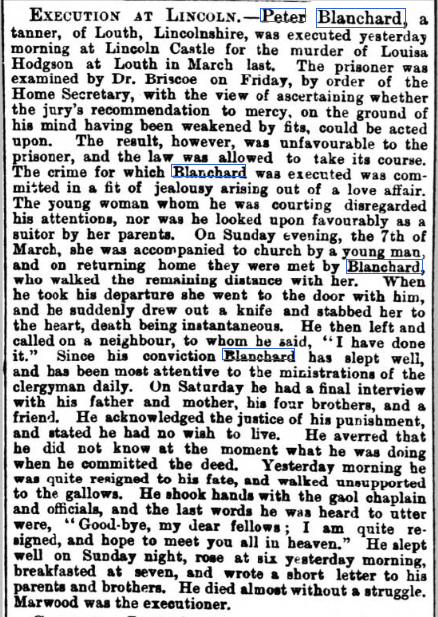
On 4 September 1875, it was reported that the parents of the young man had been in great grief since the execution and the father had just died of a broken heart.
March 26th 1877 – Lincoln – William Clark
William Clark, 44 years old (alias Slenderman) was the last person to be hanged at Lincoln Castle in a private hanging, by William Marwood at 9.00 a.m. on Monday the 29th of March 1877 for the shooting murder of 56-year-old Mr. Henry Walker during a robbery at Norton Disney (20 Miles from Billinghay) on the 30th of January 1877.
When the Lincoln Castle Gaol closed, executions were transferred to the recently constructed Lincoln Prison on Greetwell Road which had opened in 1872.
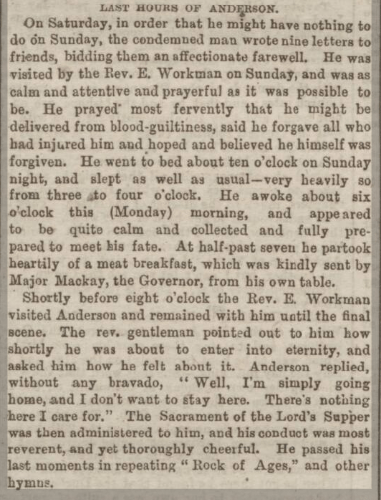
James Anderson was the first to be executed there on the 19th of February 1883, for the murder of his wife. “In Lincoln on the 19 February 1883 fifty-year-old Anderson, a Lincolnshire coal miner was sentenced to death by Mr Justice Cave at Lincoln Assizes for the murder of his wife at Gainsborough on 6 December 1882. Anderson had cut her throat, and then his own after a quarrel. He expressed deep regret for the crime and despite a petition signed by thousands of local people, he was hanged by William Marwood“.
February 19th 1883 – Lincoln – James Anderson
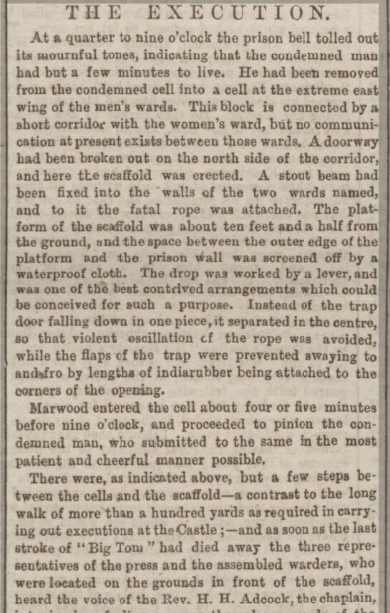
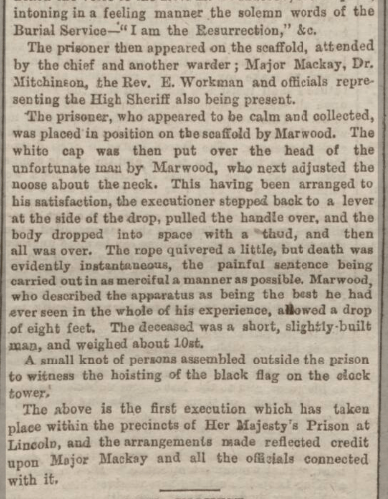
May 7th 1883 – Lincoln – Thomas Garry
Thomas Garry was a labourer convicted of the murder of John Newton who was seventy-four, “a farmer, residing at Great Hale Fen, Sleaford. Newton had lived alone on his farm since the death of his wife in the summer of 1882. Garry worked for him as a casual labourer and slept at the house. At the beginning of 1883, he took to drink with the result that his work became sloppy and he was warned by the old man that if he didn’t shape up he would have to move on. On 2nd February, Newton was found dead on the kitchen floor at the farmhouse. He had been blasted in the chest with his own shotgun which lay nearby. Police found a bloodstained footprint which matched markings on Garry’s boots; further examination revealed bloodstains on his clothing. He was convicted at Lincolnshire Assizes and hanged by William Marwood. Thomas Garry was noted in the newspapers to have been a repulsive-looking man“.
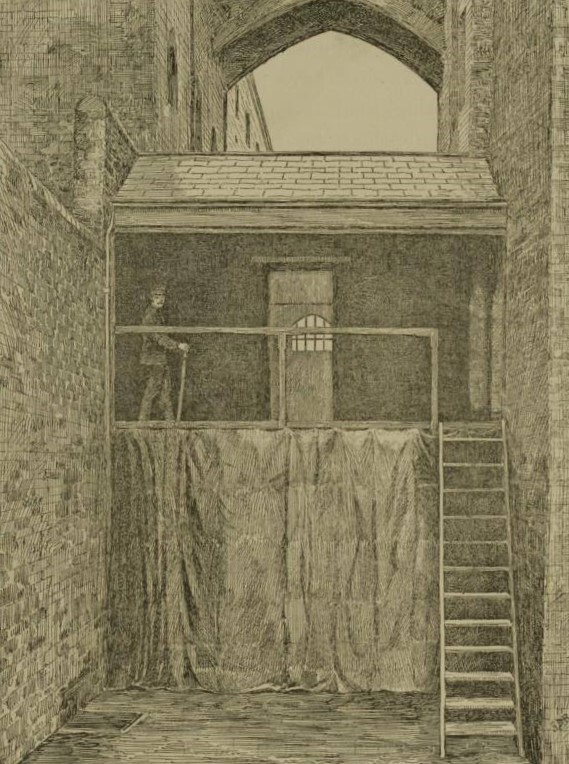
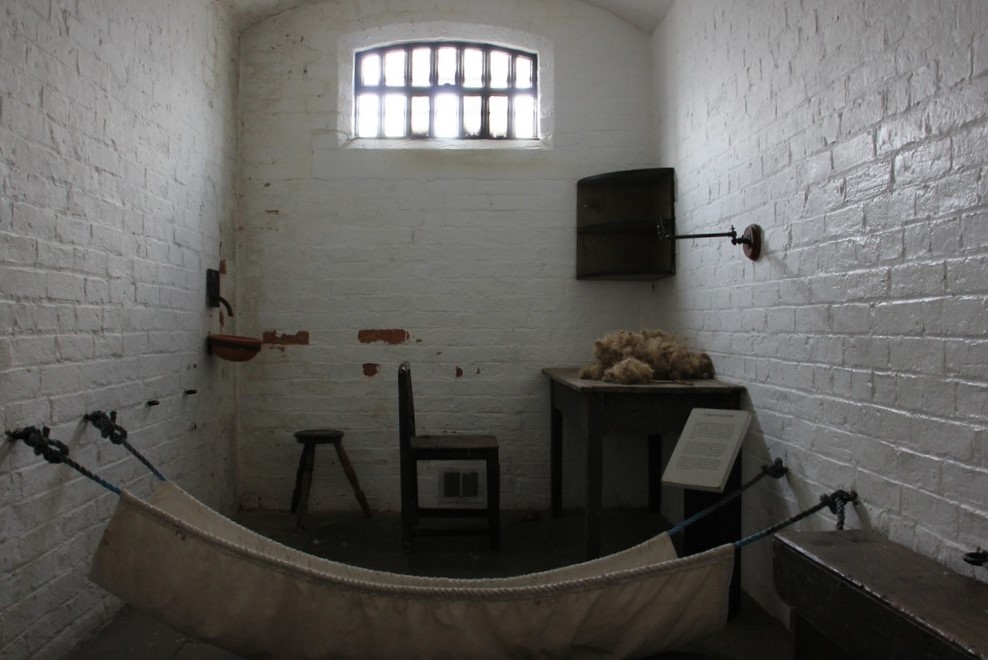
Here is a drawing below of Lincoln’s gallows and condemned cell at the time. From the Facebook page of Capital Punishment UK.
Sources of my information.
As you can imagine there are many sources for information on historic crimes on the internet and these are just a few available.
Wikipedia
https://www.britishnewspaperarchive.co.uk/
https://www.capitalpunishmentuk.org/Lincoln%20Castle.html
https://newcastlegaol.co.uk/blog/who-would-be-a-hangman
http://horncastlecivic.org.uk/horncastle/famous-people.php#apm1_9
http://www.billgreenwell.com/page.php?id=67
https://www.facebook.com/profile.php?id=100066853656113
Contact me at jackocats2@gmail.com
 familyhistorystories.blog