Once a staple of Billinghay’s life, the Cross Keys Pub stood proudly at 8 Victoria Street. It was one of the village’s oldest pubs, alongside the Golden Cross, and served the community until its closure in 1956. While the current structure still exists as a private residence, its roots stretch back to at least 1811 when it began life as the home of Joseph Bones. Early licensed premises were often extensions of homes or shops.
Who was Joseph Bones, I found him in the UK, Poll Books and Electoral Registers, 1538-1893 – when in 1818 and 1823 he was recorded as being a victualler and later a publican in Billinghay.
Whether the present building is the original, historical records Billinghay’s Old Buildings & Historic Houses from Doug’s Path contains useful information that can help us estimate the age of 8 Victoria Street.
‘8 Victoria Street is included in the local architectural review as a historic structure. The building is described as a brick-built property, typical of late Georgian or early Victorian design—which places its construction roughly between the late 1700s to early 1800s. It features traditional sash windows, brick chimneys, and a symmetrical frontage, all of which are indicators of buildings constructed during the late 18th to early 19th century’.
The records confirm it has hosted a number of landlords over its long tenure. The Cross Keys was a fully licensed public house, not merely a beerhouse, and operated for over a century.
The pub was eventually owned by the Soulby. Son & Winch Brewery.

Joseph Bones
One of the first records of the Cross Keys can be found in The Lincoln Rutland & Stamford Mercury 25 Jan 1811 at the house of Joseph Bones – the sign of the Cross Keys in Billinghay. The article reports an auction of a dwelling house owned by Mr Thompson a druggist and apothecary.

In other newspaper articles located in the Stamford Mercury – 18 March 1818 the Cross Keys was identified as the sign at the house of Joseph Bones. Clearly the home of Mr Bones was a focal point for actions and meetings for the village.

Joseph Bones died in 1832, and the pub continued to be run by his widow Alice and son James (1804). In the 1841 census James is recorded as the publican.
James Bones
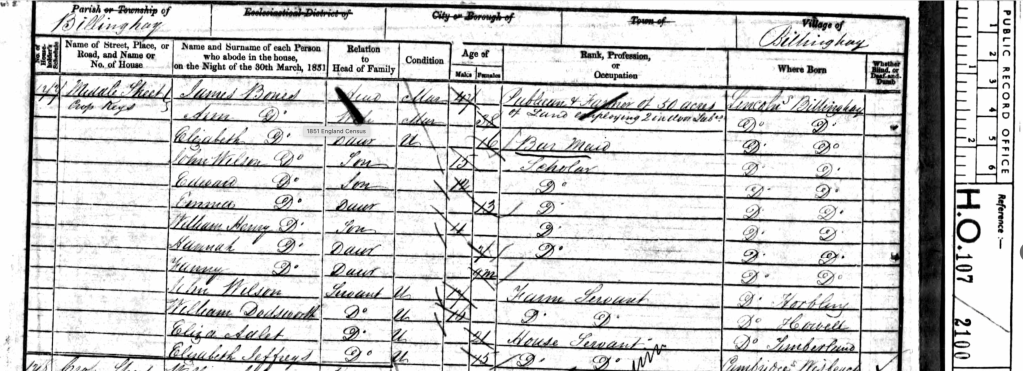
1851 – James Bones was now a farmer of 50 acres and a publican. James was married to Anne and they had seven children.
However, not everything went well for James during this period. According to a report published in the Nottinghamshire Guardian on 3 October 1863, his case was brought before the Birmingham Court of Bankruptcy.
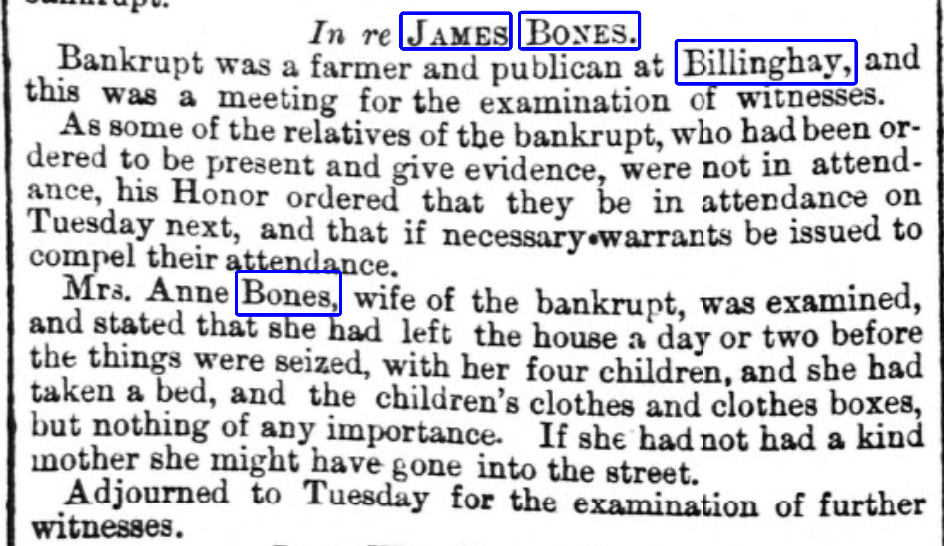
Due to James’ financial demise, the Cross Keys was taken over by William Martin he was recorded in 1868 (Post Office Directory).

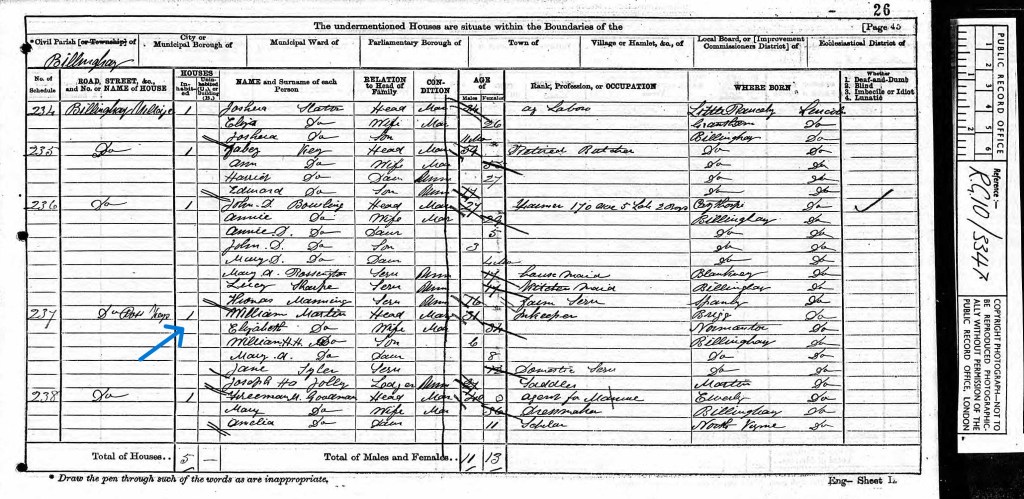
1871 census. William Martin is 31 years old. The Cross Keys.
1876. Thomas Turner. The Cross Keys. Inn Keeper
1882. James Taylor. Victualler. Cross Keys (White’s Directory)
1885. John Holditch. Cross Keys P.H. (Kelly’s Directory)
1889. George Stevenson. Cross Keys P.H. (Kelly’s Directory)
1890 George Stevenson – Sleaford Gazette 5 July 1890 – declared bankrupt
1892. John Dring. Cross Keys P.H. and Butcher (Kelly’s Directory)
1896. William Baxter. Cross Keys P.H. (Kelly’s Directory)
1900. Charles Knott. Cross Keys P.H. (Kelly’s Directory)
1901 – Census Charles Knott Publican at the Cross Keys
1905. Charles Knott. Cross Keys P.H (Kelly’s Directory)
1909. Charles Knott. Cross Keys P.H. and Butcher (Kelly’s Directory)
1913. Tom Baker. Cross Keys P.H. (Kelly’s Directory)
1946 Horace Edward Ingoldmells – Lincolnshire Echo 23 Jan 1946
Frederick Henry Storey – One of the last landlords, active in the early 1900s until closure in 1956.
History of the Cross Keys
I have already identified the earliest record located for the Cross Keys dates back to 1811, when it was described as the residence of Joseph Bones. The connection between the Bones family and the Cross Keys was firmly established through the death certificate of Alice Bones, wife of the first known landlord, Joseph Bones, and mother of James. Alice died in 1852, and her death certificate not only confirms the date and place of her passing but also identifies her husband as Joseph Bones, Inn Keeper—thus corroborating the family’s association with the establishment.

The discovery of Alice Bones’ death certificate has enabled a more in-depth level of research into both the Cross Keys and the Bones family. This investigation has uncovered a fascinating and, sinister history—most notably the revelation that Joseph and Alice Bones were the grandparents of Joseph Bones, the subject of my blog A Murder Most Horrid in Billinghay dated 31 October 2024.
Joseph Bones was born in 1822 in Billinghay, Lincolnshire, the son of John Bones (1796–1830) and Ann (née Williamson) (1790–1861). He had two brothers and three sisters. John was the son of Joseph Bones and Alice Barker.
In a tragic turn of events, Joseph was convicted of the murder of Eyre Petchell on 16 August 1866. Following his conviction, he was committed to Broadmoor Criminal Lunatic Asylum, where he remained until his death in 1879.
Finally
Family Connections — As with any research, there is often an unexpected twist—and, as is becoming something of a recurring theme in my journey, another surprise was waiting to be uncovered!
While exploring the history of the Cross Keys, one name in particular caught my attention: publican Charles Knott. To my surprise, I discovered that Charles was married to my paternal great-great-aunt, Ada Emma Watson—yet another family link to a local hostelry.
Born in 1868 in Bassingthorpe, Lincolnshire, Charles was living in Shipley by 1881 with his married sister, working first as a stuff wool sorter and later as an assistant draper. At some point, he returned to Lincolnshire, and by 1891, was once again residing there. It was during this time that he met Ada, whom he married in Billinghay in 1894. By 1900, Charles had become the publican of the Cross Keys, a position he held until 1911, when he left the trade to become a butcher. The couple had two sons and a daughter.
Charles passed away on 3 February 1920, and the 1921 Census confirms that Ada continued to run the butcher’s business after his death—demonstrating both resilience and entrepreneurial spirit.

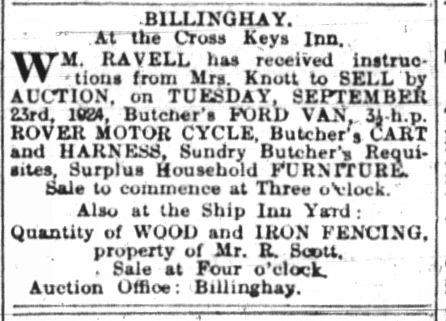
In 1921 Ada was a butcher of her own business and an employee, however by 1924 she decided to auction items from the business at of course the Cross Keys.
Reported in the Lincolnshire Chronicle 13 September 1924 –
My Great Aunt x 2 Ada Emma Knott died 2 Sep 1947 in High Street, Billinghay.

Whoever would have thought that this unassuming village pub would turn out to hold such a rich and colourful history—one woven with family ties, unexpected turns, and even a brush with tragedy?
From innkeepers and butchers to a notorious link to a murder trial, the Cross Keys has proven to be more than just a local landmark—it has become a window into the lives and legacies of those who lived and worked within its walls. What began as a simple search for family connections has unfolded into a tapestry of stories that bring the past vividly to life.
As always, if you can share any stories about The Cross Keys Inn with me or have any connections, I would love to hear from you. Please comment here or email jackocats2@gmail.com
 familyhistorystories.blog