This pub has always held special significance for my family. I recall visiting it with my parents in the late 1970s, forming early memories that stayed with me. Its importance deepened further during my family history research, when I discovered that several of my ancestors had actually served as landlords of the pub during the mid-1880s.
Naturally, this led me to begin researching the history of the pub itself and its broader significance to the village of Billinghay.

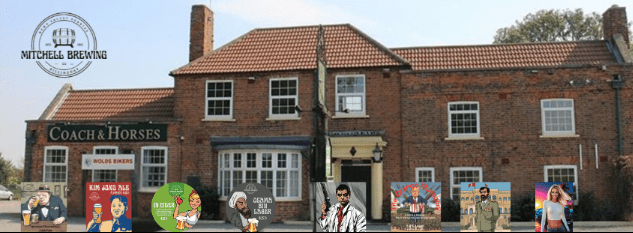
Situated on the A153, the Coach & Horses occupied a strategic position midway between Nottingham and Skegness. This location made it an essential stopover for travelers and coaches navigating the route, offering rest and refreshment. Notably, until boundary changes in the 1980s, the pub was officially within the parish of North Kyme, separated from the main village of Billinghay by the River Skirth. North Kesteven District Council+1slha.org.uk
The architectural features of the Coach & Horses reflect its historical significance. As a Grade II listed building, it showcases elements typical of coaching inns from its era, including spacious interiors designed to accommodate travellers and their horses.
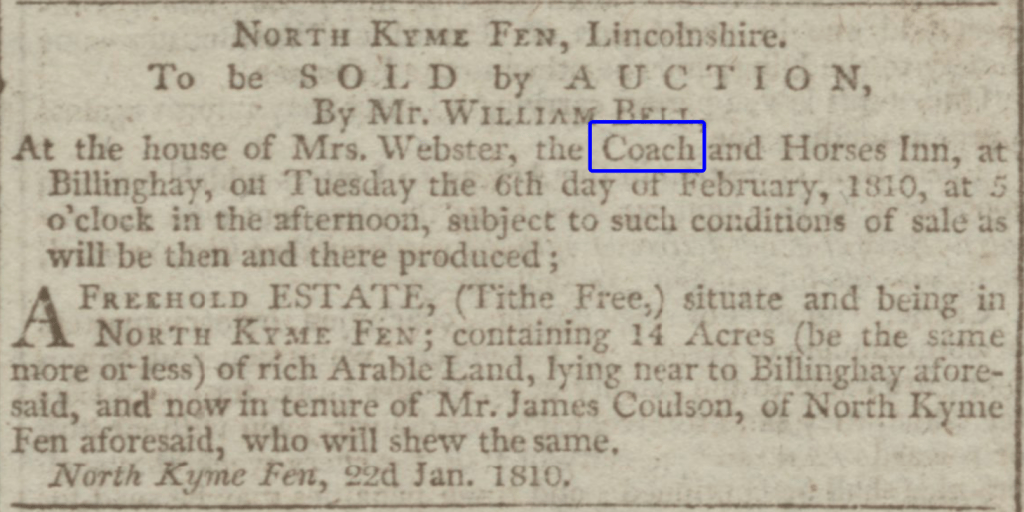
The earliest documented reference I uncovered dates to 22 January 1810, when the Coach & Horses was mentioned in the Stamford Mercury. At that time, it was identified as the home of Mrs. Webster and referred to specifically as the “Coach & Horses Inn.” This early mention suggests the pub was already well-established by the early 19th century, serving as a key social and logistical hub in a rural village reliant on coaching routes and agricultural trade.
Fortunately another newspaper article reported in the Lincoln Rutland & Stamford Mercury in 1811. Names her Mrs Mary Webster we have a landlady and her name. In 1816 Mary Webster is recorded in the Lincoln Rutland & Stamford Mercury.
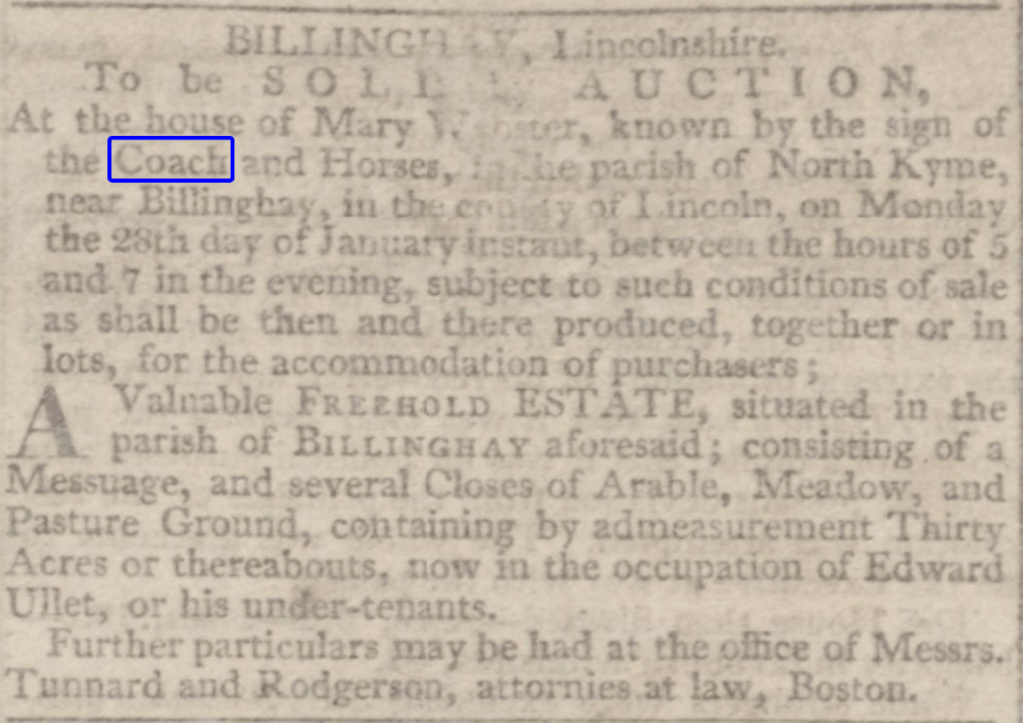
However with some more rigorous research the Webster family was located.
The Webster family
Mary Webster née Emmison was born in 1766 in the village of Billinghay, Lincolnshire. She married James Webster, a local farmer, and together they had at least ten children. Sadly, James passed away in 1807. However, the UK Death Duty Registers Index (1796–1811) indicates that Mary was left in a financially stable position following his death.
By 1810, records show that Mary had begun operating a small ale-selling enterprise from her home. This development marks a significant moment in the history of the Coach & Horses Inn, as it can be confidently asserted that Mary Webster was the first recorded innkeeper or landlady of the establishment. Her initiative not only secured her family’s livelihood but also laid the foundation for the pub’s enduring presence in Billinghay.
Mary died in 1841, however, the Coach & Horses remained in the family, as the next entry confirms. In the Stamford Mercury, 18 Nov 1831, locates a Mr Webster, not having his first name, I was unsure of his relationship to Mary Webster.
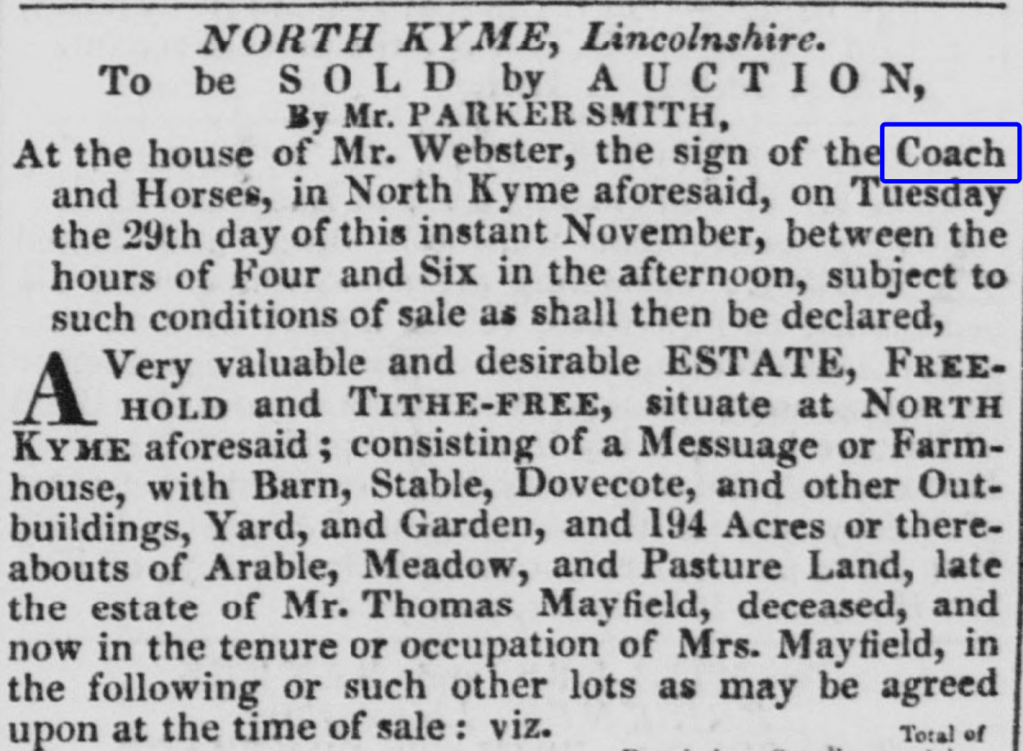

1834 – Mr Cornelius Webster – Stamford Mercury 17 Jan 1834
This mystery was soon solved when another newspaper article confirms the research of the Webster family reported in the Stamford Mercury 7 March 1834 – names the innkeeper to be Cornelius Webster, the son of Mary Webster.
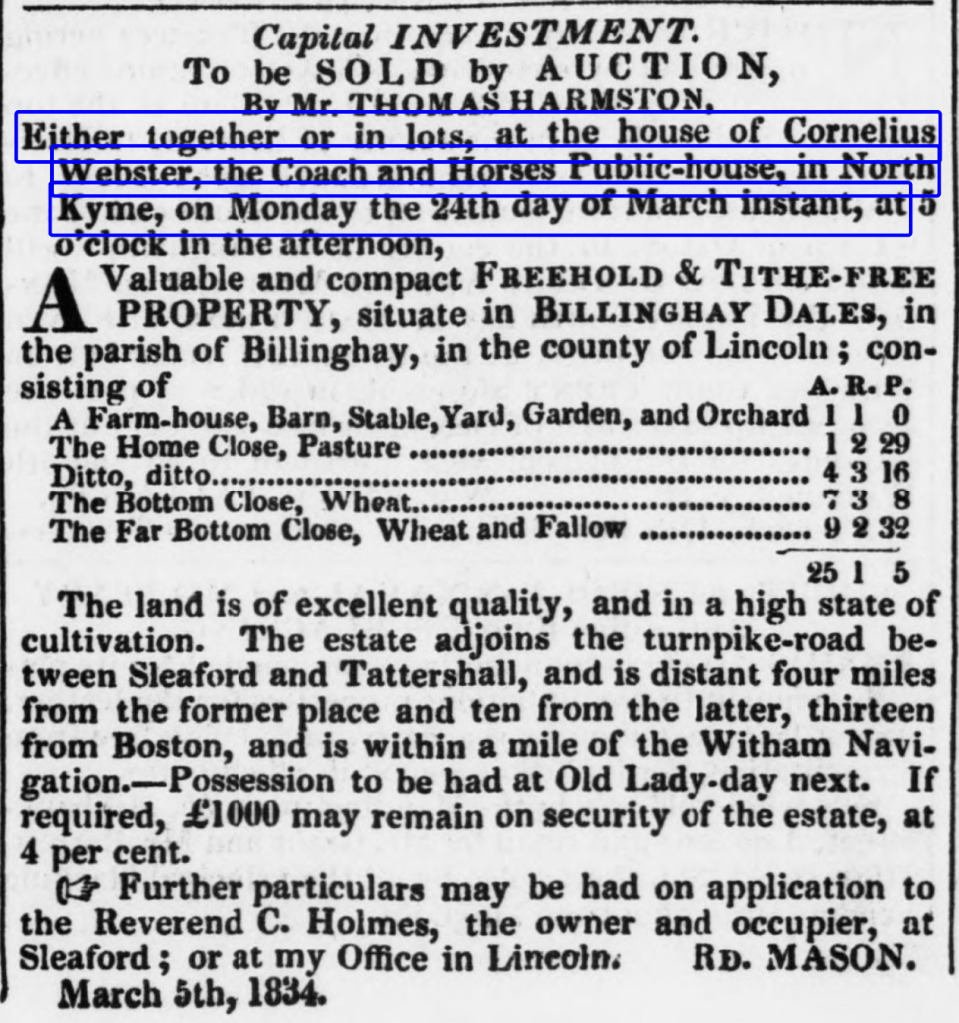
Cornelius Webster, by 1836, had left the Coach & Horses and was a successful farmer in Martin near Billinghay.
1836 – Richard Bones – Stamford Mercury 19 Feb 1836.

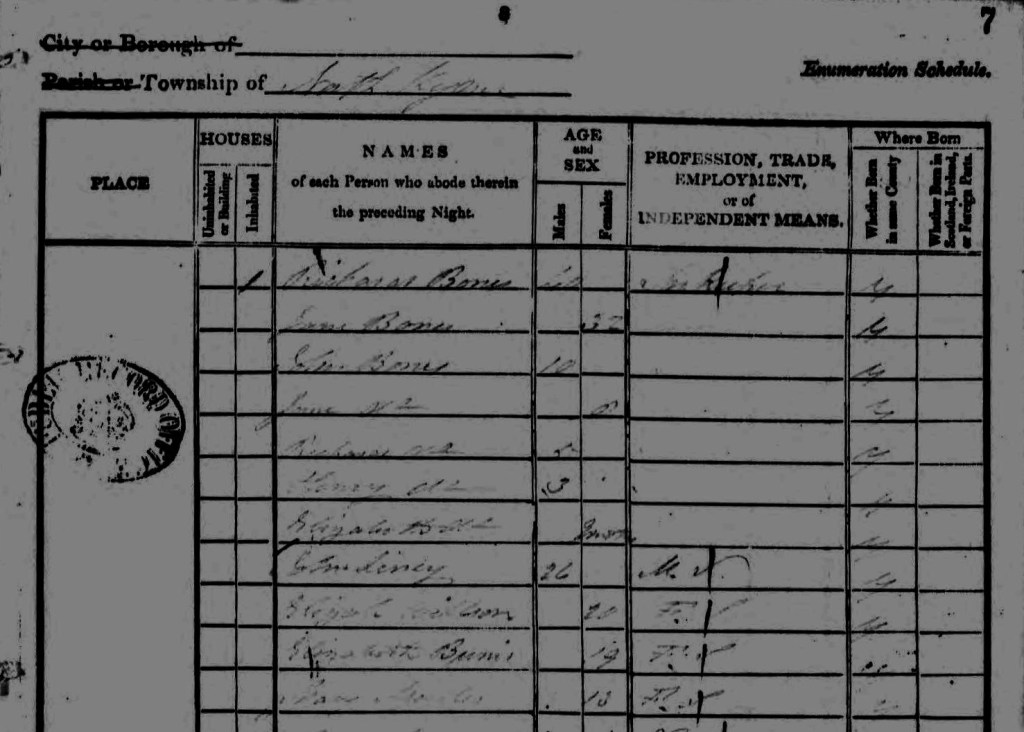
1843 – Richard Bones
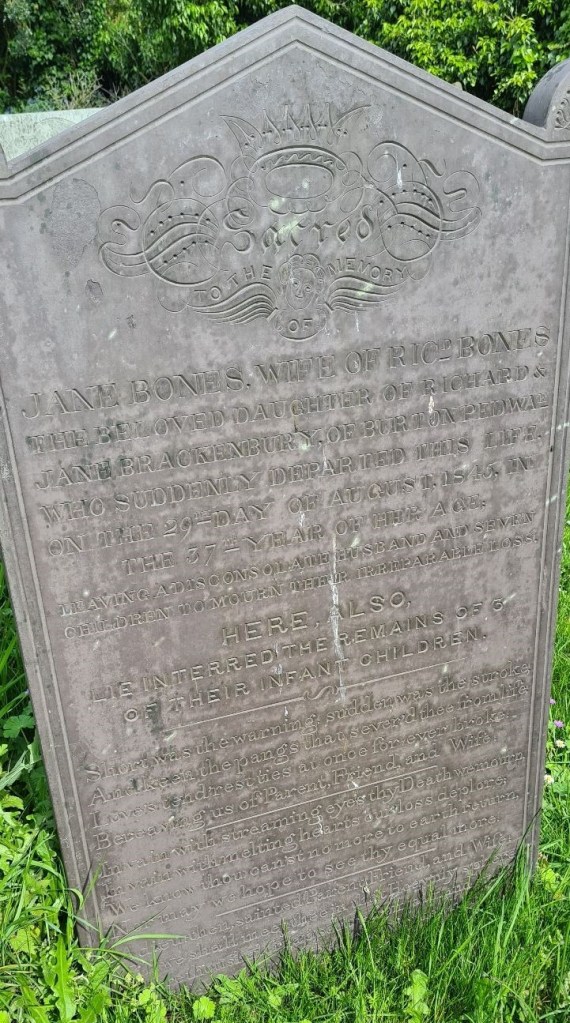
Richard’s wife Jane died on 29 August 1945; this is her headstone, in Billinghay, erected by Richard. It says, Daughter of Richard & Jane Brackenbury of Burton Pedware. Leaving a disconsolate husband and 7 children.
1848 – Richard Bones
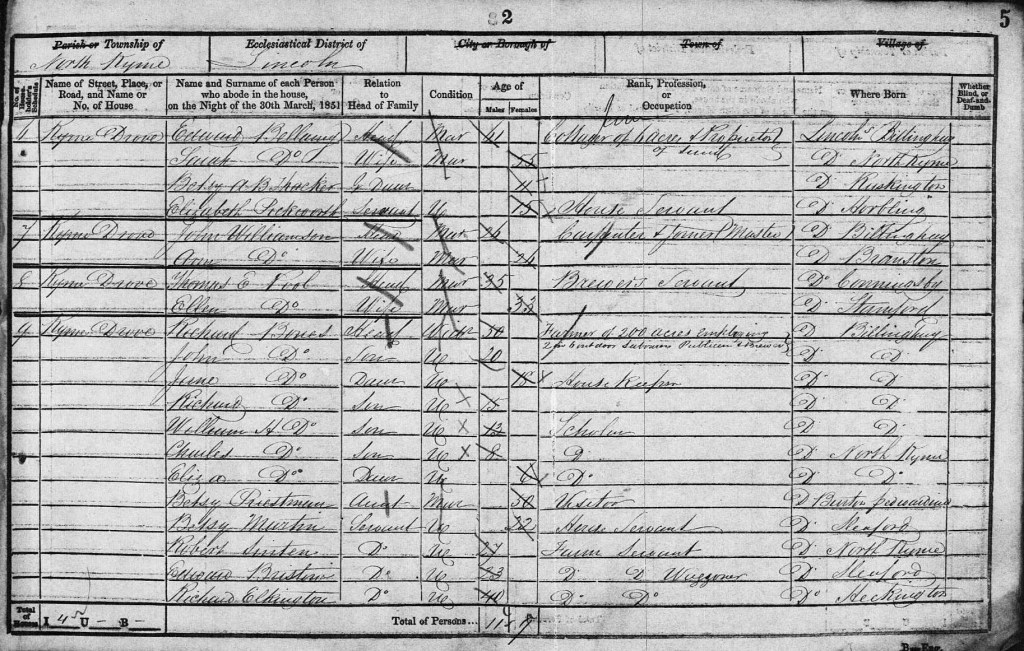
1851 – recorded in the 1851 Census – Richard Bones, Farmer and innkeeper, Richard was the uncle of the Billinghay murderer, Joseph Bones.
1856 – Mr Jonathan Cocks tenure is confirmed in the Stamford Mercury 26 Sept 1856 when a report of damage to the sign of the Coach & Horses saw three local men convicted of the said crime.

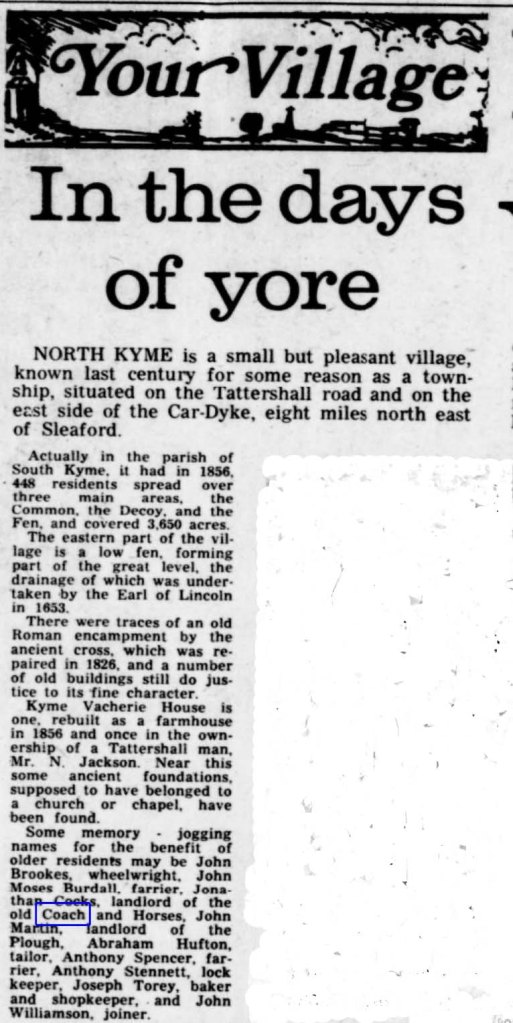
In the 1970 Sleaford Standard, covering the year of 1856 again confirming that Jonathon Cocks was the landlord of the time.
1861 – Mr Jonathan Cocks is mourning the loss of his daughter – Stamford Mercury 23 Nov 1860.

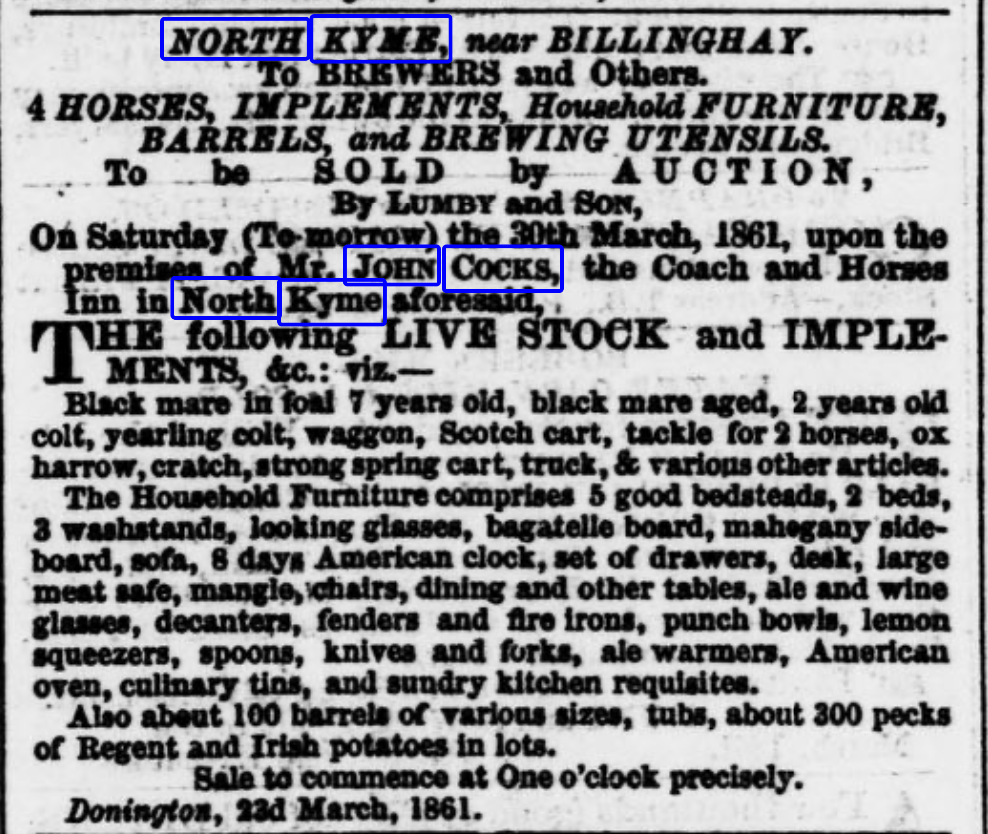
Mr Cocks was still the landlord of the Coach & Horses as reported in the Stamford Mercury 29 March 1861.
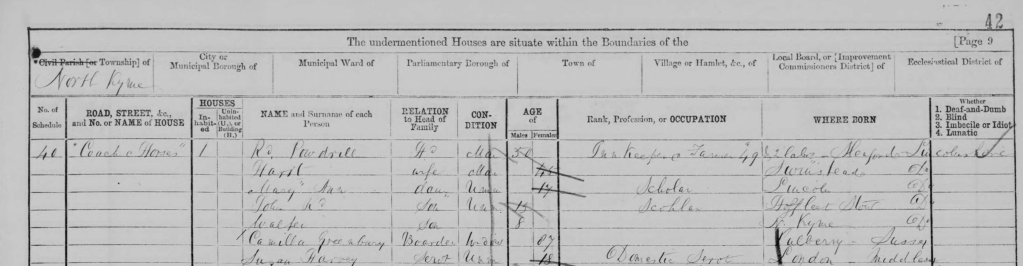
1861 \ 1871 – Richard Powdrill – in the 1871 census was recorded as being the Inn Keeper and Farmer at the Coach & Horses.
1868. Richard is also recorded in the Lincolnshire, Kelly’s Directory 1868 – the innkeeper of Coach & Horses.
1876. He is also recorded in the Post Office Directory 1876, still running the Coach & Horses. He likely continued to run the Inn until my family took over in 1878.
June 1878 – My family became involved in the inn. Mr William & Mrs Jane Watson (nee Watts), My paternal great-grandmother x2, confirmed as reported in the Sleaford Gazette 22 June 1878.

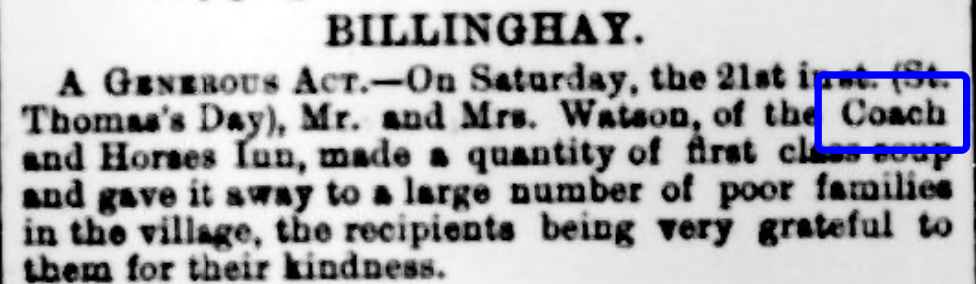
First-class soup. In the Lincolnshire Free Press, 31 Dec 1878.
1881. In the 1881 census, William Watson was the Innkeeper at the Coach and Horses Public House in Billinghay village, he was also the village butcher. Recorded in the Grantham Journal on 10 June 1882, William was still running the pub. Recorded in the Sleaford Gazette 9 Dept 1889, William was still recorded being the innkeeper.
1890. However, a twist of circumstances befalls William Watson when he went bankrupt, reported in the Sleaford Gazette, 18 January 1890.
Consequently in 1890 William and Jane had moved to Billinghay where William continued to run his butchers shop.
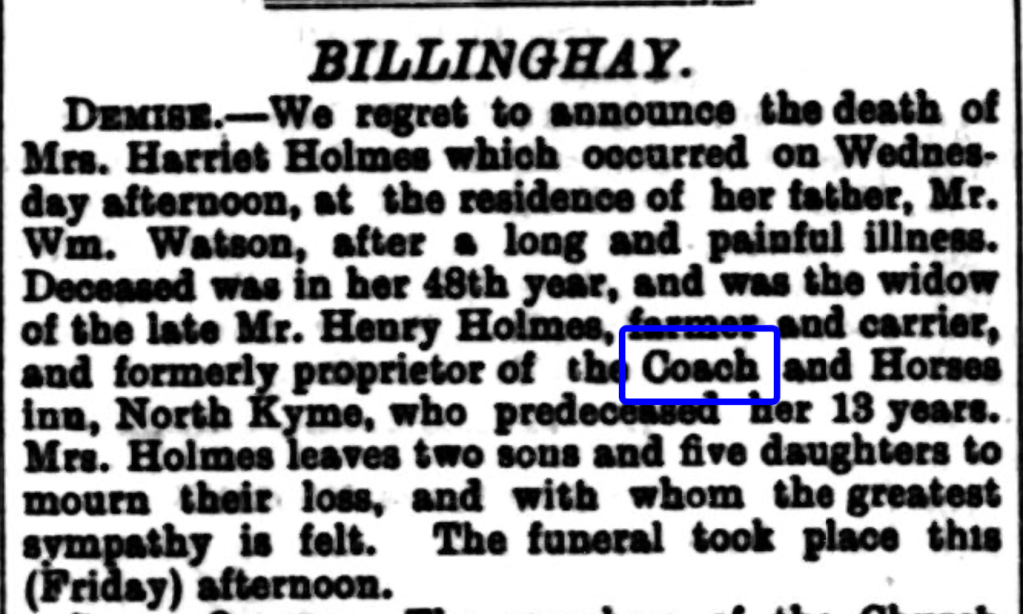
1890 – Henry Holmes, my paternal great-grandfather the husband of Harriet, the daughter of the above William and Jane Watson. Harriet’s obituary in July 1906 confirms that Henry, her husband, was at one time the proprietor of the Coach & Horses. This was confirmed through William Watson’s bankruptcy.
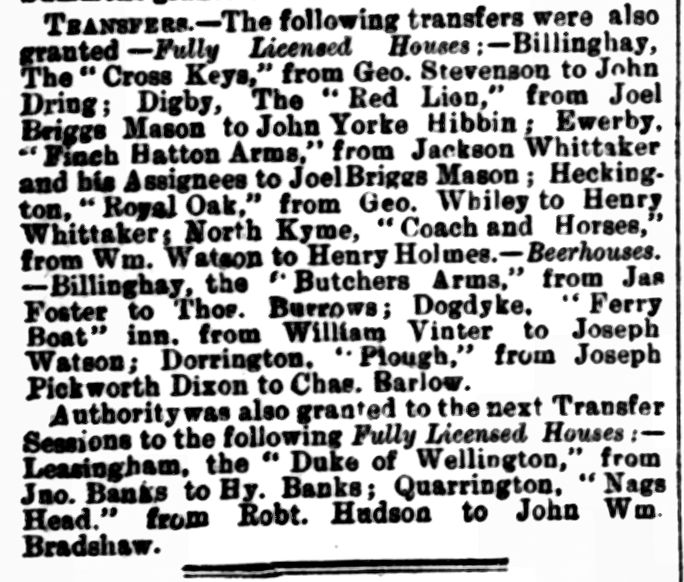
Transfer of the licence is confirmed in the Sleaford Gazette, 12 April 1890, when the Coach and Horses was transferred from William Watson to Henry Holmes.
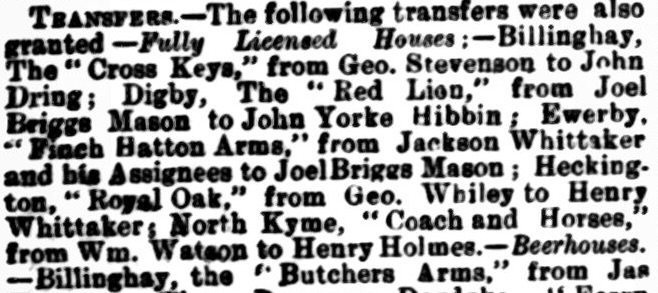
1891. Unfortunately, Henry was not the landlord for very long; he died prematurely aged just 36, in December 1891 of TB. His ownership of the Coach & Horses was again confirmed in his obituary reported in the Sleaford Gazette 18 Jan 1891.
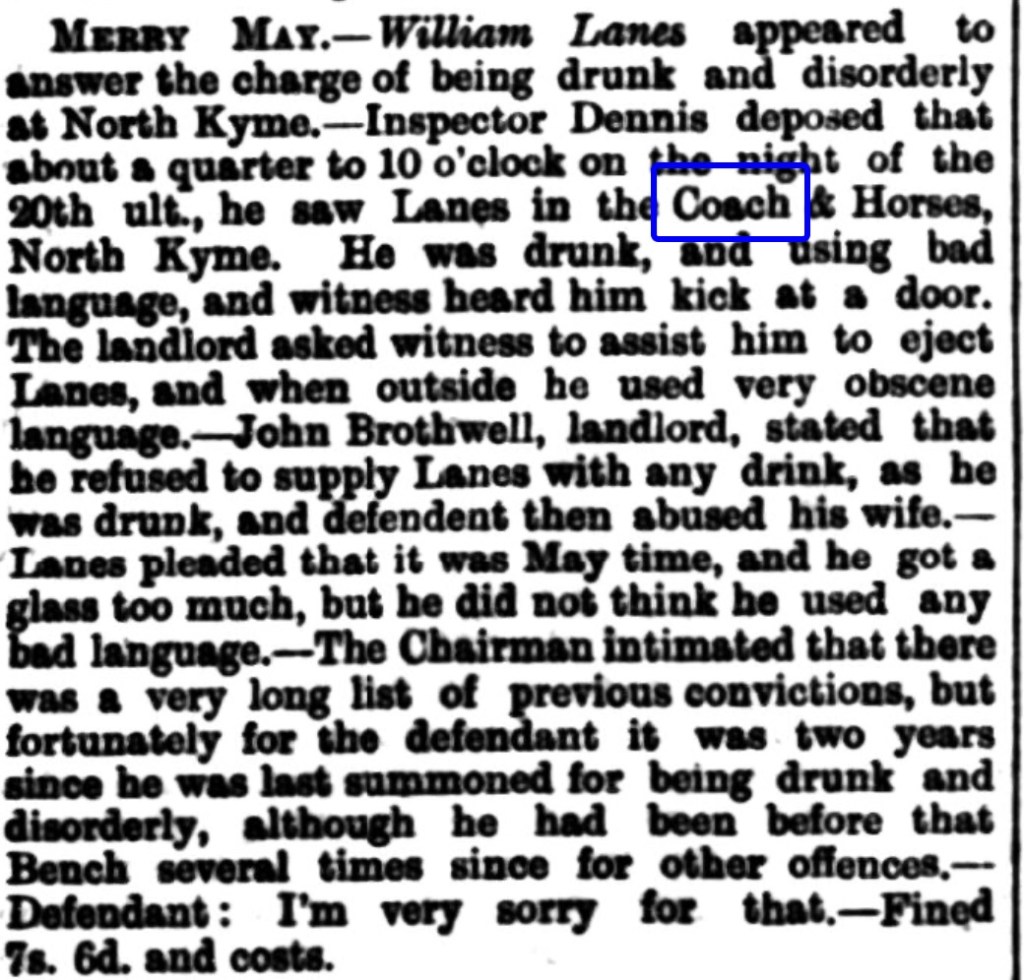
1896. The next landlord located was in 1896 – John Brothwell, recorded in the Sleaford Gazette, 6 June 1896.
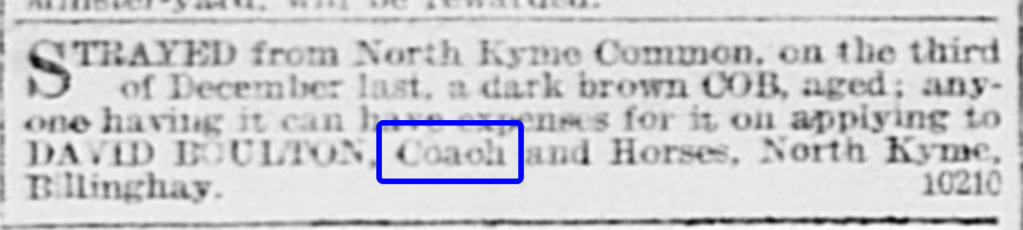
1898. David Boulton – Lincolnshire Echo 14 Dec 1898.
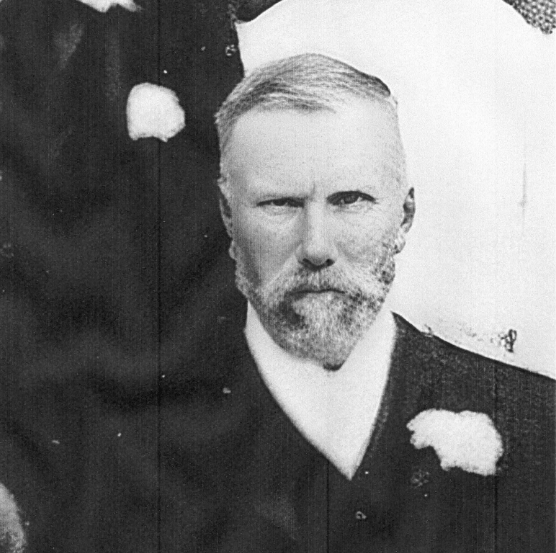
1901. Then in 1901, my family again took over the licence with Joseph Smith, he is my great uncle x2. Joseph was married to my paternal Great aunt Mary Jane Watson, the sister of my paternal great grandmother Harriett Holmes, nee Watson – she was the wife of Henry Holmes, former proprietor, who died in 1891. Joseph was a farmer and innkeeper.
Taken from his daughters’ marriage, this picture below, we believe this is Joseph Smith.
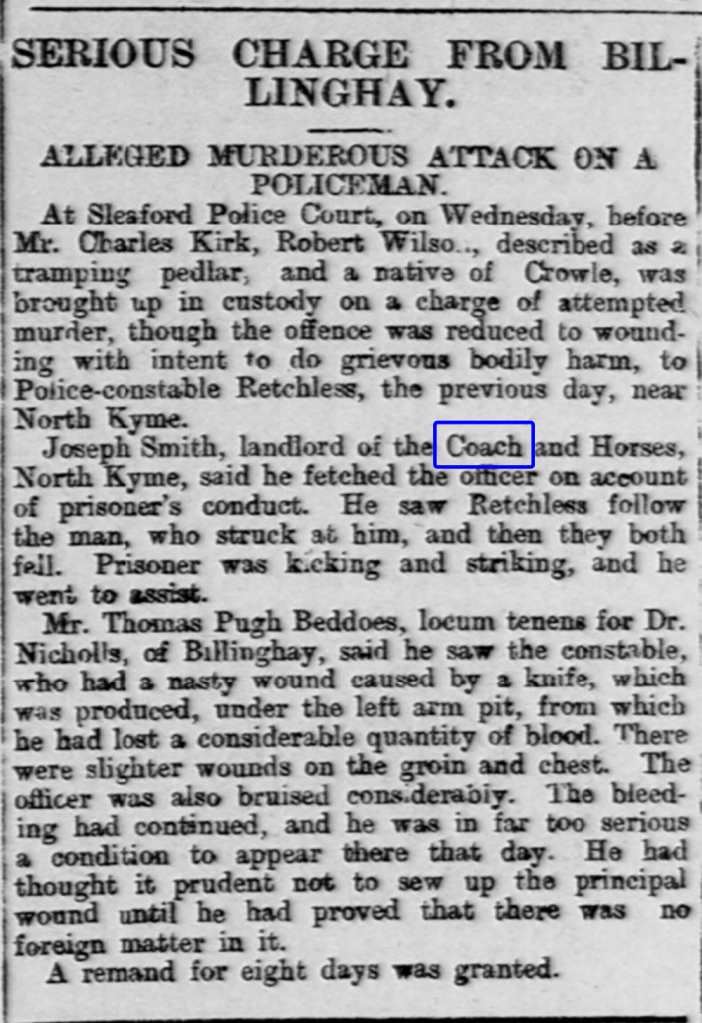
Recorded in the Lincolnshire Echo, 29 Sept 1901 confirms Joseph being the landlord when PC Retchless was attacked.
1910. In 1910, Joseph and Mary’s daughter Jane Watson Smith married John Wise and their reception was held at the pub.

Joseph was a farmer and innkeeper of the Coach & Horses. He ran the pub until 1911, when he and Mary are recorded in the 1911 Census. However, by the end of that same year, a change in tenancy occurred. As reported in the Boston Guardian on 28 October 1911, Frank Makey had taken over as landlord. His appointment marked the beginning of a long and stable period of management under the Makey family.
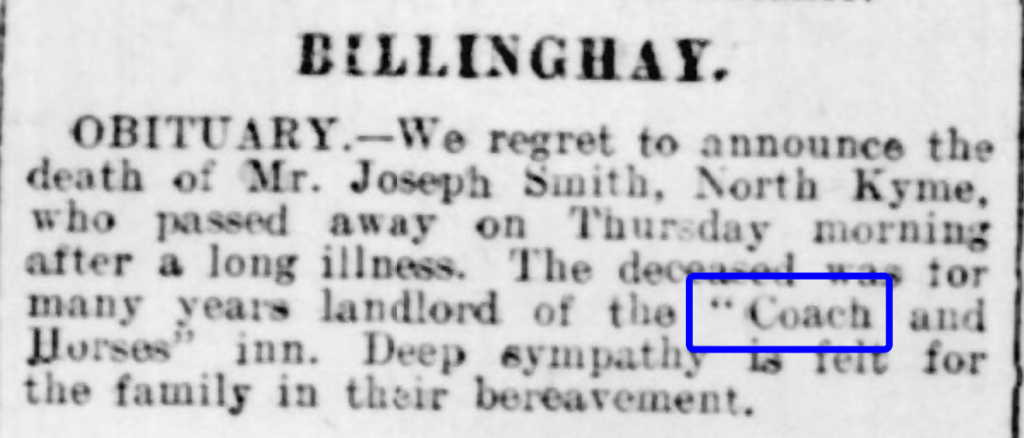
Joseph Smith died Dec 1913, and his obituary in the Lincoln Leader & County Advertiser records his tenure of the Coach & Horses.
1921. Frank Makey is recorded in the 1921 Census residing at the Coach & Horses with his wife, Mary Alice, and their son, Joseph. His stewardship of the inn appears to have been both enduring and reputable, with local records and directories continuing to list his name in connection with the establishment until at least 1929—the last known year of his documented association with the pub.
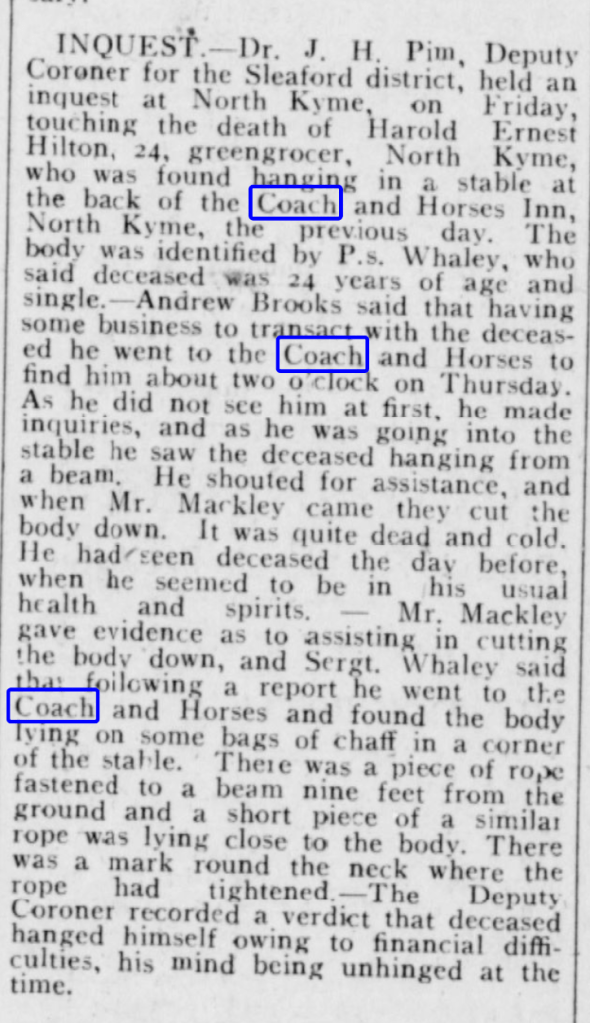
1926 – Frank Makey -Lincolnshire Echo 25 September 1926

After 1929, several short tenures of the pub, then in 1939, Mr Harry Mills was recorded being the Licensee – Lincolnshire Echo – 29 Dec 1939.

1939. In the 1939 Register, Harry Mills and his wife Ethel Irene are recorded living at the Coach & Horses hotel.

1940 – Lincolnshire Echo 23 April 1940 – Names landlord -Archibald Bruce Carter
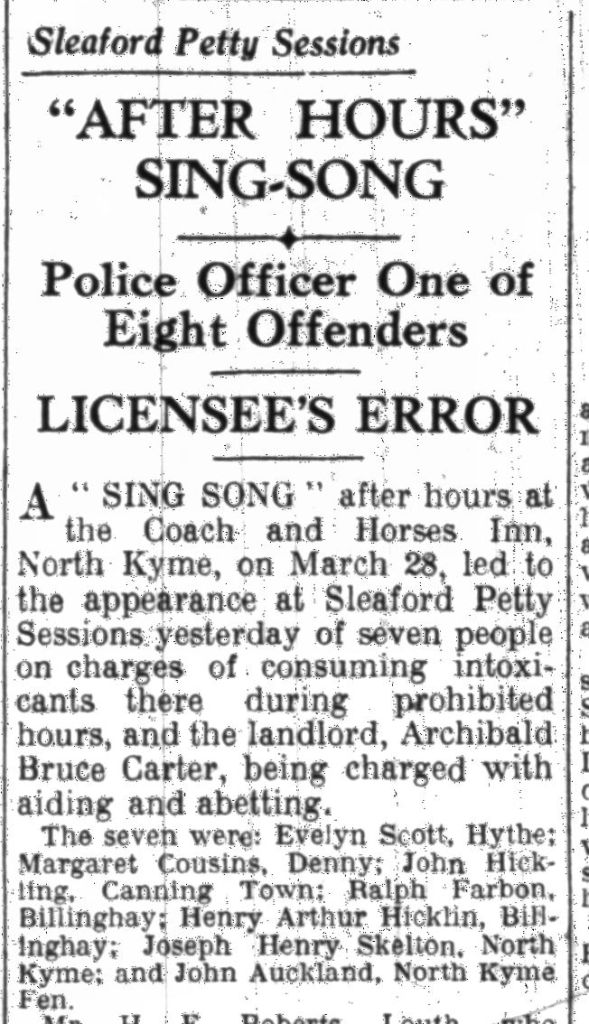
1951 – Sleaford Gazette 9 Feb 1951

1957 – Mr John Gilbert Nixon in the Sleaford Gazette 25 Oct 1957.

1957 – Mrs J G Nixon in the Sleaford Gazette 15 Nov 1957.

Researching the history of the Coach & Horses has been an absolute privilege, and most certainly full of surprises. What began as a simple search of previous innkeepers and landlords in a village pub soon unfolded into a much more personal journey.
I had no idea of my family’s involvement in the establishment between 1878 and 1911, albeit not consecutively. To discover this previously unknown connection has added a deeply meaningful layer to this research.
The Coach & Horses is more than just a public house; it has been a fixture of community life in Billinghay and North Kyme for generations—a place where stories were shared, lives intersected, and local history quietly unfolded within its walls. Knowing that my paternal ancestors were part of that narrative fills me with immense pride.
This work is, in many ways, a tribute—not only to the rich history of the Coach & Horses, but also to the enduring ties of family and place. It’s a small piece of a much larger story, and I’m honoured to share it, and long may it continue for future generations to share.
As always, if you can share any stories about The Coach & Horses Inn with me or have any connections, I would love to hear from you. Please comment here or email jackocats2@gmail.com
 familyhistorystories.blog