Introduction
My interest in speedway stems from my father, who between 1945 and 1952 rode for the Hellcats Speedway team while serving with the 1st Battalion of the Grenadier Guards. A previous blog post in January titled ‘Grenadier Guards 1st Battalion Speedway Team: A Legacy of the Hellcats (1947–1952)‘, in which I wrote about my father, led to contact with speedway historian Igor Romanov.
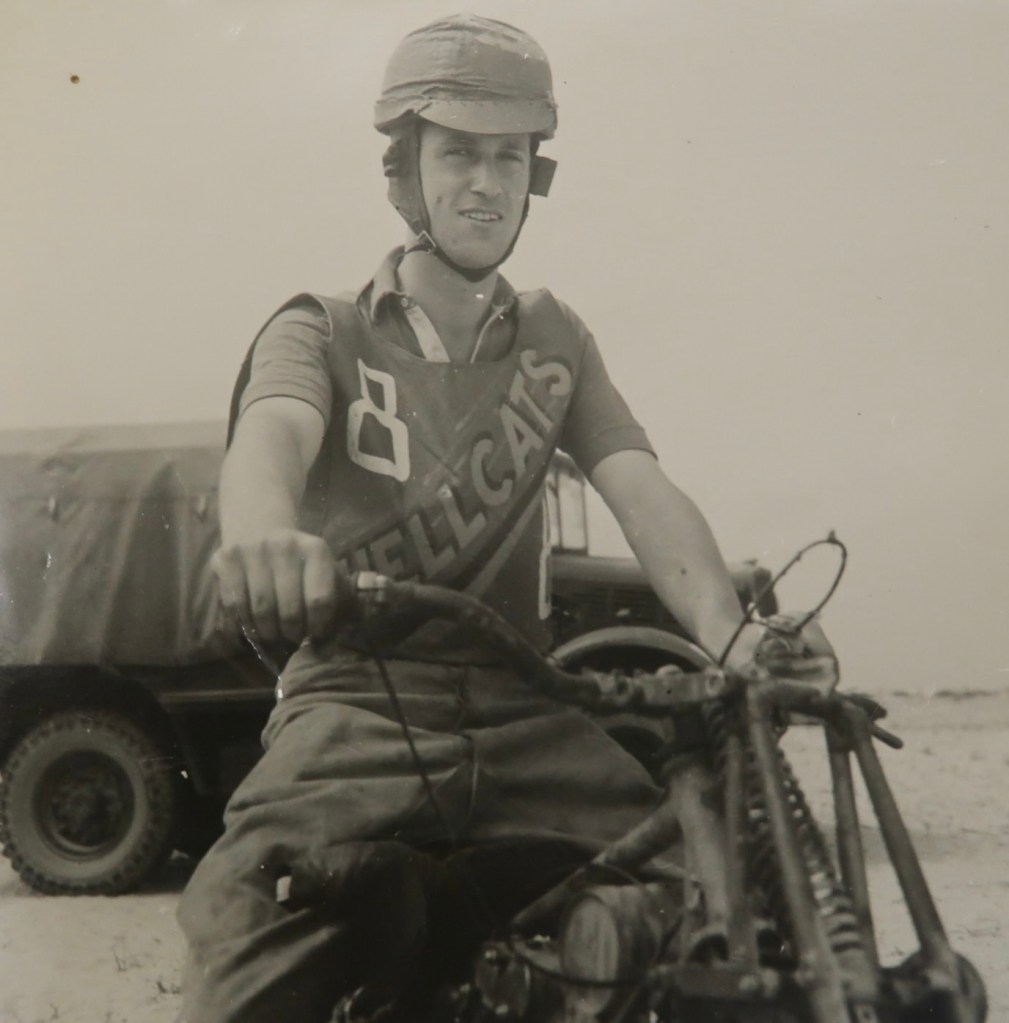
Since then, I have shared with him the photographs and historical details preserved from my father’s involvement in the sport during his military service, so that Igor can continue to build his archive on the subject. Since then, Igor has kindly, on my request, submitted the following guest blog and photos, providing a historical insight into the connection between the British Army and Speedway.
Guest Blog by Igor Romanov, Speedway Historian.

The British Army Speedway is quite a unique phenomenon in the history of motorsport. It spread across territories that had never seen motorcycle track racing before or after. It’s hard to believe now that the roar of speedway motorcycle engines could once be heard in the sands of Palestine and Libya, or along the rocky shores of Malta.
In general, it was a brief period that occurred thanks to the presence of British army units in various parts of Europe, Asia, and Africa at the end of World War II. This contingent was large, and of course, given the immense popularity of motorcycle racing in the British Isles before the war, there were many people who had a great love for this sport in peacetime. Mechanics, referees, riders, and simple fans learned new military specialties and spread across the world, but a part of each of their hearts remained on the speedway tracks of their home country—whether in England, Scotland, Wales, Ireland, or even Australia. Speedway, for each of them, was a bridge to a peaceful life.
Through memories and hopes, through the roar of engines and dust on the racing tracks, through victories and defeats in competitions, they shared a dream to return as soon as possible to normal, peaceful life—one in which speedway would certainly play a significant and important part.
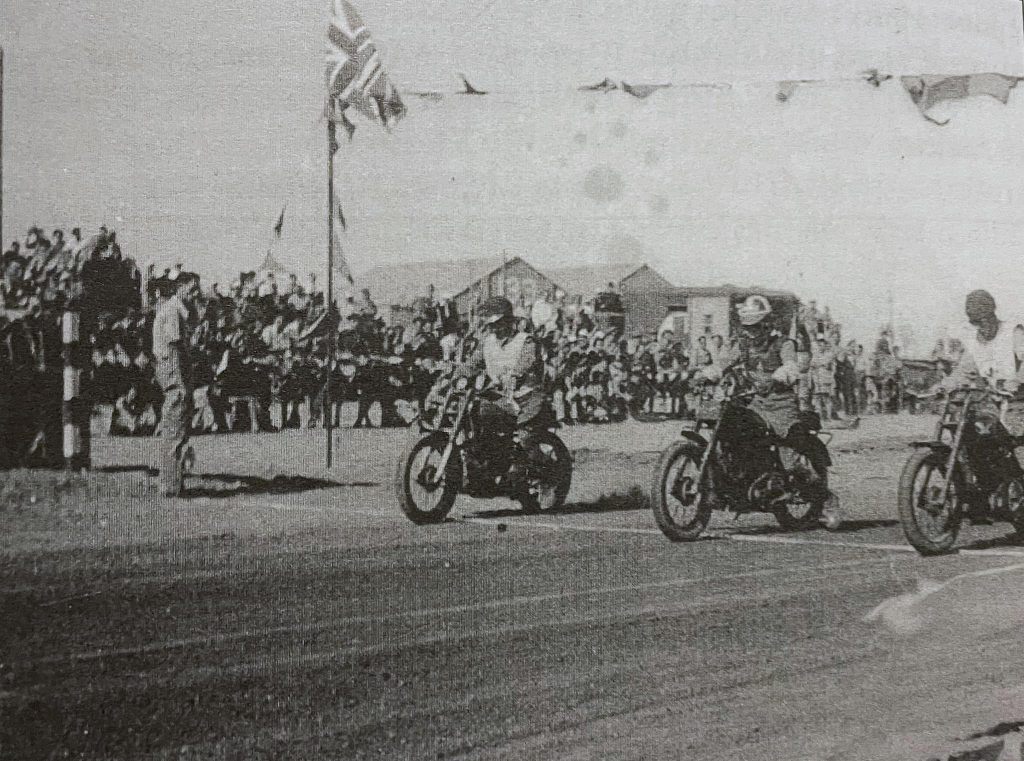
The first official speedway competition among the British army contingent took place on October 29, 1944, in southern Italy, in the town of Trani, located 40 kilometers north of Bari. The winner of the first historic race was Freddie Smith, and soon after, a real speedway league emerged in this region, consisting of teams representing Trani, Molfetta, Bari, and Bisceglie.
The most significant matches became the encounters between the army teams of Eastern and Western Italy. It was the Western region, based in Naples, that had perhaps the most professionally prepared “army” speedway stadium of that time—Vomero. The base of the speedway track was made from lava from Mount Vesuvius, and those who had the opportunity to try their strength on this track recalled that it was one of the most challenging they had ever faced.
Among those participating in the competitions were riders with considerable pre-war experience. In particular, Corporal Harry Whitfield, who had raced for the Wembley Lions, Harringay Racers, and Sheffield Tigers in the 1930s. And there were also those for whom the army speedway gave a push to continue their professional racing careers in the post-war years.

Egypt became an incredibly important region for the development of British Army speedway. It should be noted that, considering the landscape features, British military personnel in the Middle East had paid considerable attention to training motorcyclists since the early days of World War II. The Reliability Trials always attracted hundreds of participants, each trying to demonstrate their skills in the best possible way.
After 1945, when the British military contingent remained on duty in Egypt, genuine speedway competitions started taking place here. It was in Egypt that this motorsport discipline became the most widespread—by the late 1940s and early 1950s, there were 17 speedway tracks in the “Land of the Pharaohs”!
The vast majority of them had ordinary sandy surfaces, but the competition on them was just as intense as that on the pre-war speedway tracks in Great Britain.

The first organized club in the region was Bar-None MCC, which won the first official speedway race in Egypt on June 2, 1946, at the RAF Qadima track, defeating the Royal Air Force team 73-67. Later, the region saw the rise of the “star” team, El Ballah Aces, formed by representatives of the Air Formation Signals, and one of the main speedway centers became the military base in Tel El Kabir.
In 1949, the major matches of the Egyptian league began to be held at the Olympia Stadium in the city of Fayid, near the Suez Canal. At its peak, the Egyptian speedway league consisted of 13 teams.
Perhaps the most famous of all the British Army speedway hubs of the late 1940s and early 1950s was the German city of Hanover and the local Hanomag stadium. By the summer of 1945, the first speedway race was held here, organized by the Royal Mechanical Engineers. Given the large military presence in the German zone, which had fallen under British (and also American) jurisdiction after the defeat of the Nazis, motorcycle racing became a mass phenomenon.
To join one of the teams, athletes had to pass a rigorous selection process and demonstrate their best abilities. Not only did this make the competitions genuinely exciting, but it also opened the door for the best riders to enter professional speedway. Speedway races in Germany were held not only in Hanover but also in Hamburg, Ebstorf, Brunswick, Munich, Lübeck, and other cities.
However, it was Hanover, with its Hanomag stadium, that became the true center of British Army speedway in the early post-war years. The Combined Services Championship was first held in 1948, with Corporal Paddy Pullen as the inaugural winner. Larry Lazarus finished second, later continuing his racing career in the Glasgow Ashfield professional club.
Four speedway clubs were established in Hanover, named after English teams, but with the prefix “Saints”—Wembley Saints, New Cross Saints, Birmingham Saints, and Odsal Saints. Before the last season in 1951, almost 100 riders were competing for places in these four teams. The last Combined Services Champion was a Maltese rider, “Zipp” Zammit.
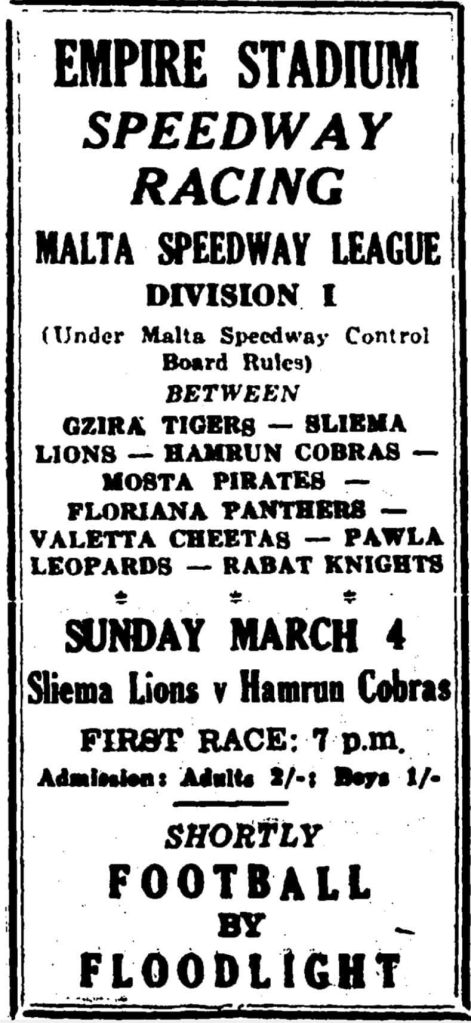
Interestingly, the successful performances of the Maltese rider in Germany did not go unnoticed in his homeland. A speedway league was established on the islands, consisting of eight teams. However, the championship in Malta lasted only a few months in early 1951, after which it became a part of the history of motorcycle racing.

It is also worth mentioning speedway races in Palestine and Libya. While the Palestinian speedway episode is not well-studied by historians, it is known to have paved the way for one of the brightest army speedway periods—those races in the Libyan capital, Tripoli. It is known that races were held in Palestine, both at military bases and at a secret location near the Dead Sea.
Why secret? We all understand how challenging the security situation was in the region at that time. Therefore, the locations for large events were kept very secret. When the British mission in Palestine ended, various equipment, including speedway motorcycles, was transported by sea to Libya. What happened there, thanks to the incredible work of military speedway enthusiasts, deserves a separate book.
In a short time, from the first half of 1948, the first racing bikes were created almost from scrap metal, and the local Busetta racecourse was chosen as the training and competition venue. It was there that the first teams were formed, including the Grenadier Guards’ Hellcats and the Royal Corps of Signals’ Meteors. Over time, the number of teams in the Tripoli speedway league grew to 12, and a special stadium, Seaview, with a 5,000-seat grandstand and a real cinder track, was built for the competitions. This marked a true speedway boom in the sands of North Africa.
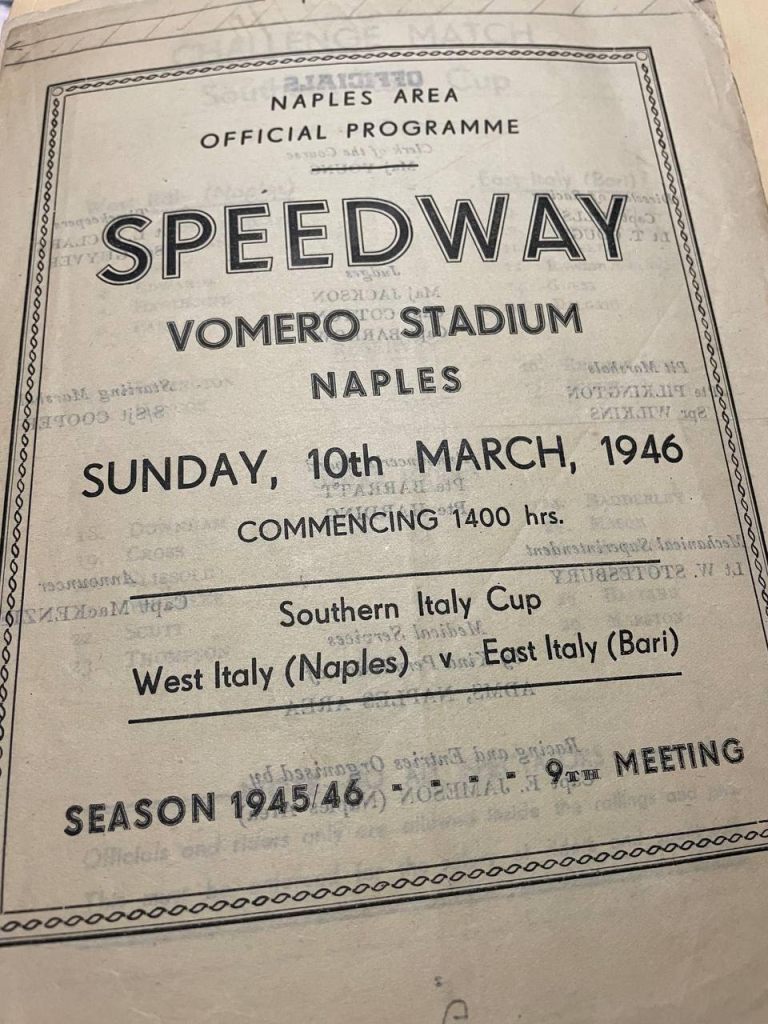
The history of post-war British Army speedway is incredibly interesting but still not well-explored. In my speedway collection, I have several priceless artifacts from that time, including programs from races in the Italian cities of Bari and Naples, as well as from the Egyptian city of Fayid. I hope to expand this collection with more rare items from other regions, including Libya. There were occasional appearances of speedway motorcycles on tracks in other countries, but information about these events is scarce. Much work lies ahead for us.
You can contact Igor on his Facebook Page here: Igor Romanov Facebook

You can contact me by commenting on this blog or via email at jackocats2@gmail.com
 familyhistorystories.blog