Many of my blogs have focused on Billinghay, yet my research interests extend to the smaller neighbouring village of Anwick, which also holds strong ties to my family history. Having most recently explored the story of Billinghay’s village post office, it feels only fitting to now turn attention to Anwick Post Office. From 1868 until 1969, this important village institution was, I’m proud to say, in the capable hands of my Jackson ancestors, who served the community faithfully across several generations.
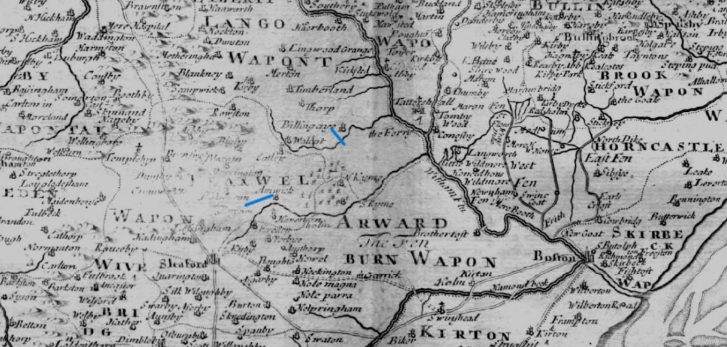
This map depicts how close the village of Anwick is to Billinghay.
The story of Anwick Post Office is not merely one of a building, but of the people who kept it at the heart of the village for over 140 years, until its eventual closure on 20 March 2008, when it was then replaced by a mobile service. In rural communities such as Anwick, the post office was more than a place to send and receive letters. It was the hub of communication, a shop for everyday necessities, and often a gathering point where neighbours exchanged news. To have one family at its helm for such a length of time was a mark of continuity and trust, and in this case, it was the Jackson family who held that responsibility.

The Jackson Family.
The Jacksons’ post office tenure began in the 1860s, at a time when the growth of the postal service was transforming village life. The arrival of the penny post, postal orders, and even telegrams brought the wider world to this quiet corner of Lincolnshire. For villagers who rarely travelled far beyond their fields and cottages, the post office offered a lifeline — a means of connecting with relatives, conducting business, and receiving news from beyond the parish boundary.
I knew that my family had served as postmasters in Anwick, but I wanted to determine when they first began operating the post office. To investigate, I turned to the local trade directories. My search led me to Morris’s Directory and Gazetteer of 1863, which records Zephaniah Jackson as a grocer.
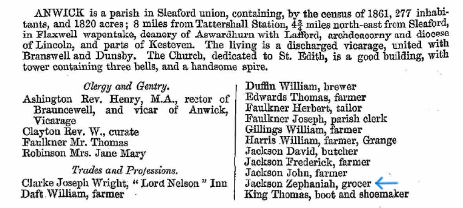
Then I found him in the 1872 White’s Directory, which records Zephaniah as both sub-postmaster and grocer. My attention now turned to the census returns for Anwick to trace further details.

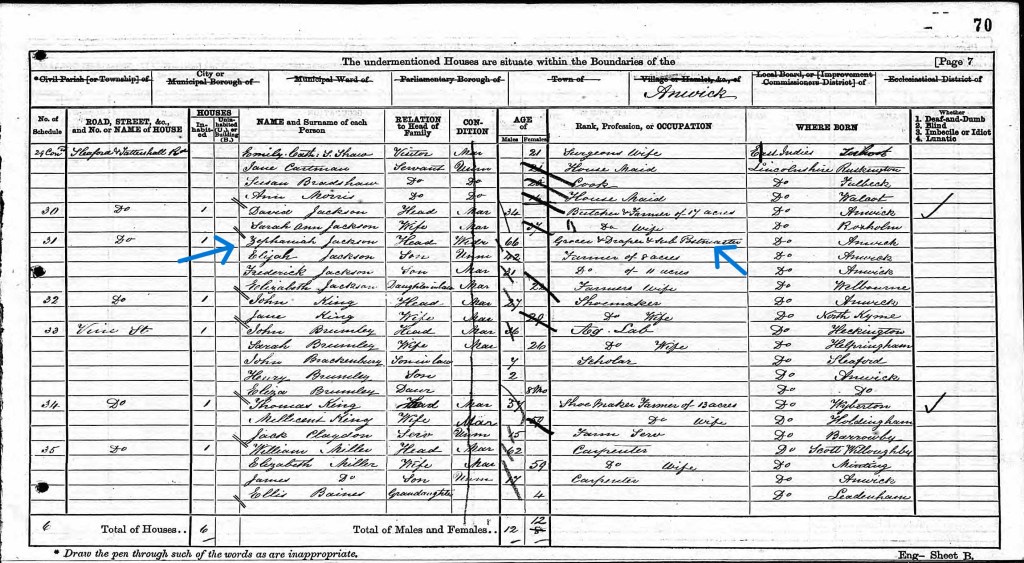
Zephaniah Jackson was my 5-great uncle, he married Susannah Cowlishaw in 1827 in Anwick; together they had seven children. In the 1861 census, Zephaniah was a farmer of 22 acres, as well as being a grocer and draper.
The 1871 census confirms that my five-times great-uncle, Zephaniah Jackson, was serving as the sub-postmaster in Anwick. By now, Zephaniah was a widower, following the death of his wife Susannah on 3 March 1867. He was living with his two sons — Elijah, the eldest and unmarried, and Frederick, the youngest, with his wife Elizabeth Bemrose. Both sons Elijah and Frederick were farmers of 11 acres.

Frederick is significant to this story which will become clear later. In 1870, at the age of 29, Frederick had married Elizabeth Bemrose (1848–1930), daughter of Joseph Bemrose, a master carpenter of Welbourn, Leadenham, Lincolnshire. Their marriage produced six known children.
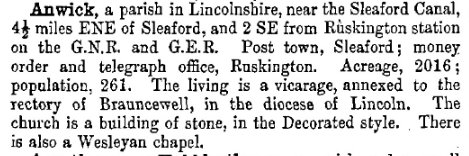
The family resided on Sleaford and Tattershall Road, Anwick, later where Zephaniah is recorded as a grocer, draper, and sub-postmaster, clearly operating the family business from that address.
Research confirms that Zephaniah was a wealthy man. The following year, in September 1872, Zephaniah is recorded in the newspapers as auctioning off land, two cottages, the grocer’s shop and other shops, yards and gardens.
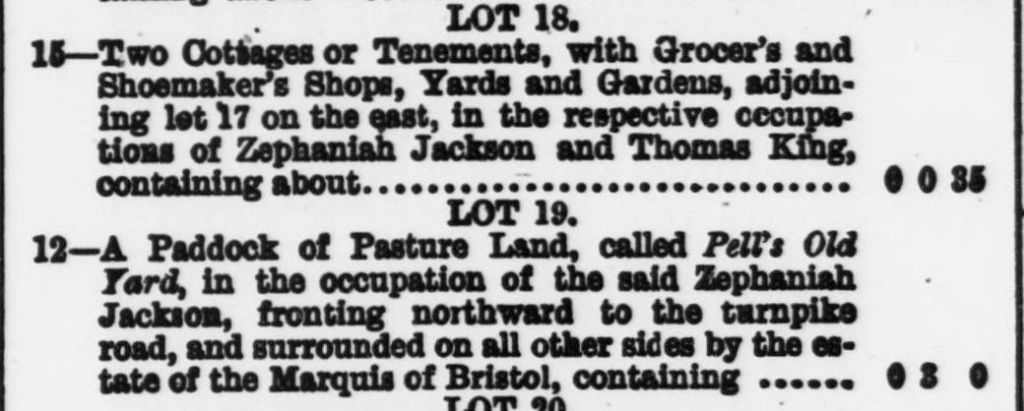

This raises the question of whether the sale of the land and buildings on Little Hale Road may have helped finance the purchase of the larger property still standing on Main Road, Anwick. I would suggest not.
Research shows that Zephaniah and Susannah Jackson, with their children, were living on Little Hale Road, Anwick, where Zephaniah was recorded as a grocer. By the 1861 and 1871 censuses, however, the family had moved to Sleaford and Tattershall Road, Anwick—later renamed Main Road—indicating a relocation rather than an expansion funded by sale proceeds.
“Sleaford & Tattershall Road” being a descriptive route label used in 19th-century records (typical for early censuses/directories), with “Main Road” appearing later as the standard postal/street name along the A153 through the village.
Five years later, Zephaniah died on 30 January 1876. He left a will which records:
“The will of Zephaniah Jackson late of Anwick, in the county of Lincoln, farmer and grocer who died 30th January 1876 at Anwick, was proved at Lincoln by Elijah Jackson and Frederick Jackson both of Anwick, farmers the sons executors”
Following his father’s death in 1876, Frederick, with his wife Elizabeth and his brother Elijah, continued to run the post office, grocery store, farm, and now a blacksmith shop.
Frederick Jackson is my 1st cousin x 5. He was born in 1839, into an era when farming life was demanding and often unforgiving. From an early age, Frederick assisted in the family enterprise, balancing agricultural work with shop duties. By 1861, he was recorded as living and working on the family farm.
In the 1881 census, Frederick was recorded as a farmer and postmaster. The Jackson family were living at the Post office.


To confirm they were still running the businesses between 1881 and 1891, they are recorded in the 1885 Lincolnshire Kelly’s Directory.
“Elijah & Fredk. Shopkeepers, farmers & Post office”.
Frederick was a hardworking man providing local services for the Anwick community. Life was comfortable for the family, which employed a servant to support the household and its heavy workload. Then tragedy struck, Frederick died aged just 49 years of age.
Frederick Jackson died on 29 March 1889, leaving his wife Elizabeth and six young children. He died of tuberculosis, called Phthisis then, a disease that was a major killer at the time before the advent of effective antibiotic treatment.

The 1901 census confirms that Elizabeth took over the running of the Post office, grocer and farmer. She was supported by her children and brother-in-law, Elijah, who continued to live at the home.

On 12 November 1907, Elijah died; he was 78 years old, leaving Elizabeth to manage the Post Office and Farm with her children.

Elizabeth continued to run the Sub Post Office and grocers in the village, in the 1911 census she was living with her unmarried son William and daughter Clara, who later took over the post office following her mothers death.
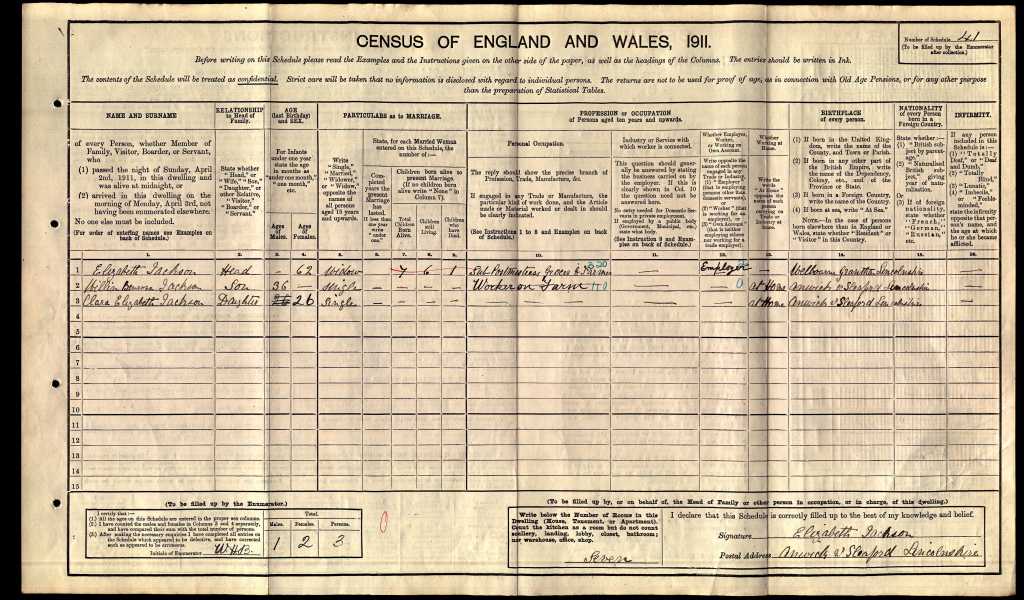
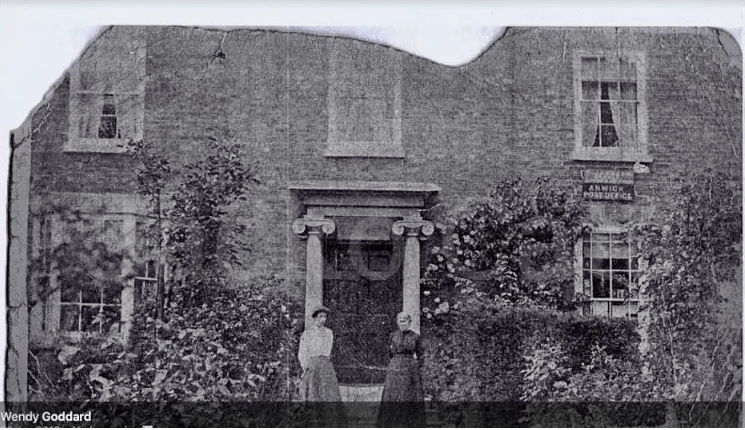
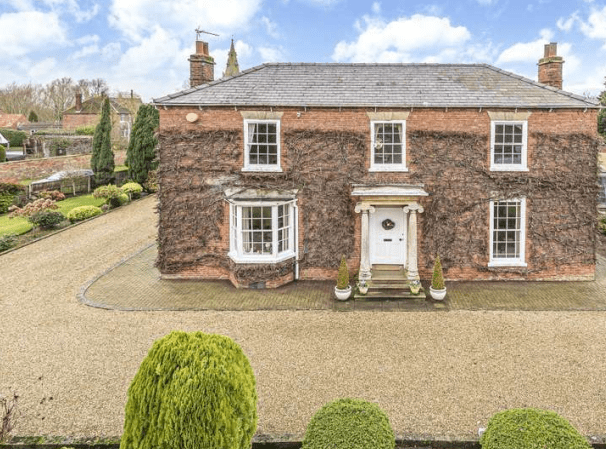
The property, which once served as both the Post Office and the Jacksons’ residence, remains standing today—though now a private home. Its survival provides a valuable glimpse into nineteenth-century rural life, when the village post office and shop formed the social and practical heart of Anwick.
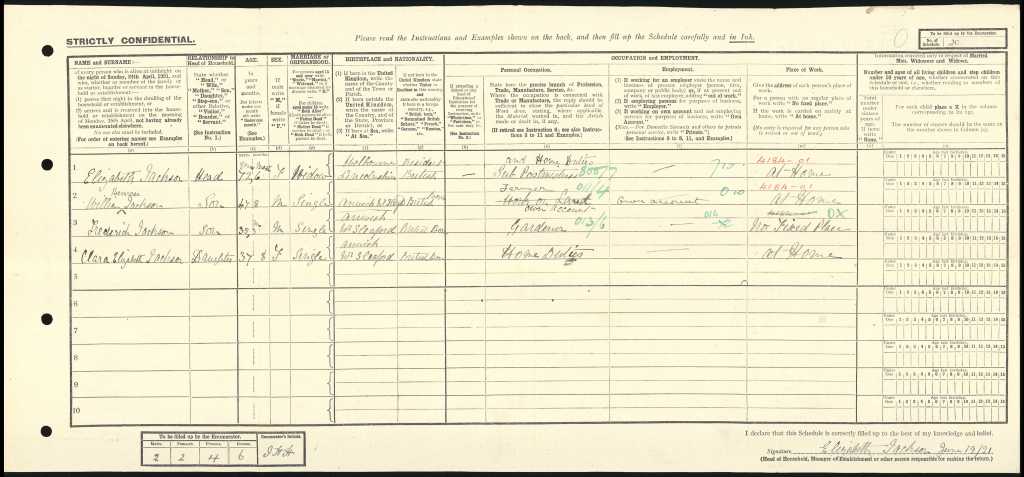
By the time of the 1921 census, Elizabeth had another of her sons back home with her. Clara was no longer a school mistress but working at home.
In 1924 Elizabeth was struck down by influenza which had broken out in the village, it was reported in the Lincoln leader & County Advertiser – 22 March 1924.
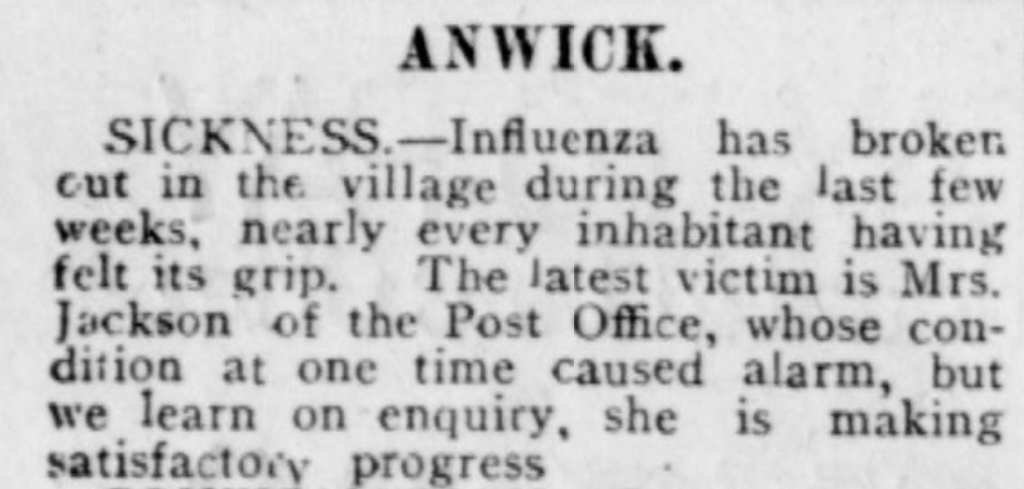
Death of Postmistress. Mrs Elizabeth Jackson.
Elizabeth Jackson continue to run the Post Office until her death on 26 August 1930. Whilst their lives were uneventful, they had an impact on the village, as illustrated in Elizabeth’s obituary.
Following her death in 1930, her obituary was in the Grantham Journal, 06 September 1930.
Mrs Elizabeth Jackson, who passed away in 1930 at the age of 82, had served as postmistress of Anwick for many years, effectively since the establishment of the local Post Office. The article notes that she “died in harness,” suggesting she continued her duties until near the end of her life. She was deeply involved in village life, particularly in managing the mail and helping to keep communication flowing in the small rural community.
A native of Welbourn, she proudly recalled attending the same village school as Field Marshal Sir William Robertson, a point of local pride. She moved to Anwick upon marrying Mr. Frederick Jackson around 1870, the same year the Franco-Prussian War began. The obituary recalls that during that time, villagers would gather at the Jacksons’ shop to read newspaper bulletins about the war — illustrating how their shop served as a hub of information and social contact.
The Jacksons ran both a village shop and a farm, enterprises of significant importance in those days. After her husband’s death, Mrs Jackson successfully managed both, a feat that earned her considerable respect in the community. The article describes her as one of the last living links to the “Anwick of old days,” a reminder of a generation whose passing marked the end of a rural era.
Her funeral drew a large turnout, showing the esteem in which she was held. The coffin inscription read:
“Elizabeth Jackson, born November 25th, 1848, died August 26th, 1930: Sweet rest in Heaven.”
The service was conducted by Rev. William Lee, and hymns such as “Father of Heaven” and “How Sweet the Name of Jesus Sounds” were sung. The list of mourners and bearers includes numerous members of the Jackson family and other notable Anwick residents a testament to her standing in the community.

I found Elizabeth Jackson’s obituary particularly fascinating, as it provides a rich historical and social insight into the life of the village — aspects not often recorded in such personal notices.
The account reflects strong community bonds, revealing how deeply Elizabeth was respected in Anwick, and how her funeral became a major local event, drawing villagers together in shared remembrance.
It also highlights the evolving role of women in village economies during the late nineteenth and early twentieth centuries. After the death of her husband, Elizabeth successfully managed both the family shop and farm, taking on significant business responsibilities that were rare for women of her era.
Her Post Office, a cornerstone of rural life, serving not only as a centre for mail and provisions but also as an informal information hub, played a vital role in connecting the community long before the advent of modern communication media.
Of particular interest is the reference to the Franco-Prussian War bulletins, which villagers gathered to hear read aloud. This touching detail hints at the early spread of news in rural Lincolnshire, and shows how Elizabeth and her family supported their neighbours — ensuring even those unable to read were kept informed of important world events.
Elizabeth left a will which was recorded in the National Probate calendar it records as follows:-
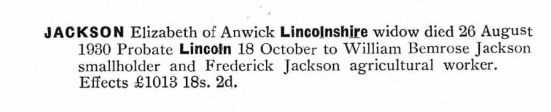
Frederick and Elizabeth JACKSON are buried in St Edith’s churchyard, Anwick, Lincolnshire.
The Old Post Office.
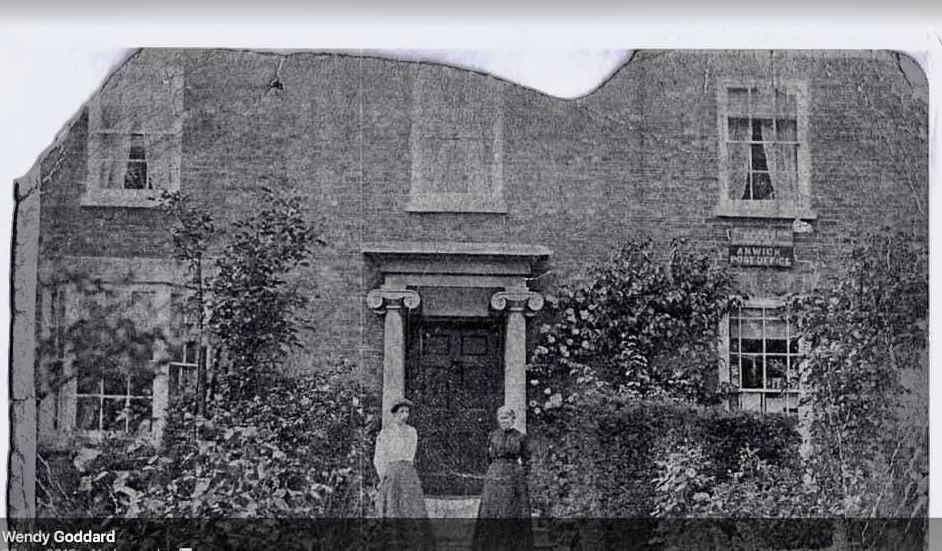
Several years ago, I was contacted by Wendy Goddard, a descendant of Elizabeth Jackson (née Bemrose). Wendy kindly shared family information and this rare photograph of the Jackson family home, offering a tangible link to the life and surroundings of one of the village’s most respected figures.
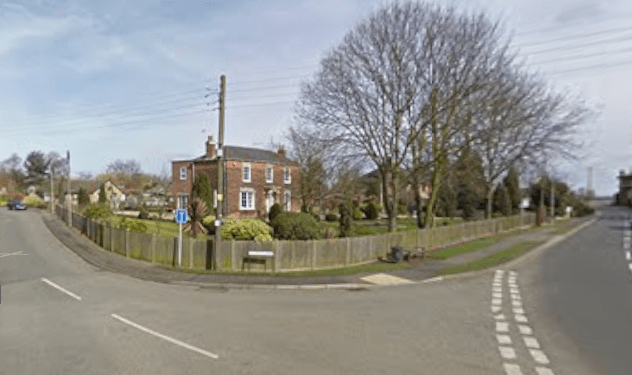
Here’s a photograph of the house now, from estate agents’ details dated September 2021.
Anwick Post Office. Beyond 1930.
So, after 1930, what happened to the Post Office? Well, I know for a fact it was taken over by Clara Elizabeth Jackson – Elizabeth and Frederick’s youngest daughter. Confirmed in the 1939 register. It also states the Post Office was on Church Lane on the register.

Clara Elizabeth “Lily” Jackson (1883-1969)
Clara Elizabeth Jackson, known locally as Lily, was born in 1883 in Anwick, the daughter of Frederick and Elizabeth Jackson (née Bemrose). The 1901 census records her working as a schoolmistress, a respected position for a young woman in the village. By 1911, she had returned to help on her brother William Jackson’s farm, remaining in the family home on Main Road, Anwick, where she continued to run the Post Office after her mother’s death.
Neither Clara, Frederick 1886-1946, nor William 1873-1961 ever married, and together they maintained the family property and business that had been central to village life for decades.


Clara is remembered by a local resident who was born and raised in Anwick — a friend of my late mother — who recalled “Lily,” a strict and rather austere figure. She was said to be formidable, particularly to children, and villagers would visit the Post Office only when necessary. Despite her stern manner, she was part of a generation that embodied diligence, self-reliance, and quiet service to the community.
Clara Jackson did not like to spend money, and her, and Frederick and William’s household lived frugally, despite occupying a relatively large house. It was remembered that they confined themselves mostly to the kitchen, refusing to have running water and electricity; they drew water from the village tap and lit their home by candlelight well into the twentieth century. They kept chickens and tended an orchard in the garden, selling eggs and fruit alongside postal goods — a continuation of the mixed rural economy that had sustained families like the Jacksons for generations. Lily was often seen walking down to the village tap, a short walk from the house, to fill her bucket.
The tap can be seen just before the cart on the left-hand side. The man is holding the handle of the water pump, to the left of the wheel.

Clara Elizabeth Jackson died in May 1969, aged 85 years. She continued to run the post office, I believe, until her death.
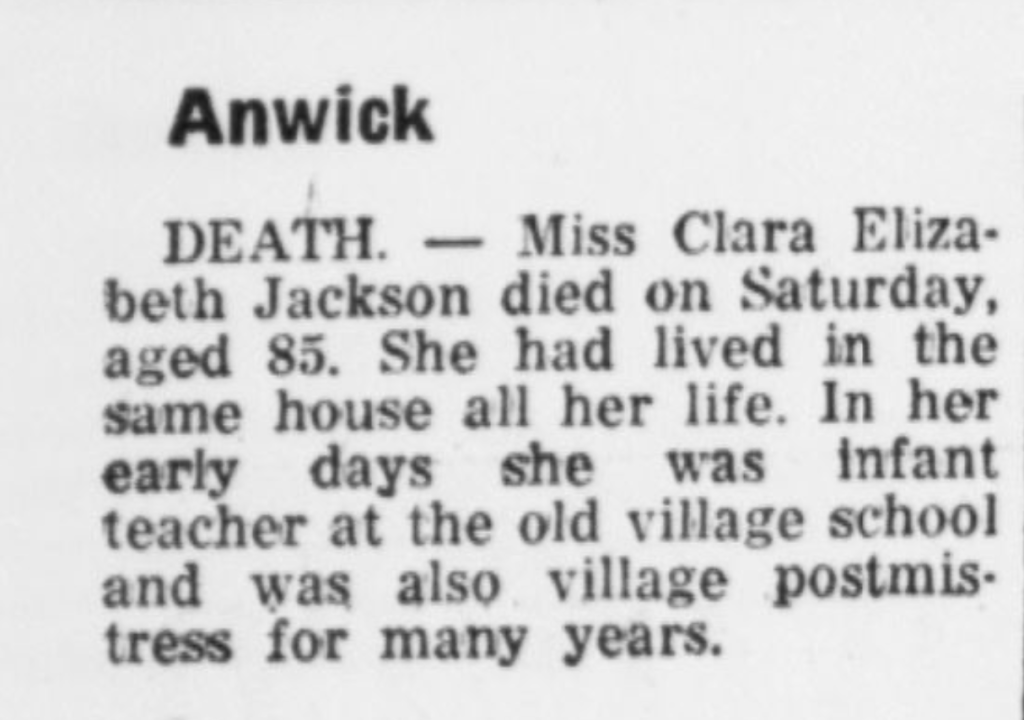
Following Clara’s death, as there were no direct descendants, the house was sold, and the post office likely went to a commercial postmaster or external appointee.
Clara’s estate went into Administration, as recorded in the England and Government Probate Death index 1858-2019 (Find My Past)

By 20 March 2008, any post office which existed in Anwick was closed and replaced by a Mobile service.
The Jackson Family and the Anwick Post Office.
The Anwick Post Office was operated by members of the Jackson family continuously from 1868 until 1969, spanning three generations. During this time the family were not only responsible for maintaining postal communications but were also central to village life in every sense.
Through their post office and adjoining grocery shop, they provided a vital lifeline to the rural community — a place where neighbours exchanged news, collected letters and parcels, and, in earlier years, gathered to read war bulletins and national reports. Long before modern technology connected remote villages.
The family’s commitment reflected the values of duty, self-reliance, and quiet service that characterised rural Lincolnshire life in the nineteenth and early twentieth centuries. From Zephaniah to Frederick and later his widow Elizabeth Jackson (née Bemrose), the steadfast postmistress who guided the office through its formative years, to her children Clara (“Lily”), Frederick and William, who continued the family tradition well into the twentieth century, each generation played a part in sustaining the social cohesion of the village.

As always, if you can share any old photos or stories about The Post Office at Anwick with me or have any connections, I would love to hear from you. Please comment here or email jackocats2@gmail.com
 familyhistorystories.blog