A Medal Comes Home for Remembrance Day
As Poppy Day approaches, remembrance has taken on a deeply personal meaning. Last week, my friend Lynn received an alert from eBay, a First World War British Victory medal had appeared for sale, it had been awarded to a soldier named PTE J A Toynbee from North Kyme, Lincolnshire.
As a direct descendant of the Toynbees of North Kyme, I was immediately intrigued and excited by this remarkable find. The chances of discovering a medal belonging to a Toynbee soldier were always going to be rare, and the possibility that it might be connected to my own family made the discovery all the more extraordinary.
Our research soon located the army records, and the regimental number 201393 engraved on the medal confirmed that it had been awarded to my paternal second cousin twice removed, Private John Aaron Toynbee of North Kyme, Lincolnshire. John had served with the Lincolnshire Regiment during the First World War, one of many young men from our Lincolnshire villages who answered the call to duty.
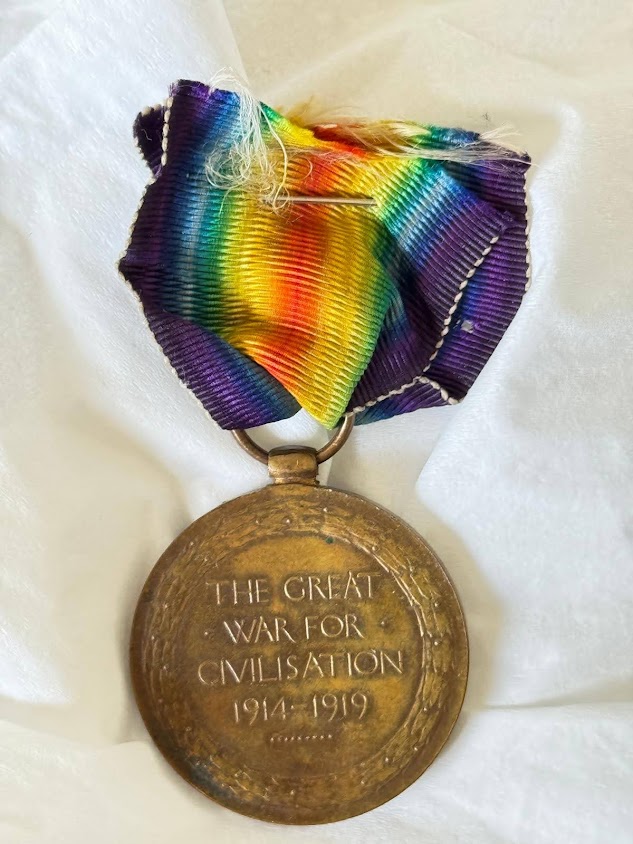
Now certain of the connection, I placed my bid. What followed was an anxious week of watching, waiting, and a brief but spirited bidding battle. At last, my bid was enough to secure the medal.
More than a century after John earned his medal in service to King and Country, it was now returning to the family, a tangible link to our shared past and a lasting tribute to his courage. This Remembrance Day, his story will be told once more, and his memory honoured anew.
John Aaron Toynbee was born in North Kyme, Lincolnshire on 16 August 1896, the eldest of three children born to Andrew Toynbee and Harriet (née Wilkinson). He was baptised on 6 Sept 1896 at St Mary’s & All Saints Church, South Kyme, Lincolnshire.
By the time of the 1901 census, the family had moved to Buckenham Street, Sheffield, where Andrew worked as a general carter. Like many rural families of the time, the Toynbees left the Lincolnshire countryside for the growing industrial opportunities of the city.

However, tragedy struck the family when Andrew suddenly died on 4 December 1901, aged just 28 years; his death certificate states the cause of death was heart failure. He lived at 28 Buckenham Street, Sheffield.

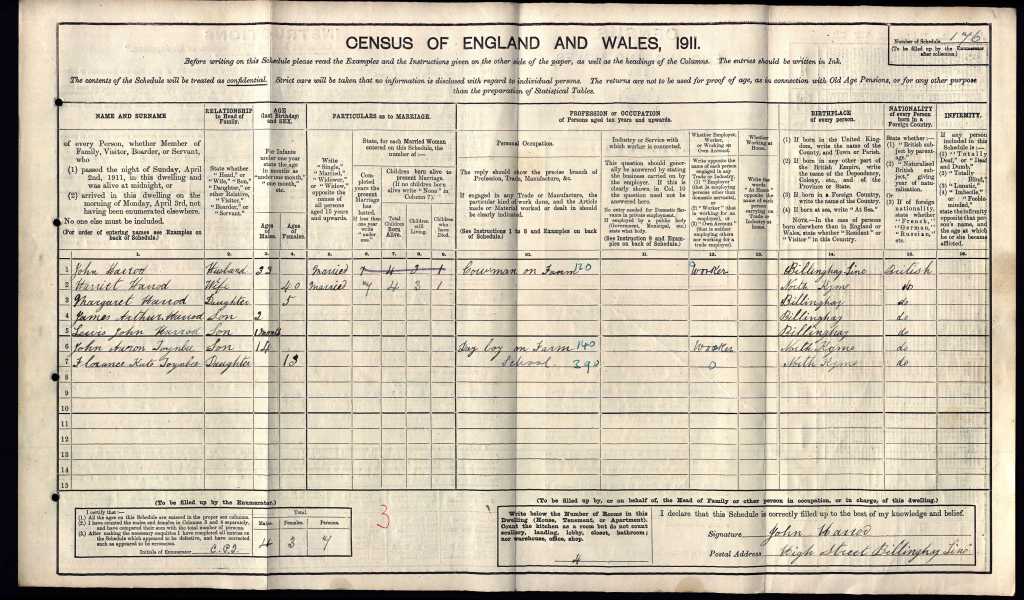
The loss of her husband left 29-year-old Harriet with three young children to care for, and she returned to North Kyme to be near her family. In 1903, Harriet remarried John Harrod, and the family later settled in Billinghay, Lincolnshire.
By the time of the 1911 Census, fourteen-year-old John Aaron Toynbee was living with his mother, stepfather, and siblings on High Street, Billinghay, where he was employed on a local farm as a farm labourer.
The next record for John is with his surviving Army service papers. Following the outbreak of the First World War, like so many young men of his generation, he answered the call to join the “Great War.” John was already a member of the Territorial Force (TF) of the Lincolnshire Regiment, with the regimental number 4146. The TF was a volunteer reserve that trained part-time but could be mobilised (embodied) in the event of war. At just 19 years of age, John was embodied on 19 May 1915, marking the moment he left civilian life behind and began full-time service with the British Army. John was deployed to the 4th Battalion, Lincolnshire Regiment. He was given a new Regiment number: 201393.
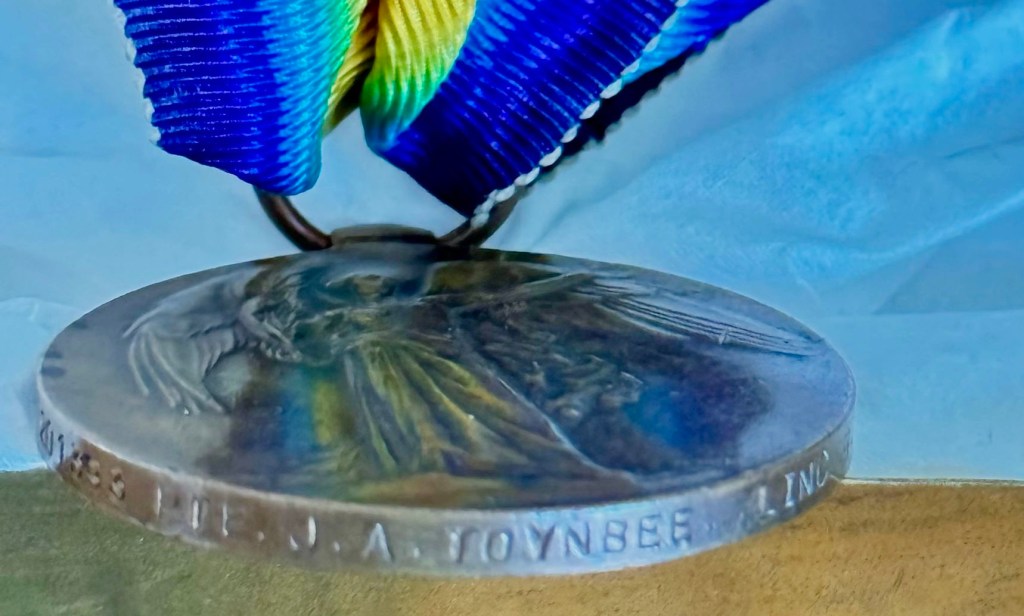
“Not all WWI medals had recipients’ names engraved on the edge, but the vast majority of British and Commonwealth campaign medals did. Some gallantry medals, like the Conspicuous Gallantry Medal, were issued unnamed, though recipients’ names might be found on the reverse of the suspension bar for some awards. Other medals might have had the recipient’s name engraved on the reverse instead of the rim, especially earlier awards, such as the 1914-1915 Star”.
After his mobilisation, John would have undergone initial training with the Regiment, preparing for the warfare that awaited him overseas. Soldiers of the Lincolnshire Regiment trained in a variety of locations during WWI, including Belton Park and Grimsby for initial training, and other camps like Leighton Buzzard, Halton Park (near Wendover), and Witley for final preparations before deployment.
John’s Medal Roll Index Card confirms that he was deployed to France on 12 December 1915, joining the Lincolnshire Regiment on the Western Front. He went on to see active service during the Battle of the Somme, one of the most intense and costly campaigns of the war. In recognition of his service, John was awarded the 1914–15 Star, a campaign medal given to those who served in a theatre of war before the end of that year.
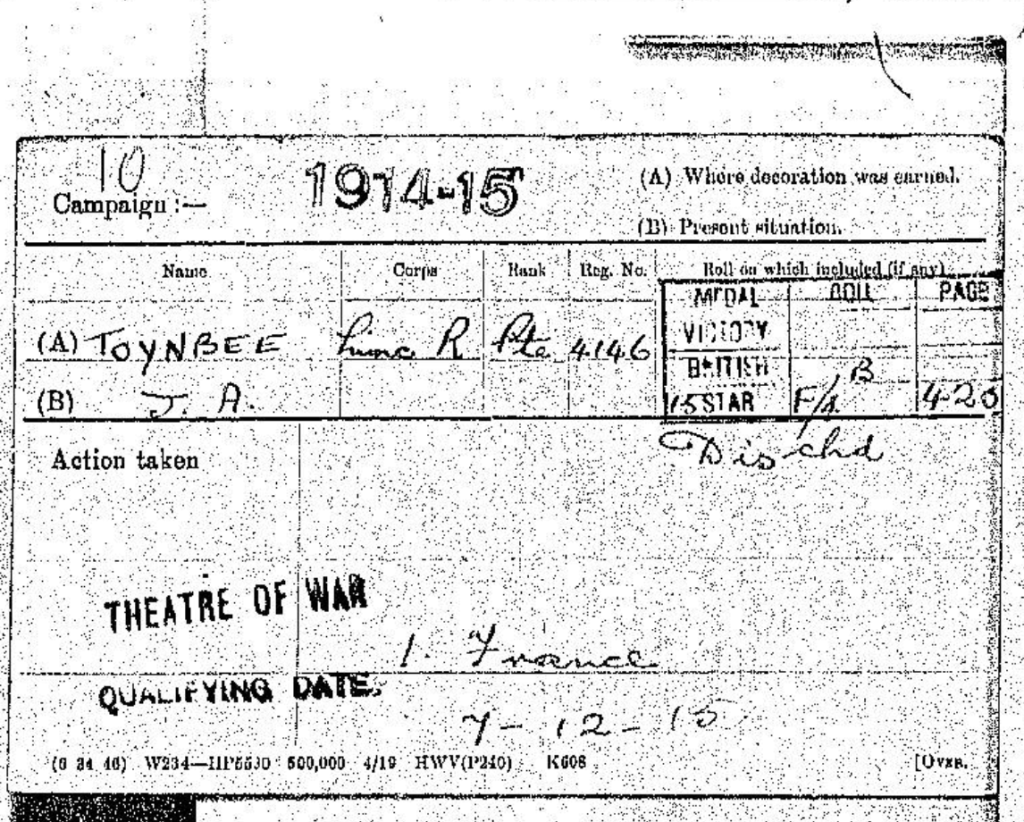
By 1915, the Lincolnshire regiment was heavily involved on the Western Front in France, where British forces faced relentless artillery, mud, and the daily dangers of life in the trenches. Many young recruits from Lincolnshire found themselves serving near the Somme and Armentières sectors, holding the line in a conflict that tested endurance and spirit in equal measure.
Unfortunately, John’s surviving army records are not very detailed, offering little insight into his exact movements or locations during the war. Between 1915 and 1918, we know he continued to serve with his regiment in France.

Wounded in Action.
The next significant entry appears on 10 April 1918, when John was recorded as having been gassed. While the precise location is not stated, research suggests this likely occurred during the Battle of the Lys, also known as the Fourth Battle of Ypres or Operation Georgette, fought in the Flanders region of Belgium and France. On that very day, German forces launched a major offensive, and numerous reports describe British troops suffering the effects of poison gas as part of the attack. Although this cannot be confirmed with complete certainty, the date and context strongly suggest that John was among those caught in this devastating action.
John was exposed to either mustard gas or phosgene during the Battle of the Lys. He would have received immediate first aid in the field, with the standard treatment being washing the eyes, skin, and clothing with water or bicarbonate solution if available, and giving oxygen or morphine for severe breathing difficulties.
He would then have been evacuated to a Casualty Clearing Station (CCS) near the front line, where medical staff assessed the extent of his injuries. If his condition was serious, as gas exposure could cause lung damage, blindness, and blistered skin, from here he would have been sent by ambulance train to a base hospital, possibly at Boulogne, Étaples, or Le Tréport in France.
Fortunately, John survived the gassing and the war, but due to his injuries was discharged from the army under the Kings Regulations “No longer physically fit for war service.” this clause was used when a soldier was discharged because of illness or injury sustained during service, for example, the effects of gas poisoning, wounds, or other medical conditions that made them unfit to continue.
John was subsequently awarded the Silver War Badge, which was introduced in 1916 and given to soldiers who had been honourably discharged due to wounds or sickness. It was a small, circular silver badge inscribed “For King and Empire Services Rendered.” Wearing this badge also confirmed he was honourably discharged from the war effort.
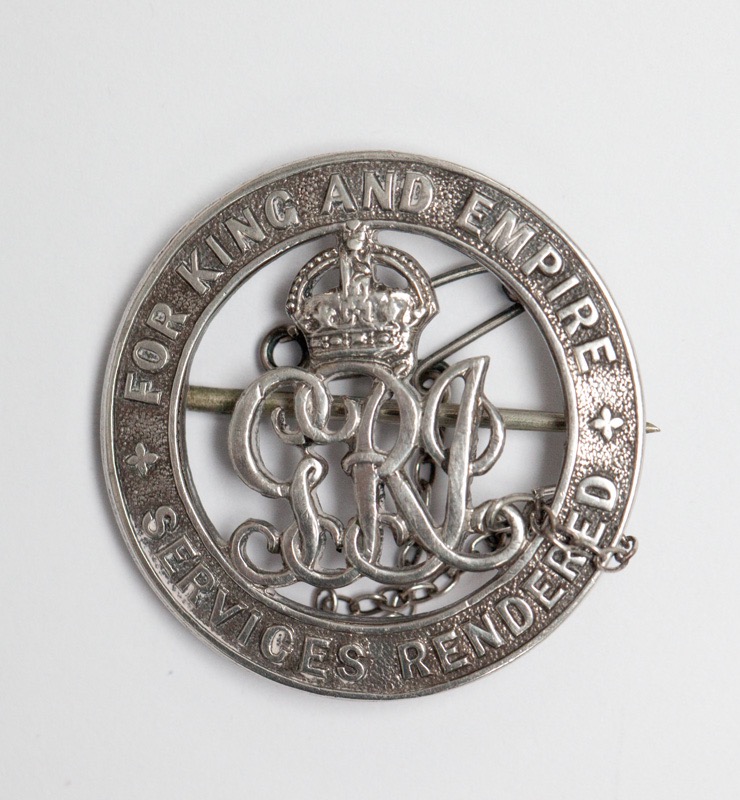
Following his wartime service, John returned to the family home, now back in North Kyme. In the 1921 Census, he was recorded as living with his mother, stepfather, and siblings, and was employed as a farm labourer for Mr Shepherd, a farmer in Ruskington Fen, returning to the rural life he had known before the war.
Interestingly, the census lists John under the surname Harrod, adopting his stepfather’s name rather than Toynbee.
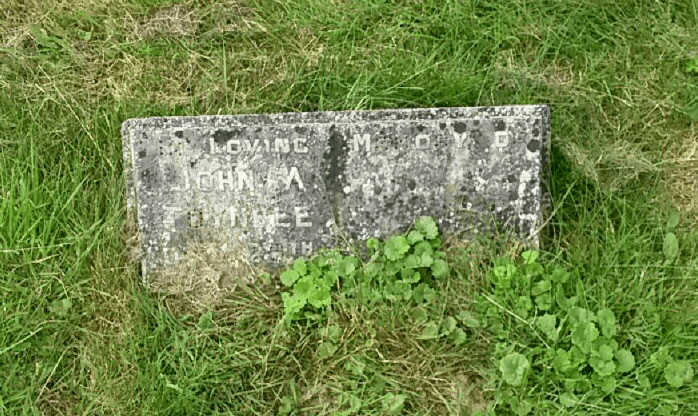
In 1930, John met and married Sylvia Jackson, and the couple settled in Sleaford, Lincolnshire, where they had one daughter, Jean Sylvia. John lived a quiet life in the community he had known since childhood. He passed away on 29 March 1965 and is buried in Sleaford Cemetery.
John Aaron Toynbee’s death was announced in the local newspaper.
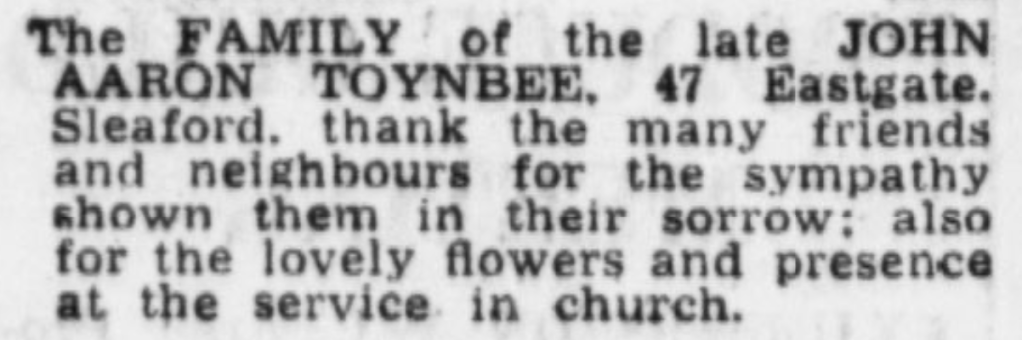
More than a century after John’s service, his British War Medal has finally found its way home. From the fields of North Kyme to the battlefields of Europe, and now back to his family in Lincolnshire, where it will be kept safe forever.
It is amazing how his story has come full circle. This Remembrance Sunday, as the nation pauses to honour those who served, John Aaron Toynbee’s courage will be remembered anew, not a forgotten or distant name in the records, but a beloved son of North Kyme whose legacy now endures within his family.
The odds of finding this medal have left us deeply surprised. The Toynbee surname is uncommon, and surviving artefacts linked to individual soldiers are few and far between. That this medal should resurface after more than a century, and be traced to our own family line, is an extraordinary stroke of luck, and a poignant reminder of how personal histories can resurface in the most unexpected ways.
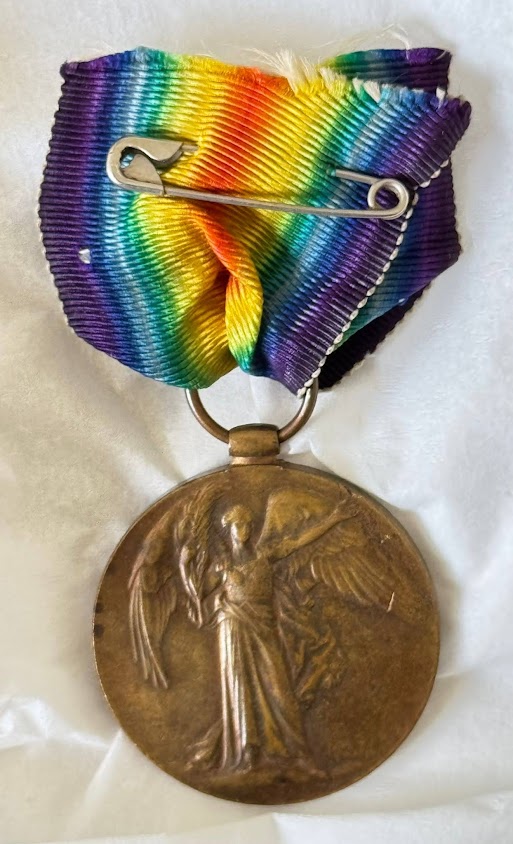
British War Medal 1914–1918 “Victory Medal”, often simply called the Victory Medal.
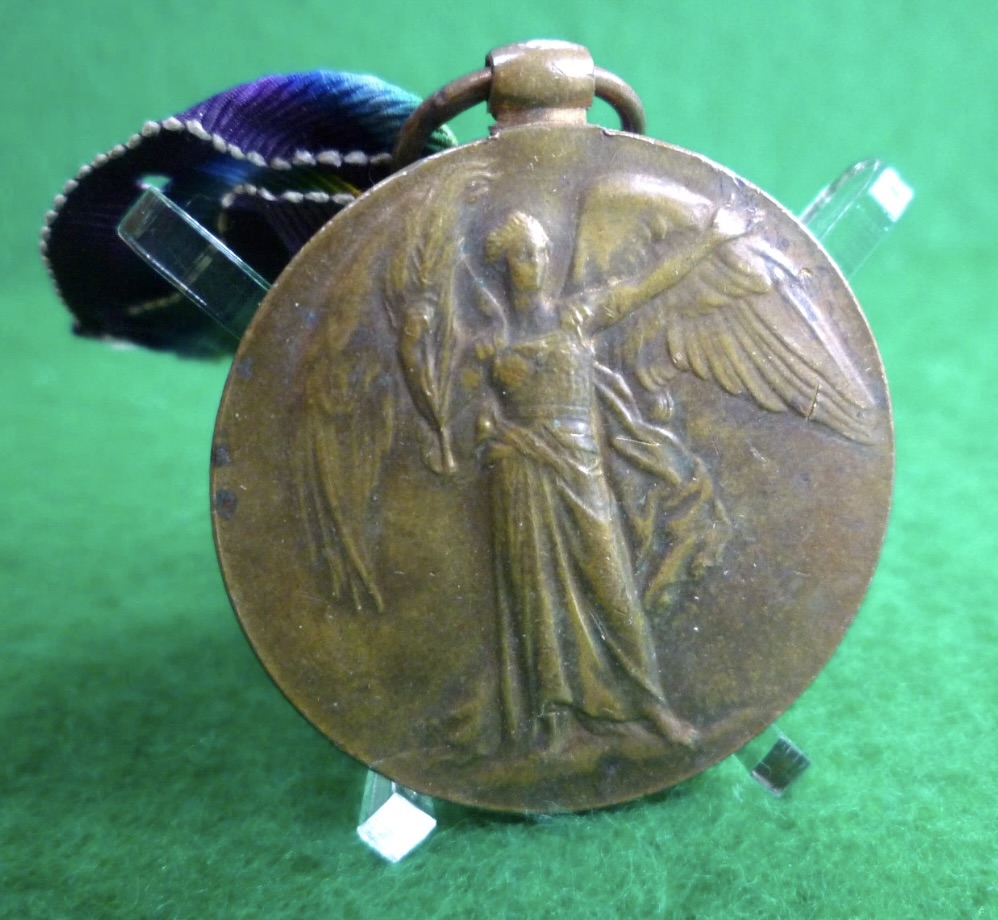
The medal John was awarded was given to all those who served in an operational theatre during World War I. Most British and Commonwealth soldiers who served overseas received it, often alongside the British War Medal and, for early service, the 1914 or 1914–15 Star.
- The design features the winged figure of Victory holding a palm branch in her left hand and extending her right arm.
- The reverse side usually bears the inscription “The Great War for Civilisation 1914–1919”.
- The medal is made of bronze and is suspended from a distinctive rainbow-coloured ribbon.
Somewhere out there are two other medals that John was also awarded. I’ll keep checking; you never know!
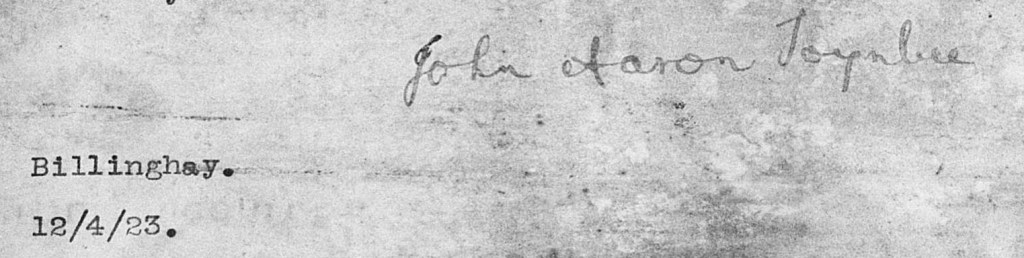
I have a copy of John Toynbee’s army records. If anyone is related to, or descended from, the Toynbee family of North or South Kyme and would like further information about him, please feel free to contact me. I would love to hear from you.
UPDATE.
An Update: A Continuing Journey to Bring John’s Medal Home
Following my recent blog about the First World War medal awarded to Private John Aaron Toynbee of North Kyme, I am very pleased to share an important update. I have now been granted permission to include a photograph of John’s daughter, Jean Sylvia Toynbee, which adds a deeply personal connection to this story and helps ensure her father is remembered not only as a soldier, but as a family man.
My hope is that this story may reach members of the wider Toynbee family. My ultimate wish is to locate direct descendants, so that in time this medal be returned to the Toynbee family where it truly belongs.
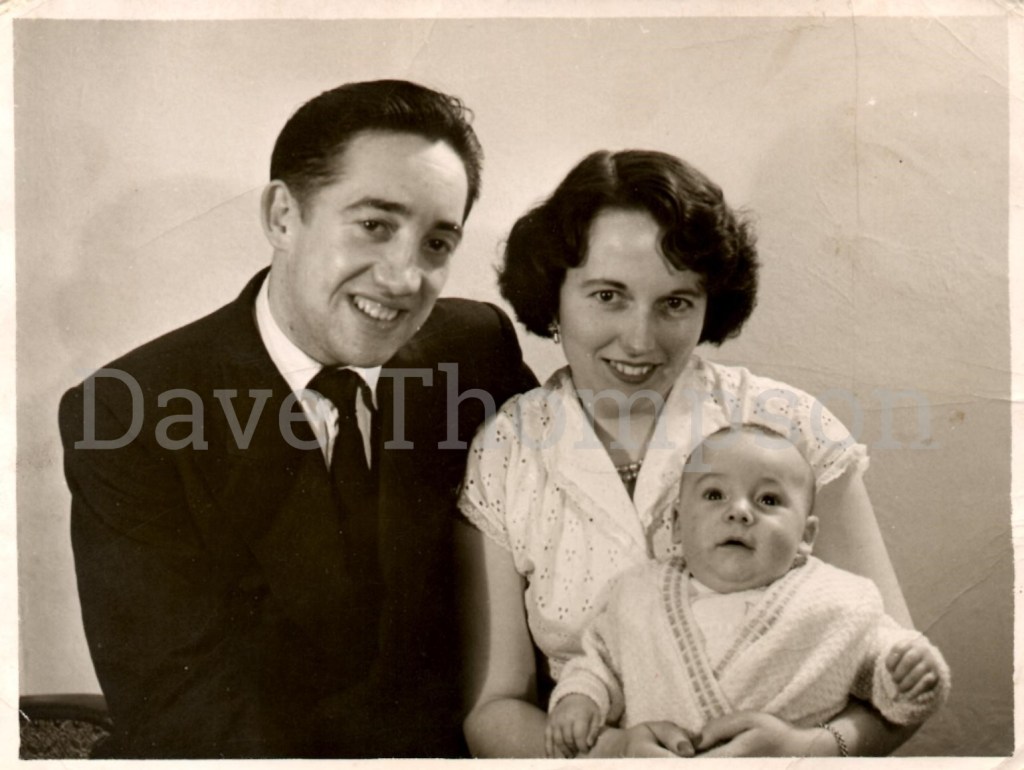
Jean Sylvia Toynbee, my first cousin three times removed, was born on 8 January 1933 in Sleaford, Lincolnshire. The only known child of John & Sylvia. She grew up in Sleaford, Lincolnshire. In October 1951, she married Ralph Milner McCartney in her hometown of Sleaford. Jean lived most of her life in Lincolnshire and passed away on 27 May 2022 in Lincoln, at the age of 89.
If you are a descendant of the Toynbee family of North Kyme or Sleaford, or believe you may be related to John Aaron Toynbee, please consider getting in touch it is my sincere wish to return his First World War medal to his direct family line. As I do not have anyone in my own Toynbee line to leave it to, it is deeply important to me that this medal remains preserved within the Toynbee family.
As always, if you can share any old photos or stories about the Toynbee Family with me or have any connections, I would love to hear from you. Please comment here or email jackocats2@gmail.com
 familyhistorystories.blog
Fantastic find Linda especially so close to Remembrance Sunday as you say 👍
LikeLike