Identifying a Family from a 116-Year-Old Postcard.
Solving the Round House Postcard Mystery.
Sometimes the smallest historical clues can hide the biggest stories.
When an eBay alert notified me about an old postcard of Anwick, my interest was immediately caught. Postcards of Anwick are quite rare, so whenever one appears, it immediately grabs my attention. As soon as I saw the listing, I didn’t hesitate, and I bought it straight away.
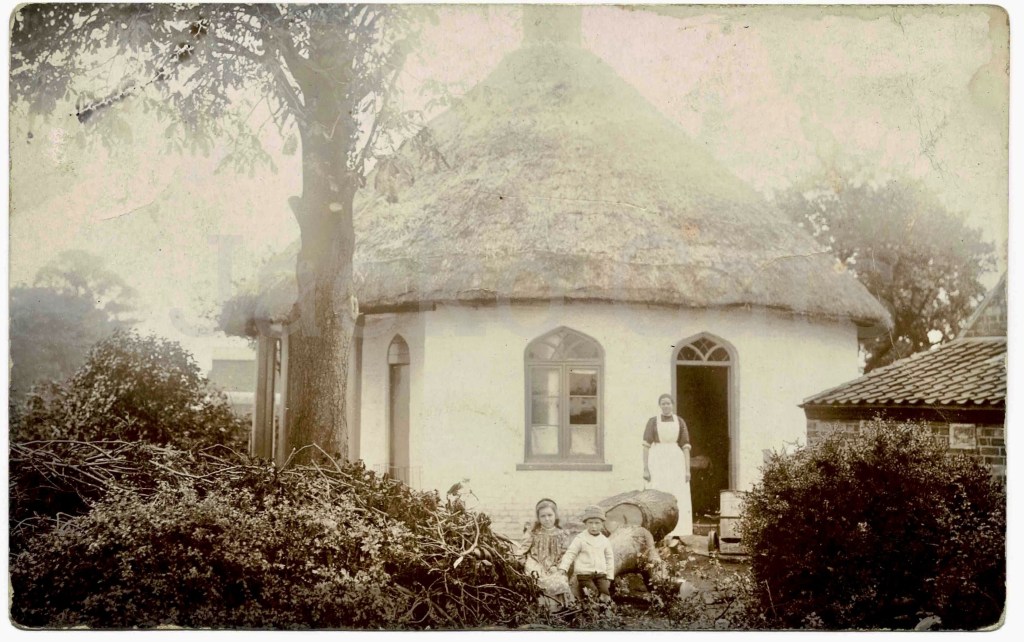
The postcard shows the unusual Round House in Anwick, a building that is instantly recognisable because of its distinctive circular shape. But what really intrigued me was that the card had been sent to a Mrs B Bembridge in Boston, yet there was no message written on it.
Although the cottage itself is a familiar landmark in Anwick, it was the woman and two children standing outside the house that drew my attention. I began to wonder whether this might have been more than just a scenic village photograph. Could this actually be a family picture taken outside their home?
That thought immediately raised two questions:
Who were they?
How were they connected to Mrs B Bembridge in Sibsey, Boston, who received the postcard?
Like many historical mysteries, the answers would lie somewhere in the records waiting to be uncovered.
Dating The Postcard.
My first task was to try to date the postcard, as this would help narrow down who might have been living at the Round House at the time. If I could estimate when the photograph was taken, it would make it much easier to search census records and identify families with children of the right ages.
The reverse of the card provided the first clues. It is a divided-back postcard, with separate sections for correspondence and the address. This style became common in Britain after 1902, when postcard regulations changed to allow messages to be written on the same side as the address.
Another useful detail was the printed multilingual heading:
“POST CARD – CARTE POSTALE – POSTKARTE.”
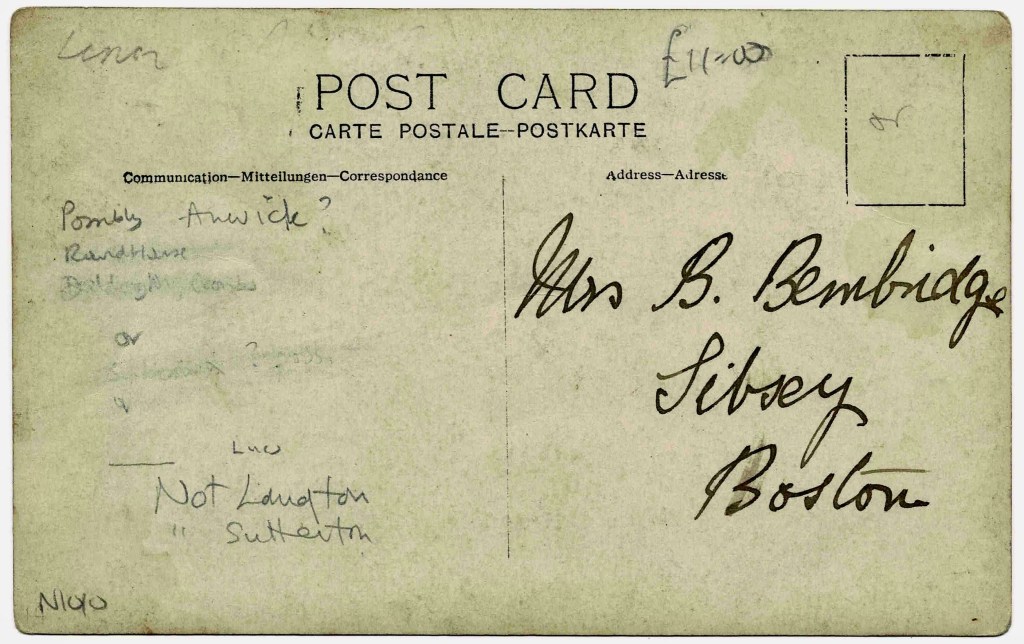
This format was widely used on commercially produced postcards in the early twentieth century, particularly between about 1905 and the early 1920s.
The absence of a postmark makes precise dating difficult, but the clothing worn by the people in the photograph also provides useful clues. The woman standing in the doorway appears to be wearing a long skirt with a working apron, typical of women managing rural cottages in the Edwardian period. The two children sitting in front of the house wear simple practical clothing, including a cap on the younger child, which was very common for boys in the early 1900s.
Taken together, these details suggest that the photograph was likely taken sometime between 1900 and about 1915.
Clues Within The Photograph.
Looking more closely at the image itself also raises some interesting observations.
The house is clearly the Round House at Anwick, easily recognisable from its distinctive circular shape and thatched roof. The tree growing close to the building, and the piles of cut branches and logs, suggest this may have been a working household where firewood was regularly collected and stored.
The woman stands confidently in the doorway, almost as if posing for the photograph, which may indicate she was the occupant or householder. The two children seated in front of the cottage appear to be perhaps four to seven years old, suggesting they could well have been her children.
If that assumption were correct, identifying a family living at the Round House with two children of those approximate ages might help solve the mystery.
Searching The Census Records.
With an estimated date in mind, the next logical step was to turn to the 1901 and 1911 census returns. However, this quickly proved more complicated than expected.
In both census years, the addresses within the village were recorded very loosely. Instead of listing specific properties such as the Round House, most entries simply state “Anwick” as the place of residence. This makes it extremely difficult to identify exactly which household lived in which cottage.
Without a clear property name recorded in the census, it becomes almost impossible to say with certainty which of the listed families occupied the Round House.
This meant the search would need to go beyond the census records alone. Other sources, such as electoral registers, parish records, local directories, and possibly old photographs or maps, would need to be examined to piece together who might have been living in this distinctive cottage at the time. Somewhere within those records, I suspected, the identities of the woman and the two children in the photograph were waiting to be uncovered.
A Breakthrough in the Newspapers.
With the 1901 and 1911 census returns proving frustrating, I turned to another source that often proves invaluable for local history research, newspaper archives.
Local newspapers frequently contain small details that never appear in official records. Reports about rural life, tradesmen, property repairs, or even passing references in feature articles can sometimes reveal exactly the information that census returns fail to provide.
After some searching, I came across an article that immediately caught my attention.
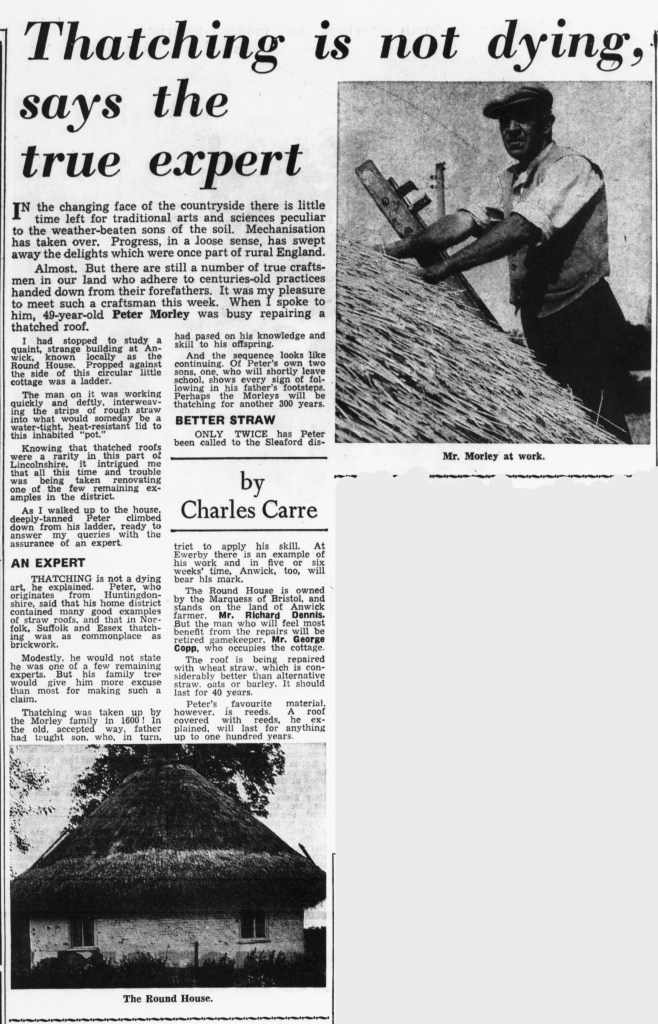
The piece discussed the traditional craft of thatching, describing the work of a local craftsman repairing a roof in Anwick. Within the article was a short but important passage mentioning:
“a quaint, strange building at Anwick, known locally as the Round House.”
Even better, the article included a photograph of the building itself, clearly showing the same distinctive circular cottage with its thatched roof.
At last, this confirmed that the unusual house shown on the postcard was indeed the Round House at Anwick.
The article also provided a small glimpse into the building’s history. It noted that the cottage stood on land belonging to the Marquess of Bristol and was occupied at the time by a gamekeeper named George Copp.
While this did not yet identify the people in the postcard photograph, it was the first solid documentary reference to the house I had been able to find.
Another Clue: A Different Name.
A second newspaper article produced another intriguing piece of the puzzle.
This time it was a report of a wedding in Sleaford, by the Lincolnshire Chronicle, 23 July 1949, describing the marriage of Miss Jean Constance Harkess to Flight Lieutenant H. Thomas Albutt of the RAF.
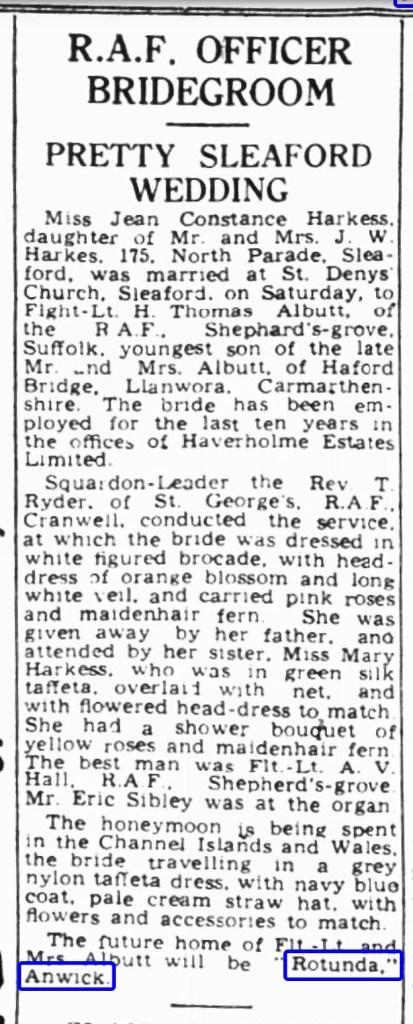
Near the end of the report was a line that immediately stood out:
“The future home of Flt.-Lt. and Mrs Albutt will be ‘Rotunda,’ Anwick.” Mrs Albutt was employed by the Haverholme estate.
The name Rotunda seemed far too appropriate to be a coincidence. Given the cottage’s circular shape, it seemed very likely that “Rotunda” was another name for the Round House.
This small detail added another layer to the story. The cottage had clearly been known locally by more than one name the Round House and Rotunda which might explain why it proved so difficult to identify in official records.
But while these newspaper references helped confirm the building’s identity and a tenant in 1962, the original mystery still remained.
A Possible Connection – George Copp.
At first, I wondered whether the people in the photograph might be connected with George Copp, the gamekeeper who later lived at the Round House.
Newspaper reports from the 1960s mention him living at the Rotunda in Anwick, and probate records confirm that he was still living there when he died in 1967. George had been born in Somerset in 1880 and had served in the army before later becoming a gamekeeper.
By the early twentieth century, he and his wife, Olive, were living in the Anwick area and working on the Haverholme Estate.
The Haverholme Estate was one of the major landed estates in this part of Lincolnshire. Centred on the former Haverholme Priory, just outside Sleaford, the estate controlled large areas of farmland and woodland across the surrounding villages, including Anwick. Many local cottages, farms, and workers’ houses were owned by the estate and occupied by employees such as farm labourers, gamekeepers, and estate workers.
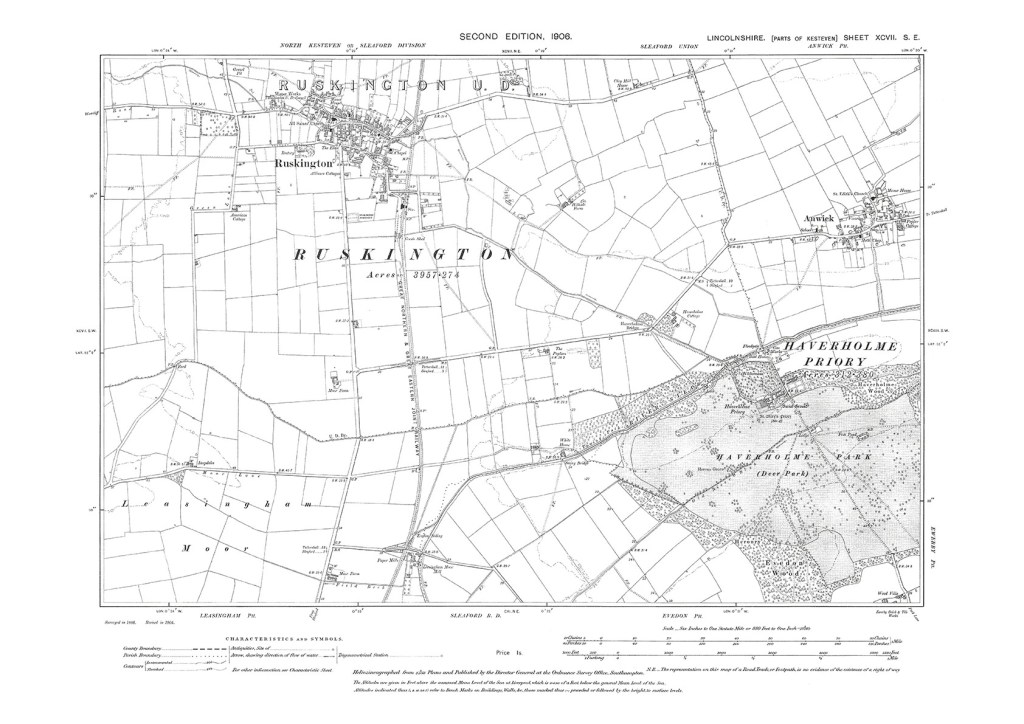
Gamekeepers like George Copp played an important role on these estates. Their responsibilities included managing woodland, protecting game for shooting, and overseeing parts of the estate’s rural land. It was therefore quite common for them to live in cottages provided by the estate, sometimes in relatively isolated locations.
This seemed promising at first. If George Copp had been connected with the Round House for many years, perhaps the woman and two children in the postcard were members of his family.
However, further research revealed a problem.
George and Olive did not have any children, which meant the two youngsters in the postcard could not belong to them.
So the mystery remained.
If George Copp was not the father of the children in the photograph, then the search would have to continue. Someone else must have been living in the Round House at the time the postcard was taken.
The Clue on the Postcard.
With the earlier leads proving inconclusive, I turned back to the postcard itself to see if I had overlooked anything.
Written on the address side was the name of the recipient: Mrs B Bembridge, who was living in Sibsey near Boston.
That small detail turned out to be the key.
I searched the census records for families named Bembridge living in Anwick, but this produced no convincing results. The census returns, as mentioned earlier, only listed the place of residence as Anwick, making it very difficult to identify specific cottages.
In the 1911 census, which only records that they were living in Anwick, but locates a Bembridge family living at Haverholme, Anwick. The head of the household was Alfred Bembridge, who was working as an agricultural labourer. Living with him were his wife Alice and their two young children. Alfred Bembridge was born in 1873 in Ancaster, Lincolnshire.
Even more exciting were the ages of the children, which seemed to match remarkably well with those in the postcard photograph: nine-year-old Annie Elizabeth and four-year-old John George.
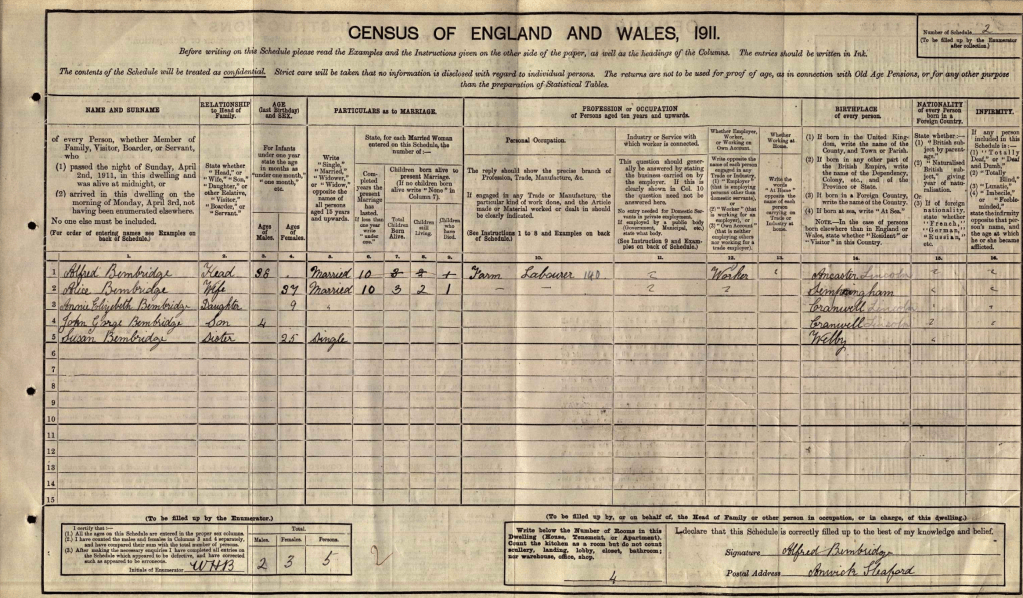
Also recorded in the household is Susan Bembridge, who would later marry into the Toulson family, another well-known family in the Anwick and Billinghay area. Connections like this help place the Bembridge family firmly within the local community at the time.
Was this Bembridge family linked to Mrs Bembridge in Sibsey, Boston?
When was the Photograph taken?
Before searching for the Bembridges of Boston, I needed to confirm this was the Bembridge family living in the Round House.
Although the 1911 census revealed the Bembridge family living at Anwick, it does not prove that they were living in the Round House itself. Census returns at that time simply recorded the place as Anwick or Haverholme, without naming individual cottages, which makes it difficult to identify the exact property.
Another important detail also emerges from the records. The 1911 census lists George Copp as a gamekeeper living in Anwick. Later newspaper reports confirm that he lived at the Round House, known locally as “Rotunda,” until 1967, when he died.
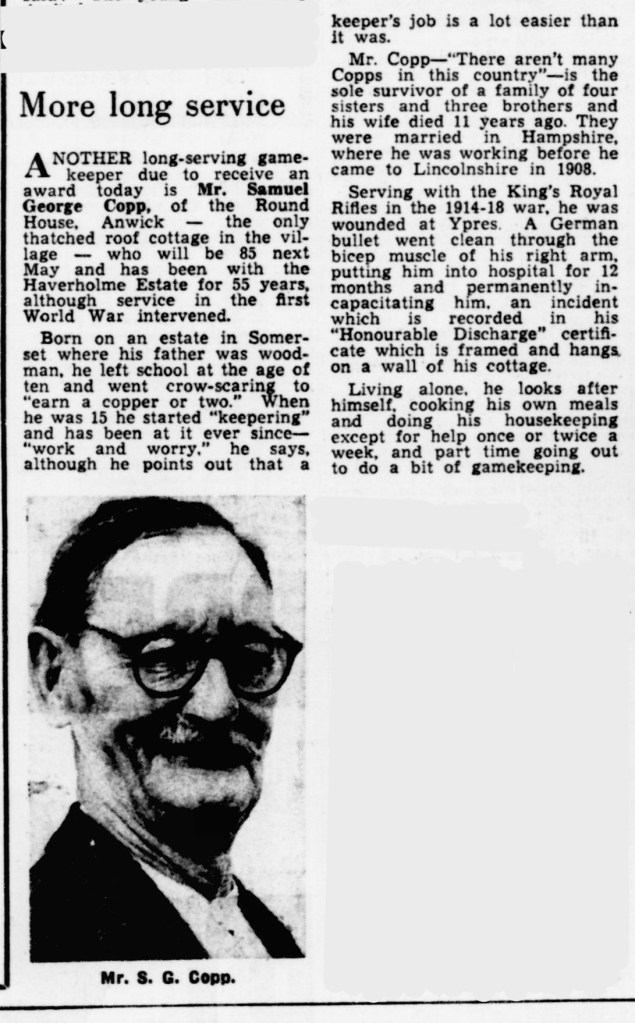
This wonderful newspaper article from the Standard, 27 July 1963, states that George Copp had been working on the Haverholme Estate for 55 years, placing his arrival on the estate around 1908.
Putting this into context, the ages of Annie Elizabeth (born 1902) and John George (born 1907), both born in Cranwell, match very closely with the children seen in the postcard photograph. The girl appears to be around eight or nine years old, while the younger boy looks to be about four or five.
This would place the photograph somewhere around 1909–1911, which fits neatly with the 1911 census entry for Alfred Bembridge and his young family at Haverholme.Although the census does not name the Round House specifically, the timing strongly suggests that the Bembridge family may have been living there before George Copp later became its long-term occupant.
Now I can move on to identifying the link between Boston and Anwick
Tracing the Bembridge Family.
I began by searching the address side of the postcard using the records on Findmypast. Focusing on the details written on the card, I searched for anyone with the surname Bembridge living in Sibsey.
Almost immediately I found a Benjamin Bembridge living there. Could this be the link I had been looking for?
To explore this further, I began searching the census returns, starting with 1881. My reasoning for beginning there was simple: Benjamin had been born in 1870, and Alfred in 1873 which meant he should appear in the earlier census records as a child.
Then came the Eureka moment!!
In the 1881 census I found Benjamin Bembridge, aged eleven, living with his family. Also in the household was his younger brother Alfred Bembridge, confirming the relationship between the two men.
The census also revealed another useful detail: Alfred had been born in Ancaster, helping confirm that this was indeed the correct family.
Their parents were listed as John and Jane Bembridge, and this immediately caught my attention. Alfred later named his own son John George, suggesting a clear family naming pattern, something often seen in Victorian and Edwardian families where children were frequently named after parents or close relatives.
This discovery firmly established the family link between Benjamin in Sibsey and Alfred at Haverholme, bringing the investigation one step closer to identifying the people in the postcard photograph.

I am now very confident to say the lady and two children out side the Round house is in fact Alice Bembridge nee Collins and their two children Annie Elizabeth and John George.
From Ancaster to Haverholme, Anwick.
Having confirmed the relationship between Benjamin and Alfred Bembridge, the next step was to trace Alfred’s movements through the census and other records.
The 1881 census showed the Bembridge family living in Ancaster, where Alfred had been born. Like many families in rural Lincolnshire during this period, their lives were closely tied to agricultural work, and movement between nearby villages was quite common as labourers followed employment opportunities.
By the early twentieth century Alfred had moved a short distance to Cranwell, where both of his children were born: Annie Elizabeth in 1902 and John George in 1907.
At some point after this the family moved again, appearing in the 1911 census at Haverholme, where Alfred was working as an agricultural labourer on the Haverholme Estate.
This movement now makes sense when viewed against the wider landscape of the area. Ancaster, Cranwell, Haverholme, and Anwick all lie within a relatively small area of rural Lincolnshire, and it was quite normal for estate workers to move between neighbouring villages depending on where work and housing were available.
By 1909 to 1911, Alfred and his young family were living on or near the Haverholme Estate, placing them within easy reach of Anwick and the Round House.
When the ages of the children recorded in the census are compared with those in the postcard photograph, the match is remarkably close.
This strengthens the possibility that the photograph captures Alfred Bembridge’s family outside the Round House, with the image being sent to his brother Benjamin in Sibsey as a family keepsake.
A Moment captured outside the Round House.
What began as a simple postcard purchase soon turned into a fascinating journey through local records, census returns, and newspaper archives.
The unusual Round House at Anwick first caught my attention, but it was the woman and two children sitting outside the cottage that raised the real question: Who were they?
Identifying the Family.
By carefully piecing together the clues, the name written on the postcard, the Bembridge family connection between Sibsey and Haverholme, the ages of Annie Elizabeth and John George, and the wider history of the Haverholme Estate, a likely story begins to emerge.
After bringing together the various strands of evidence, I am now very confident in identifying the people shown in the postcard photograph.
The woman standing outside the Round House is almost certainly Alice Bembridge (née Collins), the wife of Alfred Bembridge, accompanied by their two children Annie Elizabeth and John George Bembridge.
Later, the cottage would become associated with George Copp, the gamekeeper who spent many years working on the Haverholme Estate and eventually lived at the house known locally as “Rotunda.”
While absolute proof may remain elusive, the evidence strongly suggests that this postcard preserves a small moment of family life from more than a century ago, a mother and her children sitting outside their home on a quiet Lincolnshire afternoon.
What makes discoveries like this so rewarding is the way a single postcard can reconnect us with real people, real places, and forgotten stories hidden within the local landscape.
Sometimes the smallest historical clues really do uncover the biggest stories.

Alice Bembridge (née Collins) with her children Annie Elizabeth and John George Bembridge.
Conclusion. Solving the Round House Mystery.
What began as a simple eBay purchase soon unfolded into a fascinating piece of local history.
A mystery postcard has therefore revealed a small but intimate moment of everyday life in rural Lincolnshire more than a century ago, a mother and her children outside a distinctive cottage that still stands in the village today.
Sometimes the smallest historical clues really do uncover the biggest stories.

The Round House through Time.
The photographs below show the Round House at Anwick across more than a century.
Sadly, the most recent photograph shows a very different picture.
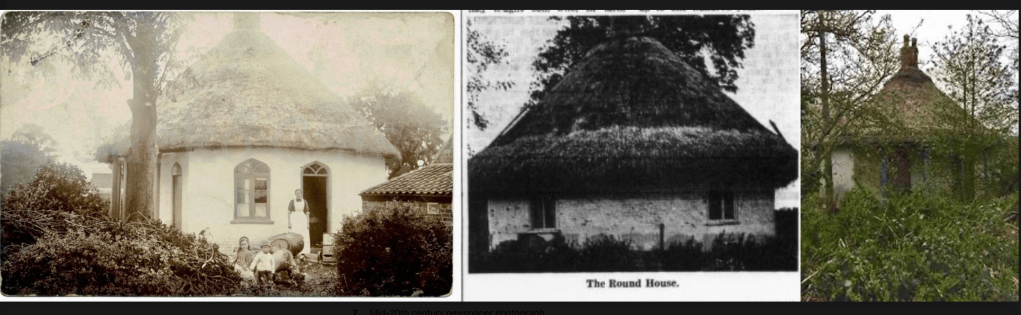
The Round House at Anwick through time: early postcard (c.1909–1911) showing Alice Bembridge and her children; a mid-20th century newspaper photograph; and the building today, a listed structure sadly allowed to fall into neglect.
Although the Round House is now a Grade 2 listed building, meaning it is considered historically and architecturally important, the cottage has been allowed to fall into a serious state of neglect. Once a well-kept rural home and a distinctive landmark in the village, it now stands largely hidden by vegetation and deterioration.
Buildings like the Round House form part of the historical identity of villages such as Anwick. They connect us directly with the lives of the people who once lived and worked there families like the Bembridges and later George Copp, whose stories are part of the fabric of the local community.
It is a reminder that our historic buildings are not just structures, but carriers of memory and heritage. They deserve to be recognised, cared for, and preserved so that future generations can continue to understand the history of places like Anwick.
Today, a listed building is allowed to disappear, a significant building in the history of Anwick. We should be proud of our heritage and preserve it for future generations.
“More than a century later, the Round House still stands, and thanks to a simple postcard, so too does the memory of the family who once called it home.”
If you are related to the Bembridge family and would like a copy of the postcard let me know, happy to share.

As always, if you can share any old photos or stories about the Bembridge family or Anwick / Haverholme, if you have any connections with the Bembridge family, I would love to hear from you. Please comment here or email jackocats2@gmail.com
 familyhistorystories.blog