The story of a chance meeting and an amazing connection.
History has a quiet way of keeping its secrets until, without warning, it decides to reveal them.
Introduction.
My interest in family history has always been closely tied to my work on the history of Billinghay, where my family has deep roots. Over time, I have built a local history page to record and share those connections.
What I did not expect was that this interest would lead to a chance meeting and the discovery of a remarkable link between my family and another one that brought my research into Billinghay to life in a completely unexpected way.
Where It All Began.
In 2010, I began what I believed would be a straightforward journey into the past, enrolling on a genealogy course with the Institute of Genealogical and Heraldic Studies (IHGS).
Institute of Genealogical and Heraldic Studies
Over the next five years, culminating in 2015, I immersed myself in research: tracing names through faded records, navigating centuries-old documents, and learning how to reconstruct lives from the smallest of clues.
It was meticulous, often demanding work. But nothing in that training prepared me for what was to come. The moment itself seemed entirely ordinary.
I enrolled onto a weekend residential course with the IHGS, during a break in one of the sessions, I struck up a conversation with another student. We struck up a casually conversation.
“Who are you researching?” I asked.
“My family,” she replied, “from a small village in Lincolnshire. I don’t think you’ll know it.”
“Try me,” I said. “I have family from Lincolnshire.”
She paused, then said it.
“Billinghay.”
I laughed instinctively, almost in disbelief.
“You’re joking… my goodness that’s exactly where my paternal family are from.”
For a second, we simply looked at one another both surprised at this revelation, because places can overlap. Counties can coincide. But a small village? The same one?
That was more than just a coincidence.
And as we began to compare notes, what we uncovered would prove even harder to explain.
So we began to talk, wondering if there might be any family connection. We exchanged names, dates, and bits of family history, trying to see if anything matched.
Then Ann mentioned something that immediately caught my attention, her grandfather had been the local GP in the village Dr Smallhorn.
In a place like Billinghay, the village doctor would have known most families. He would have been involved in all aspects of village life, often caring for several generations.
It made me stop and think.
My paternal family lived in and around the village so undoubtedly he would have known my family members
For some time, we chatted about the village, her grandfather, and what a coincidence it was that we had met and thought it was amusing that both of us with connections to the same place.
At that point, it simply felt like one of those small world moments, we had no idea there was more to come.
After a while, our conversation moved on to other topics. Ann mentioned that she was a violinist with the Bournemouth Orchestra and that she came from a very musical family.
She also told me that her grandmother, Mrs Smallhorn, had been a music teacher and had run the church choir in Billinghay. At that stage, it still felt like an interesting coincidence.
At this point, we agreed to look more closely into whether our families were connected. We exchanged email addresses, keen to follow things up, and left the conversation there for the time being.
But it was far from the end of the story.
A Shared Past Remembered.
Several weeks later, I went to visit my dad’s cousin, Tim. He was in his 90s, and the two of them had grown up together in the village. Tim had lived there all his life and knew both the family history and the village inside out.
I told him about my meeting with Ann, about her grandfather being Dr Smallhorn, and how her grandmother had run the church choir.
Before I could go any further, Tim immediately responded.
“Oh yes,” he said. “Your dad and I used to go to the Smallhorns’ house for choir practice because we were both part of the school choir.”
It completely stopped me.
What had seemed like a possible connection was suddenly something real something remembered, part of everyday life.
The families hadn’t just crossed paths in history. They had known each other well. In that moment, everything seemed to fall into place. What had started as a chance conversation had become something much more meaningful a genuine link between our families, confirmed not just through records, but through lived memory.
I needed to look more closely at the man at the centre of it all, Dr Smallhorn.
Dr Smallhorn: At the Heart of Village Life.
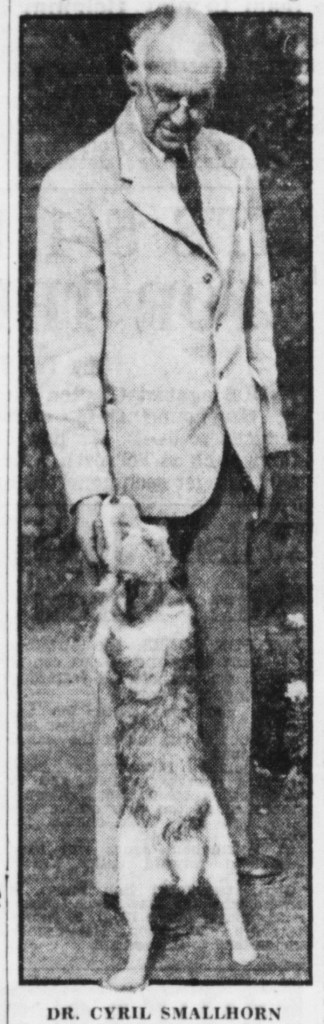
Dr Cyril Aubrey Smallhorn (1878–1948), often recorded simply as Cyril Smallhorn, was born in Witney, Oxfordshire. He was the son of Thomas Smallhorn and Sarah Jane Smallhorn (née Gibbons), and in 1908 he married Isabella Maude Forster. They went on to have four children.
He was a well-educated man, holding the qualifications MA MB, indicating both a university education and formal medical training.
Like many doctors of his generation, he served in the Royal Army Medical Corps during the First World War, including service in France. In 1915, he was mentioned in despatches, a formal recognition of distinguished service.
Following his military service, Dr Smallhorn returned to civilian life and established himself as a medical practitioner in Billinghay, likely from around 1916 onwards. His practice was situated on Skirth Road, where he purchased Thorpe House, not far from my grandmother’s family home.
Thorpe House now known as Blair house is a grade II listed building.
In a village setting, the role of a doctor extended far beyond medical treatment. He would have been involved in all aspects of community life supporting families through illness, attending births, and providing care during difficult times, including periods of public health concern.
Dr Smallhorn lived and worked in Billinghay for many years until he died in 1948. Although his son Thomas followed in his father’s footsteps into medicine, he did not continue the practice in Billinghay, instead establishing himself in Ruskington.
Dr Cyril Smallhorn remained a well-remembered figure in the village, known not only for his professional work but also for his contribution to the wider community. His family, too, became part of village life, with his wife playing an active role in music and the church, where my father and his cousin were also involved. He is still remembered by the older villagers, which is a testament to his impact on his patients and their families.
A Chance Meeting. A Lasting Friendship.
In many ways, this isn’t really a story about Dr Smallhorn. It’s about connection: how a chance meeting with another student, living some 250 miles away from Billinghay, uncovered a shared history that had quietly linked our families for generations.
What began as a simple conversation turned into something much more. Through our shared interest in family history, Ann and I not only uncovered an unexpected link between our families but also formed a genuine friendship.
We stayed in touch over the years, sharing discoveries and comparing notes, each finding adding another piece to the story we had begun together. That brief exchange on a genealogy course led to something neither of us could have anticipated.
Ann has sadly since passed away, but the connection we discovered and the friendship that grew from it remain a lasting and important part of my journey into family history.

As always, if you can share any old photos or stories about Anwick or Billinghay, I would love to hear from you. Please comment here or email jackocats2@gmail.com

