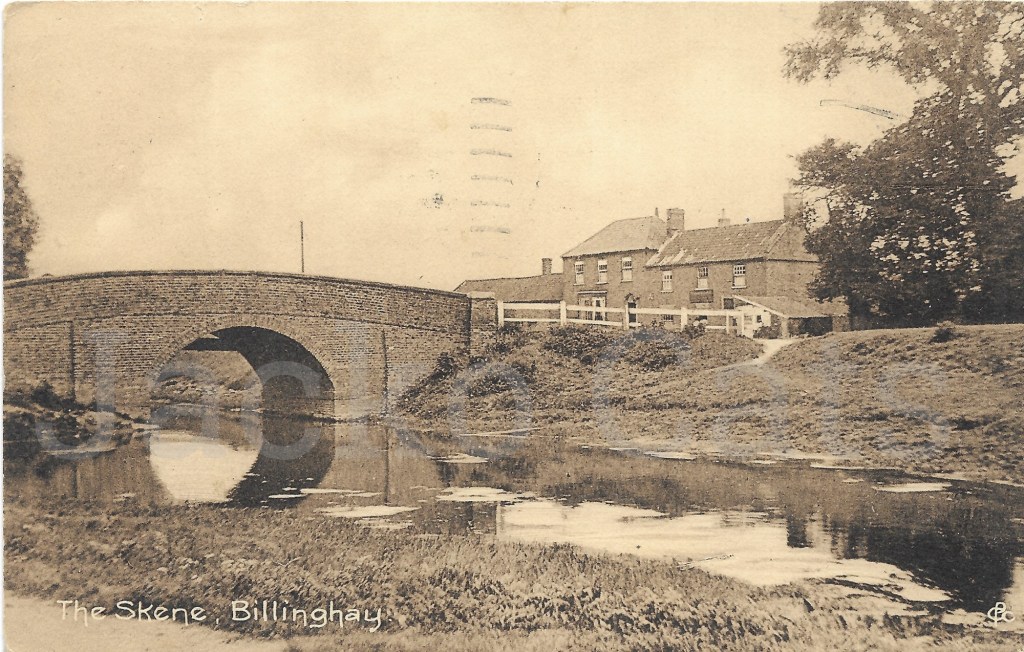
I was particularly pleased to acquire this postcard, not only because it is a lovely view of The Skene, but because it also captures the Coach & Horses Inn in the background. Whilst only a small detail within the scene, it provides a rare glimpse of the inn during its working life and offers a valuable insight into the surroundings that previous landlords would have known during their time.
One of the joys of local history research is that new discoveries often emerge when least expected. What began as the purchase of an attractive postcard has provided another piece of the story, helping to connect a familiar village landmark with the life of one of its former publicans and adding further colour to Billinghay’s rich history.
William Watson & the Coach & Horses.
Those of you who have followed my local history page for a while will know that I previously wrote a series of blogs exploring the inns of Billinghay and the fascinating characters associated with them. Several of the landlords were my own family ancestors.
This latest acquisition, a postcard dated 1939, has inspired me to revisit one of those stories. In the background of the postcard, beyond The Skene, you can see the Coach & Horses Inn. That discovery has led me on to the next chapter of the inn’s history and the life of one of its former landlords, my 2× great-grandfather, William Watson.
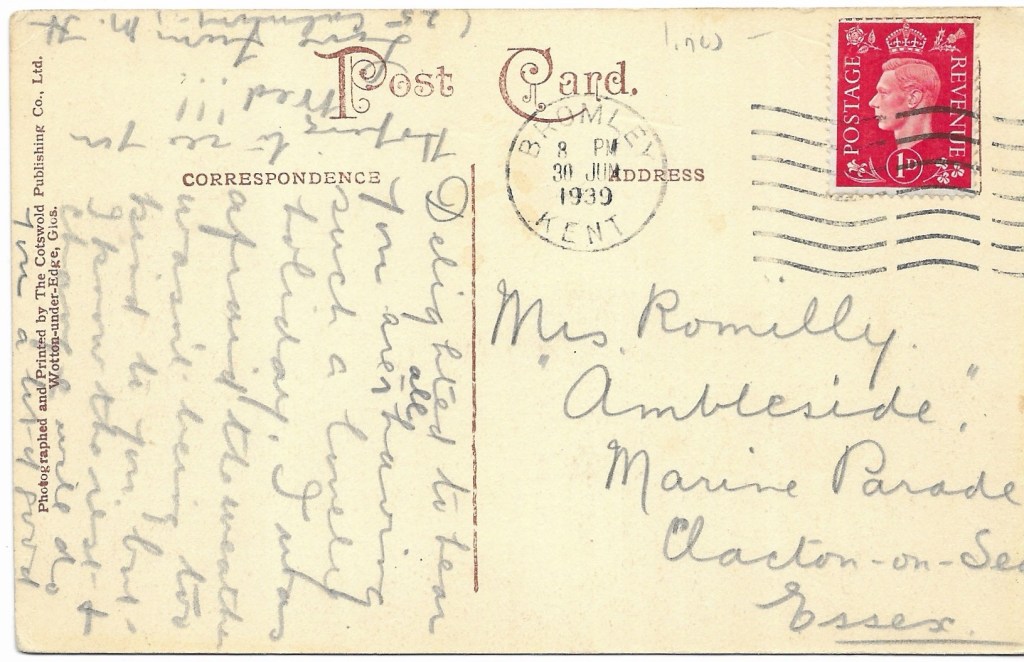
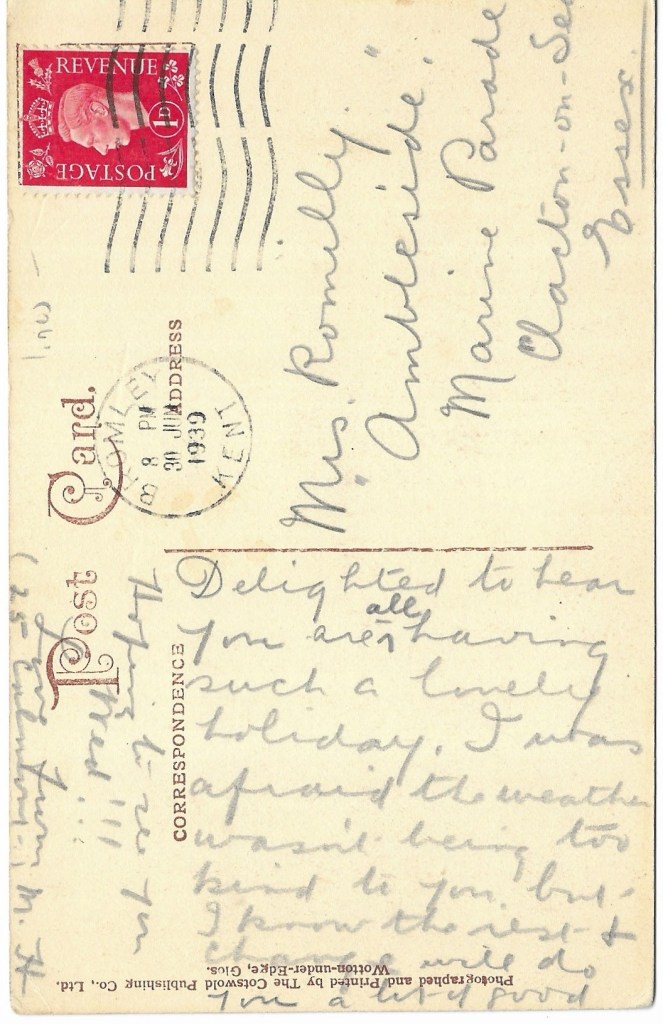
The message reads as follows:
‘Delighted to hear you are all having such a lovely holiday. I was afraid the weather wasn’t being too kind to you but I see by your letters a lovely time is being enjoyed. The weather has improved here now and I am glad to hear that Mary is not getting tired.
Love to all.’
The postcard also raised an interesting question. It was addressed to Mrs Romilly at “Ambleside”, Marine Parade, Clacton-on-Sea. Curious to discover more, I searched for Mrs Romilly in the records available on Findmypast, but found no evidence of her living at that address.
This led me to consider another possibility. During the 1930s, Marine Parade was lined with hotels, boarding houses and guest accommodation catering for the many holidaymakers visiting the Essex coast.
Working on the assumption that Ambleside was the name of a hotel rather than a private residence, I turned to Google and soon found confirmation. Not only was Ambleside a well-known seafront hotel, but this photograph survives showing the building in all its glory. The hotel remained a feature of Marine Parade until its demolition in 1972.
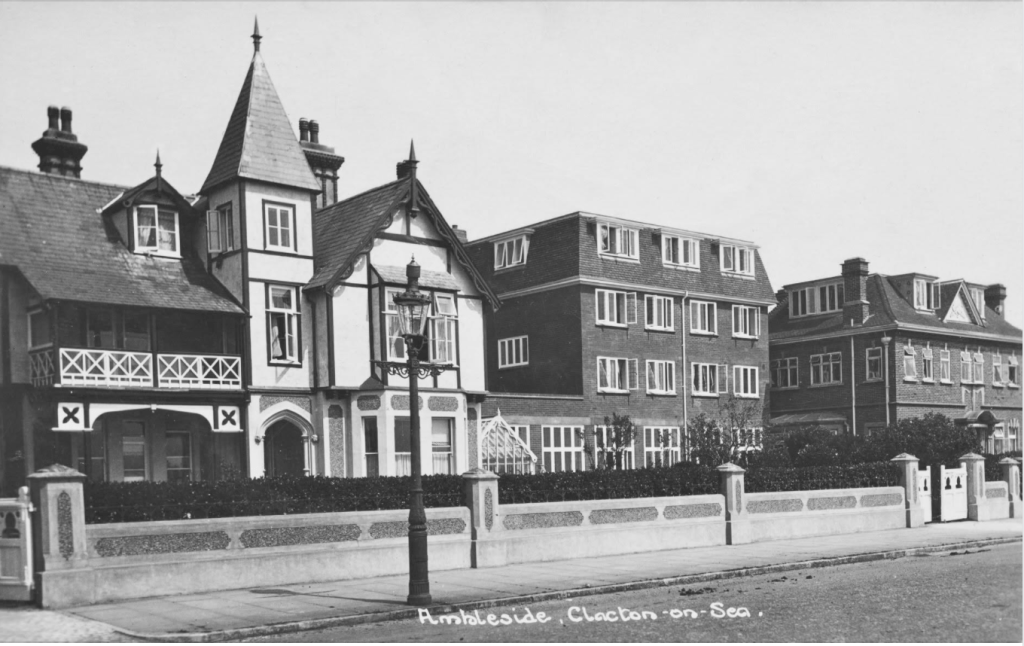
Taken together, the evidence strongly suggests that Mrs Romilly was enjoying a seaside holiday when the postcard arrived in July 1939. The message itself, which speaks of a “lovely holiday” and comments on the weather, perfectly supports this conclusion. It is a small but fascinating glimpse into an ordinary family holiday during the final summer of peace, just weeks before the outbreak of the Second World War.
William Watson, the landlord.
In the 1881 census, William was the Innkeeper of the Coach and Horses Public House in Billinghay village, as well as being the village butcher.
So who was William Watson? Well, he is my paternal great-grandfather x2, the second of my ancestors who were the innkeepers of the Coach & Horses.
William Watson was born on 23 Jun 1828 and baptised on 20 July 1828 in Leadenham, Lincolnshire, the 4th child of eight to John Watson and Ann Doughty. John Watson, at the time of his son’s baptism, was a blacksmith in Leadenham.
William married Jane Watts on 04 Aug 1851 in Rossington, Doncaster. At the time of his marriage, he was a plate layer. Jane was from Bawtry, Doncaster.
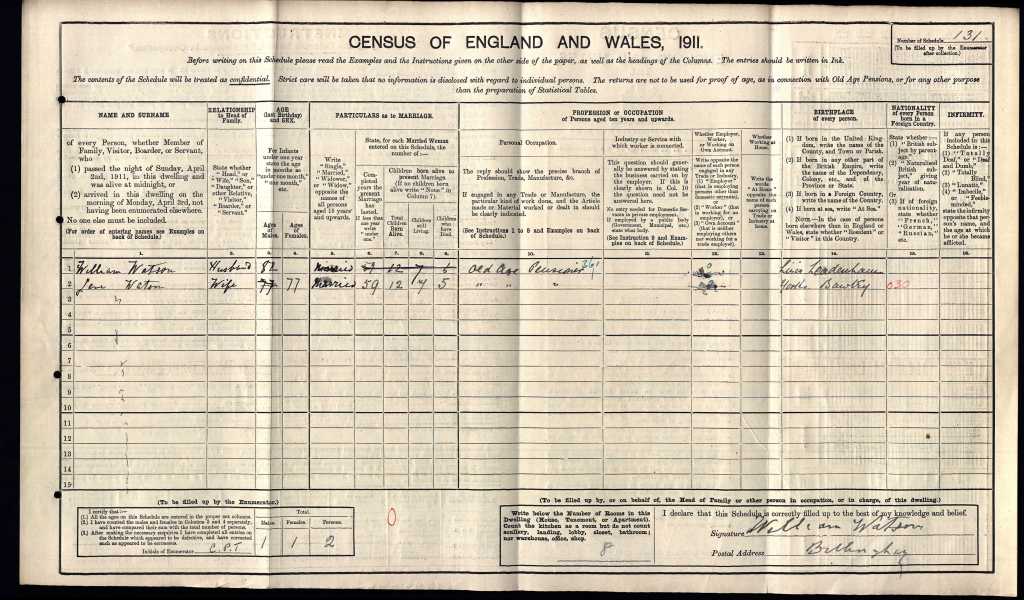
Recorded in the 1861 census, William was working as a railway guard in Boston, Lincolnshire. By this time, he and Jane had 12 children, tragically, five of whom did not survive.
The family were living on Boston’s aptly named Liquorpond Street and employed as a railway guard during the great age of railway expansion.
By 1871, William and Jane, together with their seven surviving children, had returned to Leadenham. William had left the railways behind and established himself as a Master Coal Merchant, a respected occupation in a village that relied heavily on coal for domestic and agricultural use.
A decade later, William embarked on yet another chapter in his working life. In the 1881 census, he was now the innkeeper of the Coach & Horses at North Kyme, near Billinghay. As landlord, he would have been at the centre of village life, serving travellers, local labourers and farmers alike. William remained at the Coach & Horses for almost ten years, but by the time of the 1891 census, his circumstances had changed considerably.
Following bankruptcy, he had left the inn and moved on from the licensed trade. The Coach & Horses passed into new hands, bringing William’s chapter in the history of the inn to a close.
Like many Victorians, William experienced both success and hardship during his lifetime. His journey from railway guard to coal merchant, publican and later butcher paints the picture of a man who continually adapted to changing circumstances and sought new opportunities when faced with adversity.
William and Jane moved back into Billinghay village along with their two daughters, Fanny and Annie, and their granddaughter, Jane Watts Holmes (my paternal grandmother). Whilst he had left behind his role as an innkeeper, William remained deeply rooted in the community; he was now running his own butcher’s shop in the village.
By the 1911 census, William and Jane were still living in Billinghay, his income being from his “Old Age Insurance”. The census confirms William and Jane had 12 children, of whom only 7 survived, including my great-grandmother Harriett Watson. Henry died in July 1911.
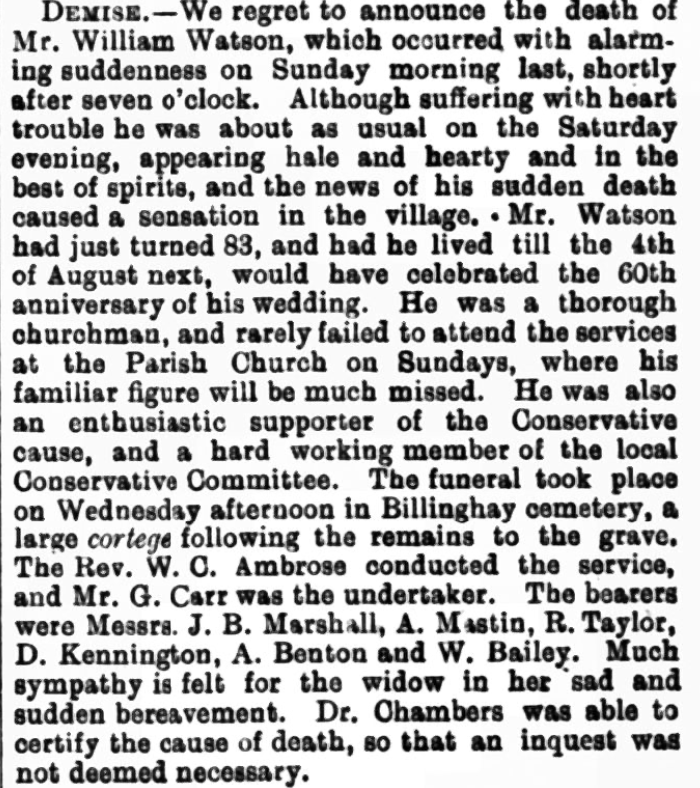
Recorded in the Sleaford Gazette dated 8 July 1911, William died suddenly at home. His obituary gave some insight into the type of person he was! He certainly occupied a prominent place in village life, his familiar presence at the Parish Church, involvement in local affairs, and the large attendance at his funeral reflecting the esteem in which he was held by his neighbours.
Finally.
The postcard provides a rare glimpse of the inn as it would have appeared during the lifetime of William Watson, who became the landlord of the Coach & Horses at North Kyme in the late nineteenth century. William’s life was one of remarkable enterprise, taking him from railway guard in Boston to Master Coal Merchant in Leadenham, before he entered the licensed trade as an innkeeper. This newly acquired postcard offers a tangible connection to both the village and one of its colourful Victorian characters.
As always, if you can share any old photos or stories about Anwick or Billinghay. I would love to hear from you.
Please comment here or email jackocats2@gmail.com
 familyhistorystories.blog
Not sure why the postcard states The Skene? Many locals call it the Sketh but it is known as the Skirth nowadays.
LikeLike
Hi That’s an interesting point. suggesting there may have been several local variations of the name over the years. Whether this was a dialect pronunciation, a local nickname, or simply the publisher’s interpretation, it shows how place names can evolve whilst describing the same familiar stretch of water.
LikeLike
Hi, now that’s an interesting point, and in all honesty I’m not entirely sure either, the locals have traditionally referred to it as the Sketh, yes the postcard calls it the Skene ! So maybe it’s local variation or simply the photographers interpretation at the time.
One observation I have noted is the photographer was from Gloucestershire, so I would lean towards variation of dialects.
LikeLike