Willows & Sons, Atchinson’s Post Office and the Search for the Missing Postcards.
Since I began researching the local history of Anwick and Billinghay, I have been fortunate enough to acquire a growing collection of postcards and photographs, each providing a fascinating glimpse into village life of the past. For me, however, they are much more than simply historical images.
Many of my blogs have begun with one of these old postcards. Sometimes it is the scene itself that starts me digging; at other times it is the name and message written on the back that leads me into the life of the person who sent or received it. What began as an interest in local history has gradually become something of an obsession with the stories these little pieces of card can tell.
Every postcard is a snapshot of a familiar place, a reminder of the people who once walked these streets and, quite literally, a tangible link with previous generations.
Recently, however, I began looking at the postcards themselves rather differently.
I noticed that some were numbered. Others carried the names of local photographers, shopkeepers or publishers. Cards I had previously regarded as individual views of Billinghay suddenly appeared to be pieces of something much bigger.
And one name kept cropping up:
Willows & Sons.
Initially, I simply wanted to discover who Willows & Sons were. Who were this family whose name appeared on postcards of Billinghay more than a century ago? Where did they live? What was their business? And what place did they occupy within village life?
That investigation has taken me somewhere I wasn’t expecting.
What I originally thought was a relatively small series of postcards now appears to have been part of a much larger collection of Billinghay views. As more examples have surfaced, the numbers have begun to form a sequence, but with tantalising gaps.
So this blog has become two stories intertwined.
It is the story of Willows & Sons and their place within Billinghay, but it is also the story of an attempt to reconstruct a lost series of postcards, to discover how many there were, who actually photographed them and how they came to be sold in the village.
So, Who Were Willows & Sons?
In a word, they were grocers and bakers, with their premises eventually situated on the corner of Bridge Street and Queen Street. Like many village stores of the period, however, they sold far more than their basic trade might suggest.
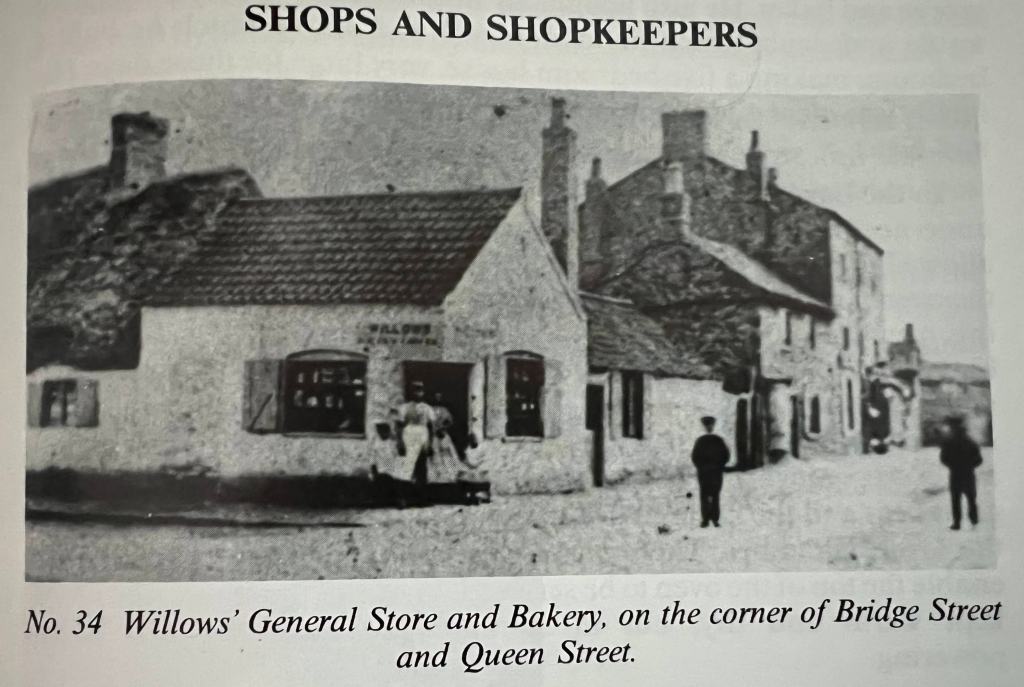
Willows General Store & Bakery.
The Willows family’s story in Billinghay can be traced back to at least 1851, when they appear in the census returns living in the village.
At the head of the household was John Locking Willows, born in Tetney, Lincolnshire, in 1838, the eldest son of Edward and Susannah Willows. Interestingly, John’s occupation was recorded as a baker, perhaps not such a surprising choice when we discover that his father, Edward, had been a miller. Flour and bread, it seems, were already very much part of the family story.
By 1861, John was married to Rebecca, and the couple already had two young sons, John Henry and Edward. The family bakery was situated on Church Street, Billinghay, establishing a business presence in the village that would ultimately continue through subsequent generations.
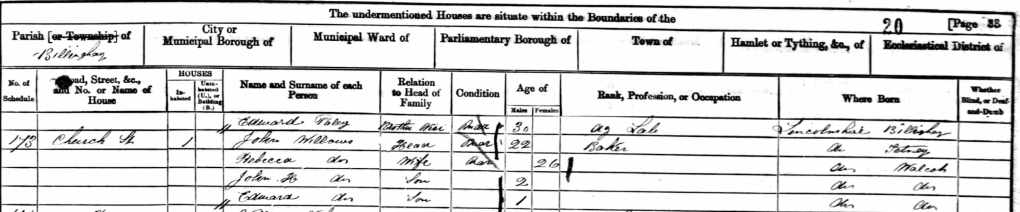
At this point, there was, of course, no mention of postcards or photography. John Willows was simply a village baker, providing one of the everyday necessities of Victorian life.
But over the coming decades, the Willows family business would evolve considerably, and eventually their name would find its way onto some of the most evocative surviving images of old Billinghay.
Each successive census helps us build a picture of a growing and increasingly established village business. By 1871, John was no longer described simply as a baker, but as a grocer and baker, suggesting that the family had begun to broaden the range of goods they offered to the people of Billinghay.
John and Rebecca were living with their daughter Mary and son Edward, who had been born in Walcott in 1859. Sadly, their eldest son, John Henry, who had appeared with them in the 1861 census, had died in 1864.
The Willows family were putting down firm roots in Billinghay, while John’s original bakery was gradually developing into something more substantial, the beginnings of the business that would eventually become known as Willows & Sons.
The 1876 trade directory reinforces John’s status within the village, recording him as a grocer and baker.
The 1881 census provides the first indication that the next generation was becoming involved. John continued to be recorded as a grocer and baker, but now his son Edward was working alongside him, described as a general shopman. The family business was beginning to pass from one generation to the next.
By 1891, that transition appears to have taken place. Edward was now recorded as the grocer and baker, while John had stepped away from the day-to-day running of the business. John and Rebecca, together with their unmarried daughter, were living in Wigford, where John was described as “living on his own means.”
After thirty years in which we can trace him from village baker to established grocer and baker, John appears to have retired, leaving Edward to carry the Willows business forward.
And it was under this next generation that the Willows name was about to become associated with something rather different from bread and groceries: The picture postcard.
John Locking Willows died on 17 September 1921, with his son Edward named as beneficiary of his estate.

An Unexpected Family Connection!
I now started to search for Edward Willows and discover more about his influence on village life. But, as with so many of my blogs, there always seems to be a little twist lurking somewhere in the records.
I turned to the 1911 census, where I found Edward and his family still running the family business. Nothing particularly unexpected there.
But then one name caught my eye…
Living in the Willows household and employed as their domestic servant was Kate Florence Jackson.
Can you believe it? Kate was my great-aunt, my late father’s aunt.
Suddenly, this wasn’t simply a story about a Billinghay family who sold postcards. My own family had become part of the Willows story.
More than a century later, I was collecting postcards bearing the Willows name, completely unaware that my great-aunt Kate had once lived and worked under the very same roof.
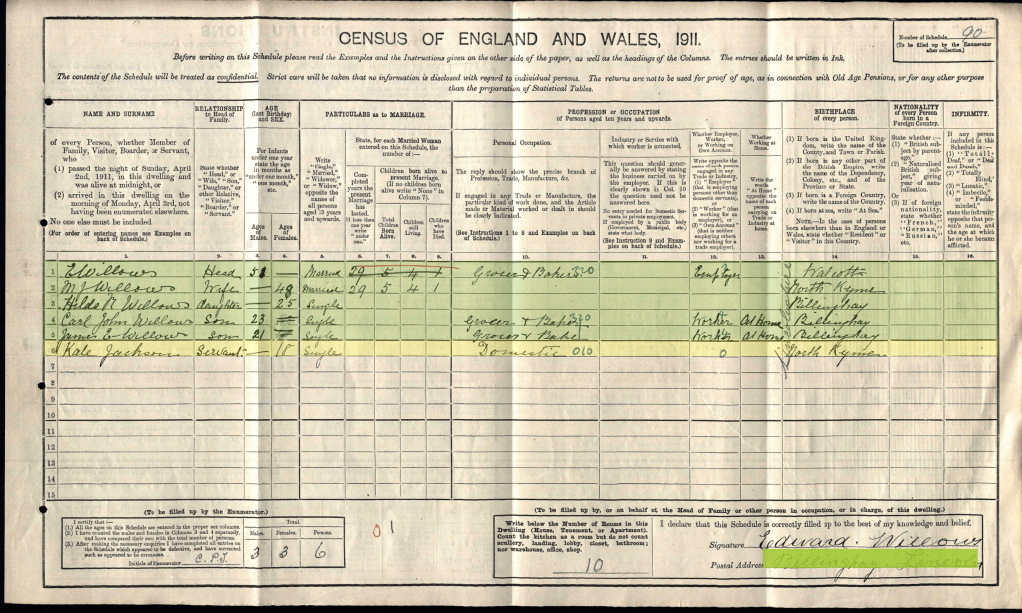
It’s one of those wonderful moments in family and local history when two apparently separate strands unexpectedly come together, and exactly why I never quite know where one of these blogs is going to take me.
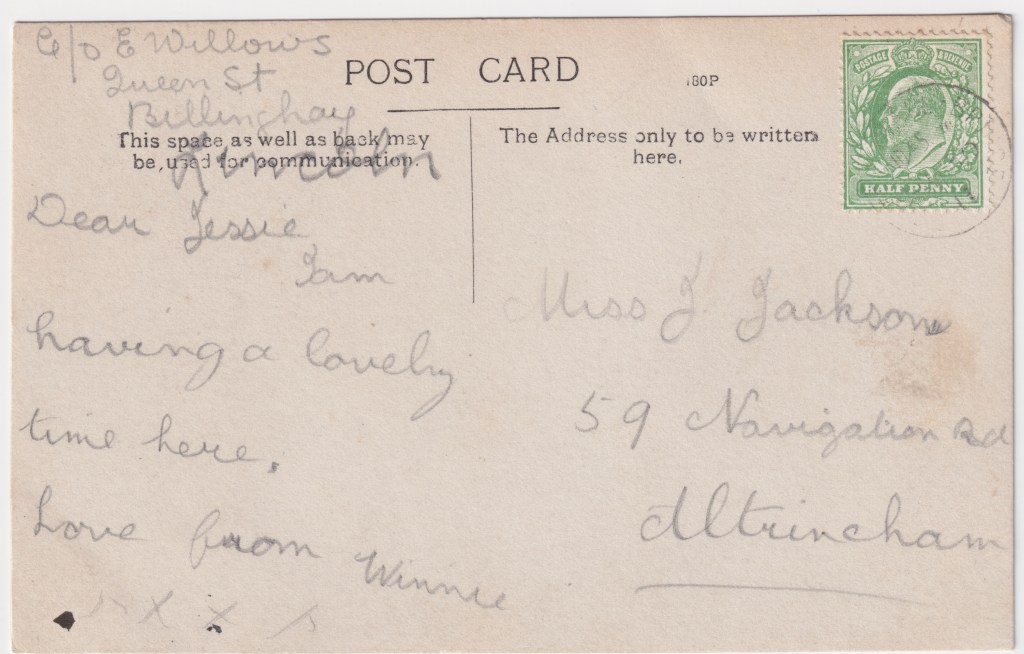
The following postcard in my collection also has a link with the above census record.
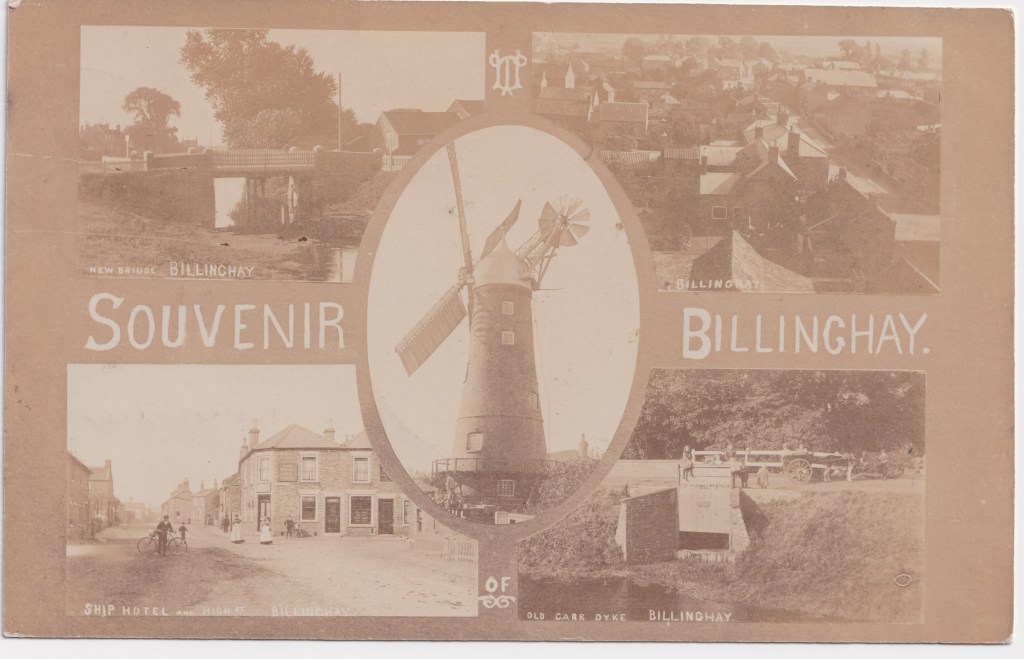
If you look at what’s written top left on the back. It says ‘C/O E Willows, Queen St, Billinghay ‘, which I know was Edward Willows at this time. Although on the 1911 census Edward has written Bridge Street, Billinghay, it was on the corner of Queen Street and Bridge Street.
Although it’s not a Willows postcard, it’s interesting to see that it arrived at their premises in Queen St for Miss Jessie Jackson. So, a relation of Kate Jackson’s. I shall save the story of this postcard for a future blog.
The Next Generation. From Willows to Willows & Sons.
By 1911, Edward and Mary Willows had had five children, four of whom had survived. The family business continued, and by 1921 they were living in Market Place, Billinghay, with another generation now involved.
Their son James Edward Willows was working in the family business as a baker and grocer, seemingly following the same path as his father and grandfather before him. Everything pointed towards the Willows business continuing into a third generation.
But here comes another twist.
When we find the family in the 1939 Register, things had changed considerably. Edward was now described as a retired grocer, but neither of his sons appears to have continued the family trade. James Edward, who had previously worked alongside his father as a baker and grocer, was now a teacher of music, while his brother Carl John Willows was a farmer.
After almost seventy years in which we can trace the Willows family from John Willows’ bakery in 1861, through the expanding grocery business and eventually into a third generation, it appears that the family’s long association with retailing in Billinghay had come to an end.
Exactly when the shop finally closed or passed into other hands remains to be established, but by 1939 the evidence suggests that Willows & Sons, as a family business, had ceased to exist.
What they left behind, however, was something rather special.
Scattered among collections, albums and drawers more than a century later are postcards carrying the Willows & Sons name little photographic records of the Billinghay they knew.
And it was when I started bringing those postcards together that the story took an entirely unexpected turn.
But What About the Postcards?
When I first came across postcards carrying the Willows & Sons name, I naturally assumed that the family had commissioned or perhaps even taken the photographs themselves and sold the finished cards through their shop in Billinghay.
All the cards were numbered, which immediately suggested that they formed part of a series. From the examples I had initially managed to identify, the numbers appeared to run only into single figures, leading me to believe that Willows & Sons had produced a relatively small collection of views of the village.
That alone fascinated me. Here was a family whose story I could trace from John Willows’ bakery in 1861, through successive generations of village life, and whose name had survived on photographic images of Billinghay more than a century later.
As my collection grew, however, so did the series.
I now have seven numbered views:
No. 2 – Market Place
No. 4 – St Michael’s Church
No. 5 – The Mill
No. 6 – High Street
No. 8 – River Skirth
No. 9 – Old Bridge
No. 12 – River Skirth (Outskirts)
The discovery of No. 12 was particularly interesting. It established that the numbered sequence extended to at least No. 12 and left some tantalising gaps — Nos. 1, 3, 7, 10 and 11 — not to mention the possibility that the series continued beyond No. 12.
At this point, I thought I was simply trying to reconstruct a lost Willows & Sons postcard series.
That’s until I studied the backs of the cards.
And that was when things became rather more interesting.
Several cards carry the familiar wording
“Published by Willows & Sons, Billinghay, Lincs.”
But No. 2 – Market Place doesn’t. That postcard carries the name of Atchinson’s Post Office instead.
Other examples from the numbered sequence have no retailer or publisher identified on the reverse at all.
Yet when the cards are placed together face-up, they appear to tell a very different story.
The numbering continues across them. The titles are presented in a remarkably similar fashion. The numbers occupy the same position. Everything about the fronts suggests that these photographs belong to the same numbered sequence.
Then I realised I might have been asking the wrong question.
Rather than trying to reconstruct a Willows & Sons series, was I actually reconstructing a much larger Billinghay photographic series, sold through more than one village shop?
If so, Willows & Sons were certainly an important part of the story, but there is currently no evidence that the Willows family themselves were photographers. They may have been very good at making bread and running a village store, but that doesn’t necessarily mean they were the people behind the camera!
One Series, Two Village Stores?
Once I had spotted the different names on the reverse of the cards, I went back to the photographs themselves and began comparing them much more closely.
That was when another detail caught my attention.
The handwriting.
Despite the different names appearing on the reverse, the fronts show some striking similarities. The titles and numbers appear in consistent positions and, more importantly, there are distinctive similarities in the handwriting itself.
Look, for example, at the stylised “No.”, the shape of No. 4 – St Michael’s Church, and the distinctive looping No. 9 – Old Bridge, and compare them with known Willows examples such as No. 5 – The Mill and No. 6 – High Street.
The similarities are difficult to ignore.
While handwriting comparison alone cannot identify the photographer, it adds weight to the possibility that these photographs originated from the same numbered photographic series, despite postcards from that series subsequently appearing with the names of different Billinghay retailers on the reverse.
Following the Clues.
The numbering itself offers another tantalising clue. When the known cards are placed in sequence, the photographer appears to have moved around Billinghay recording some of its most recognisable landmarks the Market Place, church, mill, High Street, bridges and River Skirth.
Whether the photographs were taken during a single visit or over a longer period we cannot yet know, but they certainly appear to have been conceived as a numbered collection of Billinghay views.
One photograph also provides us with an important dating clue.
In No. 2 – Market Place, Billinghay’s War Memorial is already standing complete and enclosed by its railings. As the memorial was unveiled in April 1922, the photograph must have been taken after that date. If the numbered photographs were created together, or within a relatively short period, this potentially places the series in the early 1920s.
But the reverse of No. 2 presents us with perhaps an even more intriguing piece of evidence.
Examples from this photographic sequence survive carrying the names of both Willows & Sons and Atchinson’s Post Office, while others appear without either name. Rather than showing that each retailer commissioned a separate set of photographs, the consistent numbering and presentation suggest they may have had access to images originating from the same photographic source.
Exactly how that arrangement worked remains unknown.
Were the photographs commissioned by one of the Billinghay businesses and subsequently made available to another? Did an outside photographer visit the village, create a numbered series and offer the resulting postcards to local retailers? Or was there another arrangement altogether?
At present, the postcards don’t give us that answer.
What they do tell us is that the name printed on the back of a postcard doesn’t necessarily identify the person who stood behind the camera.
And that leaves perhaps the biggest mystery of all:
Who was the Photographer?
Difficult to pin down exactly, I think, but there are three possibilities:
A local Billinghay photographer took the photographs and supplied the negatives to a postcard publisher.
A travelling commercial photographer came through Billinghay photographing the village, probably taking a batch of views in one visit.
Willow & Sons themselves commissioned photographers to travel around Lincolnshire and photograph suitable villages, subsequently printing the cards as their own series.
The Series of Billinghay Postcards I have.
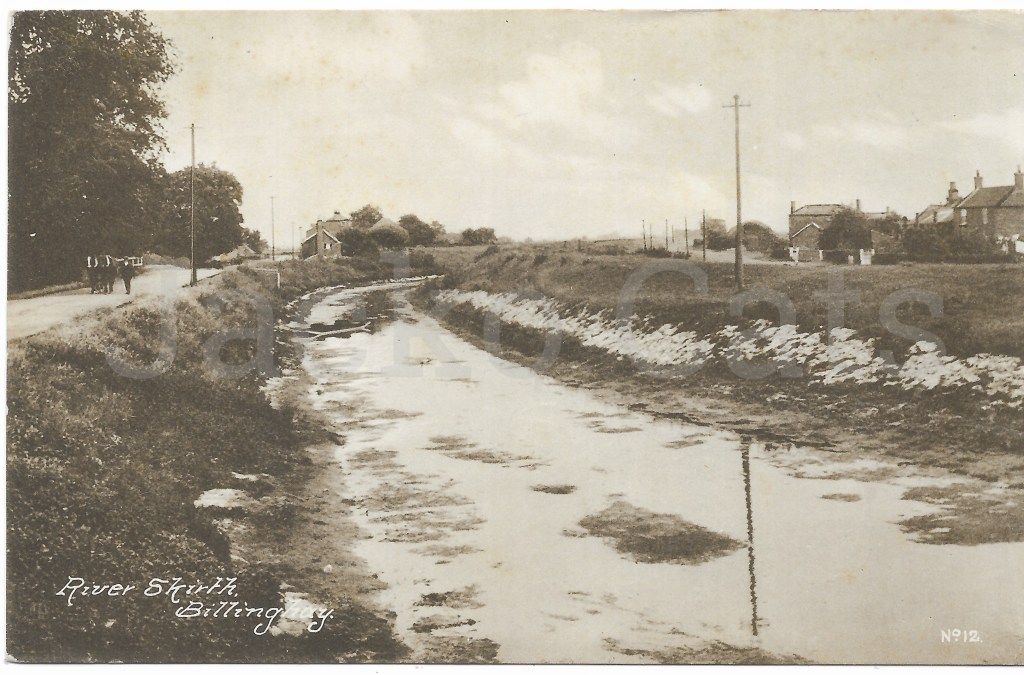
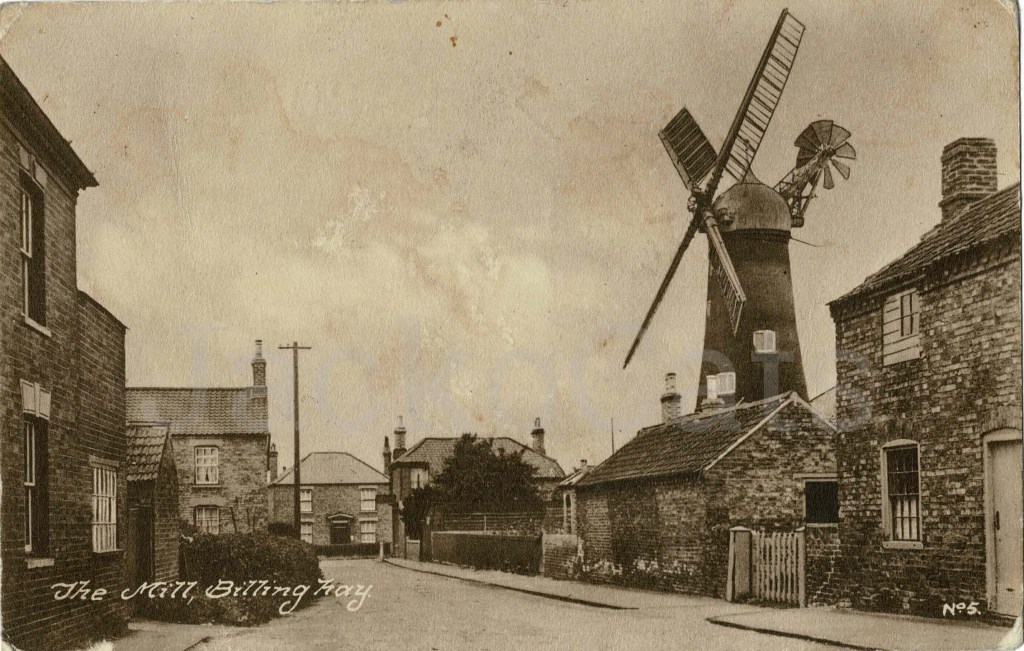
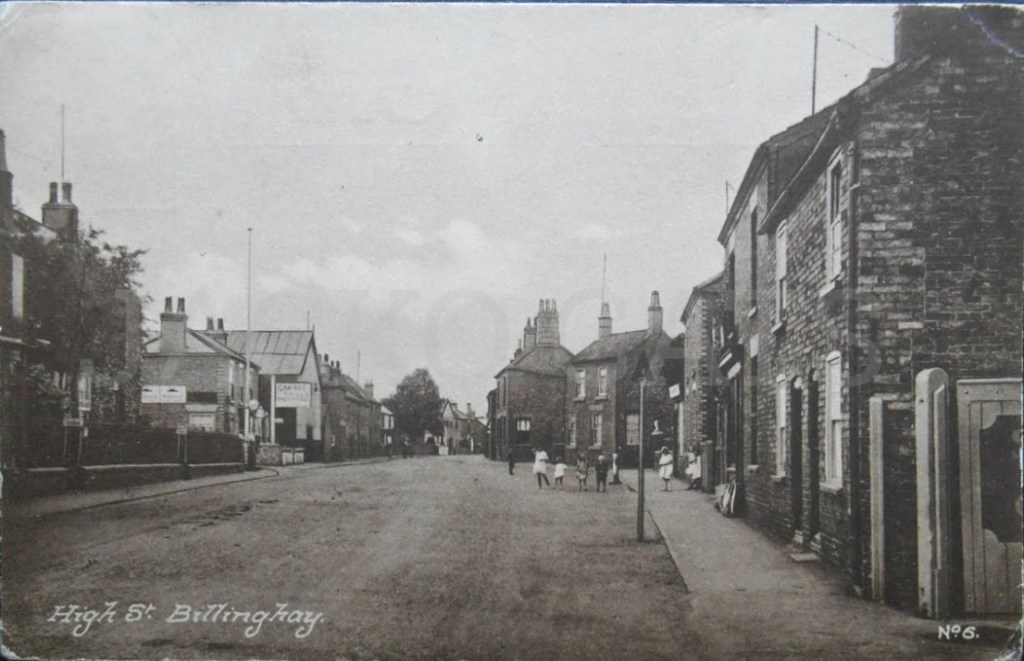
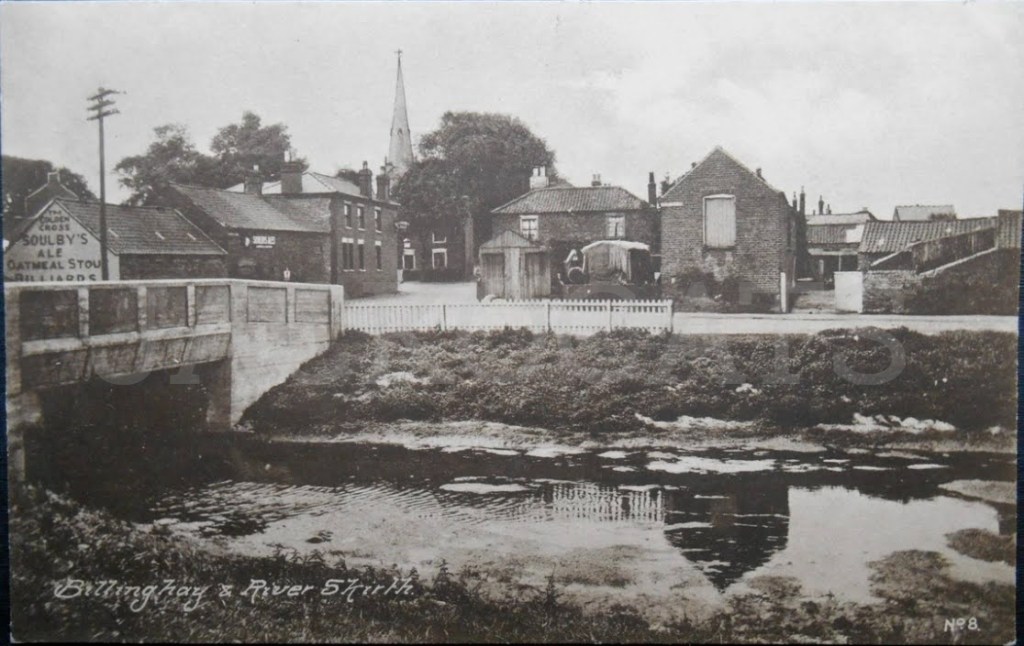
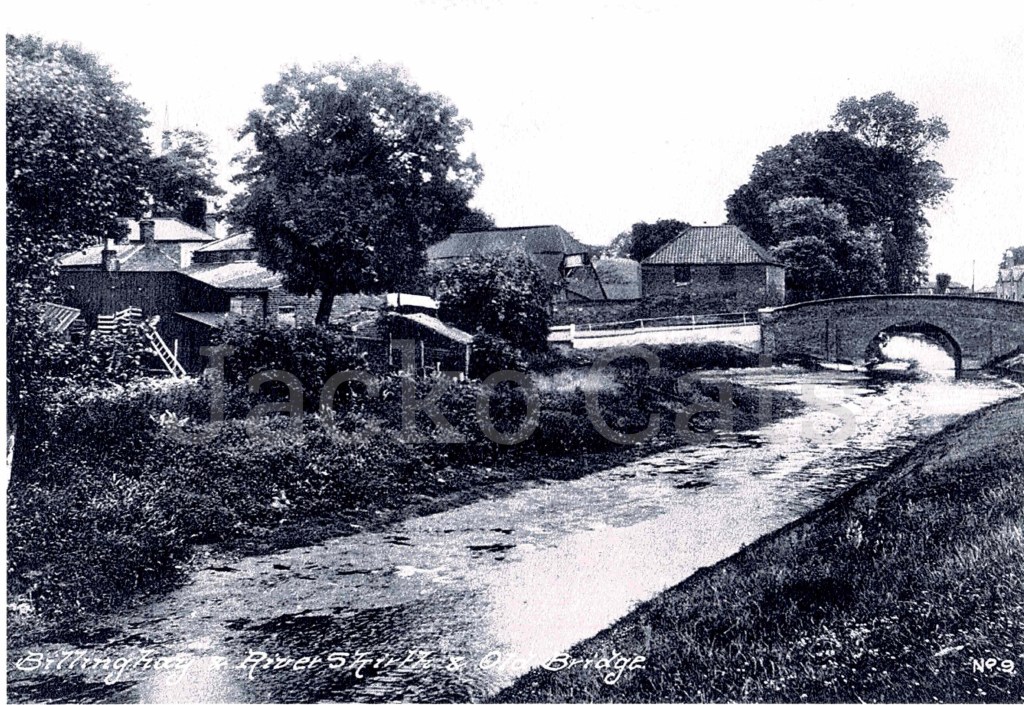
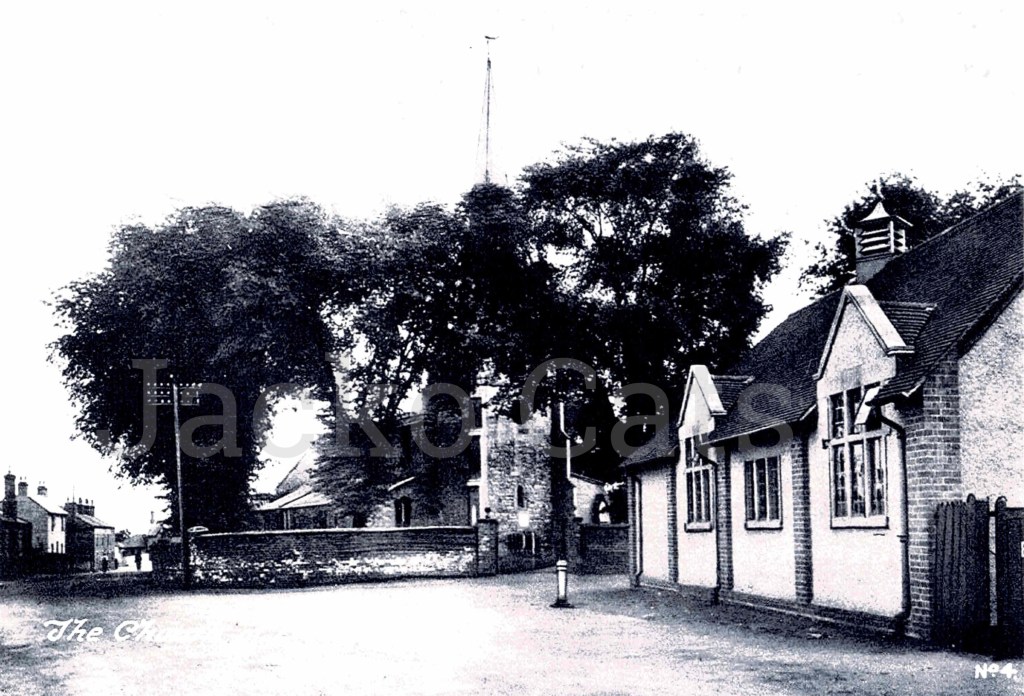
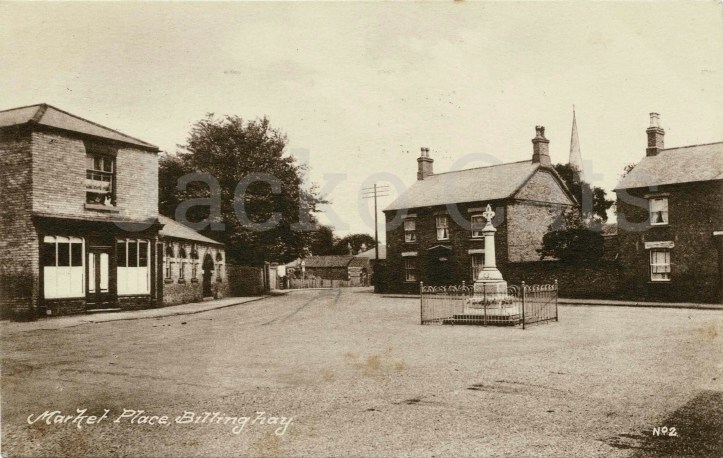
The Billinghay Numbered Series. The Story So Far.
The seven known cards currently in my collection: Nos. 2, 4, 5, 6, 8, 9 and 12. Can you help find the missing numbers?
The Missing Numbers.
So where does all of this leave us?
From the sequence identified so far, five very obvious gaps remain:
No. 1 – ?
No. 3 – ?
No. 7 – ?
No. 10 – ?
No. 11 – ?
But those missing numbers may be important for another reason.
Looking at the subjects we already have, the Market Place, Church, Mill, High Street, Bridges and River Skirth. I began to wonder whether we were actually following the photographer’s route through Billinghay.
Was the photographer walking through the village, deliberately photographing key landmarks and views along the way?
It is an intriguing possibility. The surviving subjects certainly have the feel of a planned photographic survey rather than a collection of completely unrelated views. Perhaps the photographer came to Billinghay specifically to create a series of village postcards that could then be offered for sale through local businesses.
Whether the numbers represent the actual order in which the photographs were taken is something we simply cannot know yet. But this is where the missing cards become particularly interesting.
What, for example, came immediately before No. 2 – Market Place? What view lies between the Market Place and No. 4 – St Michael’s Church? And where would No. 7 take us after High Street and before the River Skirth?
Finding even one of those missing numbers might help us establish whether there really was a geographical journey behind the sequence and perhaps even give us a clue as to where the mysterious photographer began and ended their tour of Billinghay.
And then there is another question:
Was No. 12 actually the final card in the series?
At the moment, I simply don’t know. There may have been a No. 13, No. 14 or perhaps even more. Somewhere, tucked away in an old family album, postcard collection or forgotten box, another numbered Billinghay view may still be waiting to be rediscovered.
For me, that is now part of the fascination. What began as an attempt to discover more about Willows & Sons has developed into an effort to reconstruct a photographic record of Billinghay created more than a century ago.
So this is where I need your help.
Have a look at those old Billinghay postcards! Don’t just look at the picture look carefully for a number, look at the style of the title and, most importantly, turn the card over. Whether it says Willows & Sons, Atchinson’s Post Office, or nothing at all could provide another piece of the puzzle.
Here are two examples of the Backs published by the Willows & Sons.
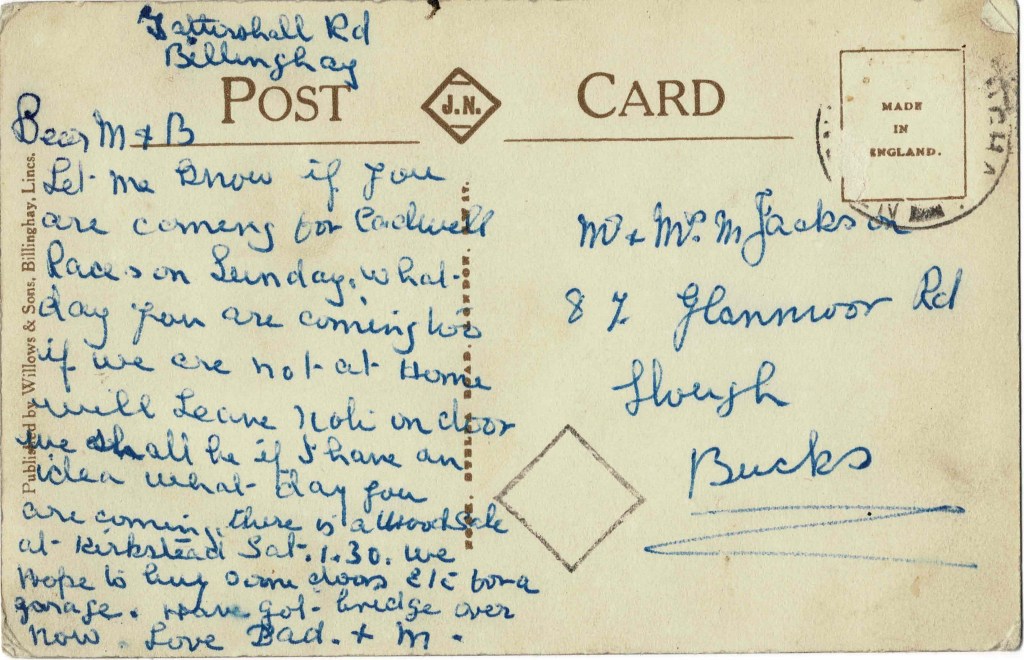
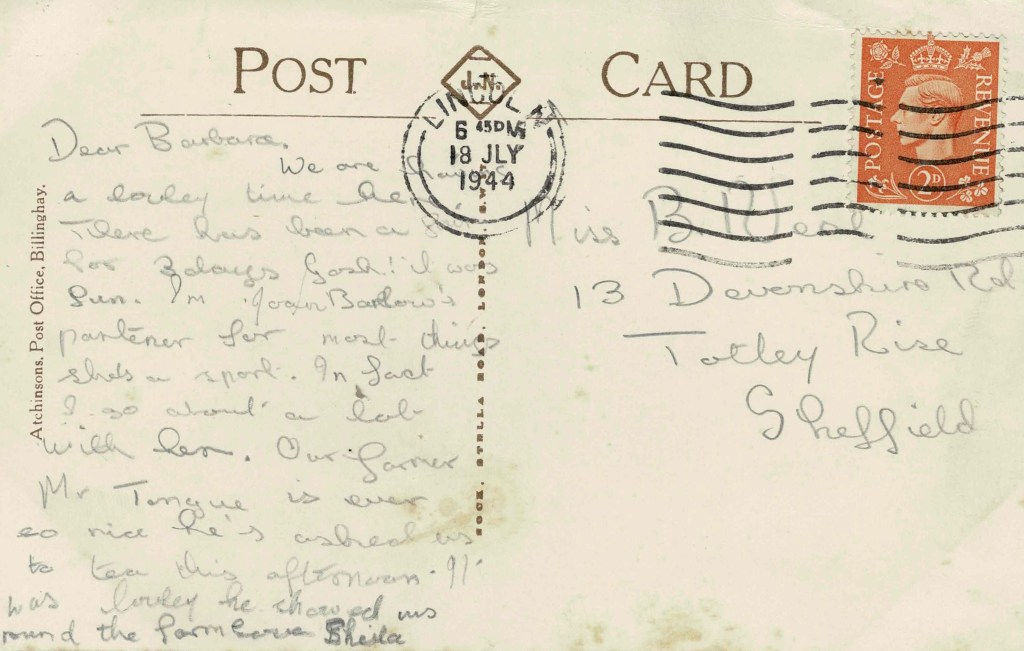
If somebody has No. 1, 3, 7, 10 or 11, I would absolutely love to see it.
And who knows?
Perhaps between us we can put the whole series and maybe even the photographer’s journey through Billinghay back together.

As always, if you can share any old photos or stories about Anwick or Billinghay. I would love to hear from you.
Please comment here or email jackocats2@gmail.com

