Where Billinghay worshipped: The Religious Census in 1851.
If you had walked through Billinghay on a Sunday morning in 1851, you might have assumed that St Michael & All Angels was at the heart of the village’s religious life. The numbers tell a rather different story.
On Sunday 30 March 1851, the people of Billinghay did what they had done on countless Sundays before. They put on their Sunday best, left their homes and made their way to worship.
But they were not all heading in the same direction.
Some walked to the ancient parish church of St Michael & All Angels, which had stood at the heart of village life for centuries. Others made their way to the Wesleyan Methodist Chapel, while another substantial congregation gathered at the much newer Bethel Chapel, home to Billinghay’s Strict Calvinists, or Particular Baptists.
And thanks to an extraordinary census taken on that particular Sunday, we can discover just how many people walked through each of those doors.
The Religious Census of 1851.
The 1851 Ecclesiastical Census was a groundbreaking, a one off nationwide survey of religious accommodation and attendance conducted across England, Wales, and Scotland on Sunday, 30 March 1851. Organised alongside the standard decennial population census, it remains the only official census of religion ever undertaken by the British government. The survey gathered data from over 30,000 places of worship, capturing the number of free and appropriated sittings, the size of congregations at morning, afternoon, and evening services, and Sunday school attendance.
So why was the Census taken?
- Measuring Spiritual Provision: The primary catalyst was the rapid population growth and intense urbanization driven by the Industrial Revolution. The government and the Church of England needed to evaluate whether the expansion of church buildings had kept pace with the shifting demographic landscape, particularly in fast growing industrial towns.
- The “Church Extension” Movement: Religious and political leaders wanted hard data to justify state funding and private philanthropy for building new churches in areas deemed spiritually neglected.
- Quantifying Dissent: Amid growing political friction between the state established Church of England and expanding Nonconformist denominations (such as Methodists, Baptists, and Congregationalists), authorities sought an accurate measure of the nation’s changing religious allegiance.
Outcome.
The published results shocked Victorian society by revealing that only about half of the population attended a service on Census Sunday. Furthermore, the data showed that Nonconformists accounted for nearly half of all active worshippers, shattering the assumption of Church of England dominance and permanently reshaping British political and religious discourse.
The 1851 Religious Census in Billinghay.
So how did this census In 1851 Billinghay parish had a population of 2,247 inhabitants , but those inhabitants did not worship as one religious community. By the middle of the nineteenth century, alongside the established Church of England, two flourishing Nonconformist traditions had become firmly established in the village.
When I began looking at the Billinghay returns, I expected the parish church to dominate village worship.
It didn’t.
The figures reveal something rather more interesting.
Instead of the Anglican parish church of St. Michael and All Angels drawing the vast majority of those 2,247 residents, it was the local “dissenting” chapels that stole the show. When the numbers from that rainy Sunday in March were tallied, the combined attendance at the Bethel Baptist Chapel and the Wesleyan and Primitive Methodist chapels didn’t just rival the established church, they thoroughly outpaced it.
For a traditional country parson, these statistics were nothing short of a nightmare. The returns proved that the Church of England had lost its spiritual monopoly over the working-class soul of Billinghay. In the fens, where life was defined by the brutal, exhausting labor of farming and drainage work, ordinary people were actively choosing the democratic, self-governing spaces of the chapels over the rigid, squire-dominated pews of the parish church.
When we look closer at these raw numbers, we can see exactly how the religious landscape of our village was rewritten overnight
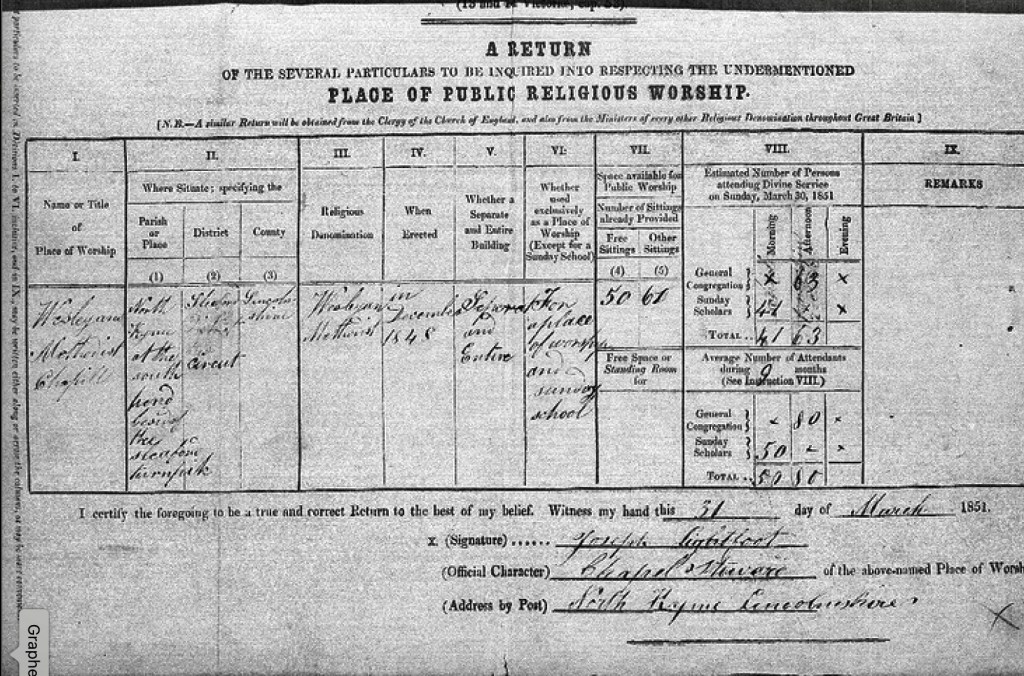
Three Places of Worship.
For centuries, the parish church of St Michael & All Angels, had been the established centre of worship in Billinghay.
It was by far the oldest of the village’s three places of worship and would have been familiar to generations of local families. Baptisms, marriages and burials had taken place there for centuries, and the church occupied an established position not only in religious life but within the parish itself.
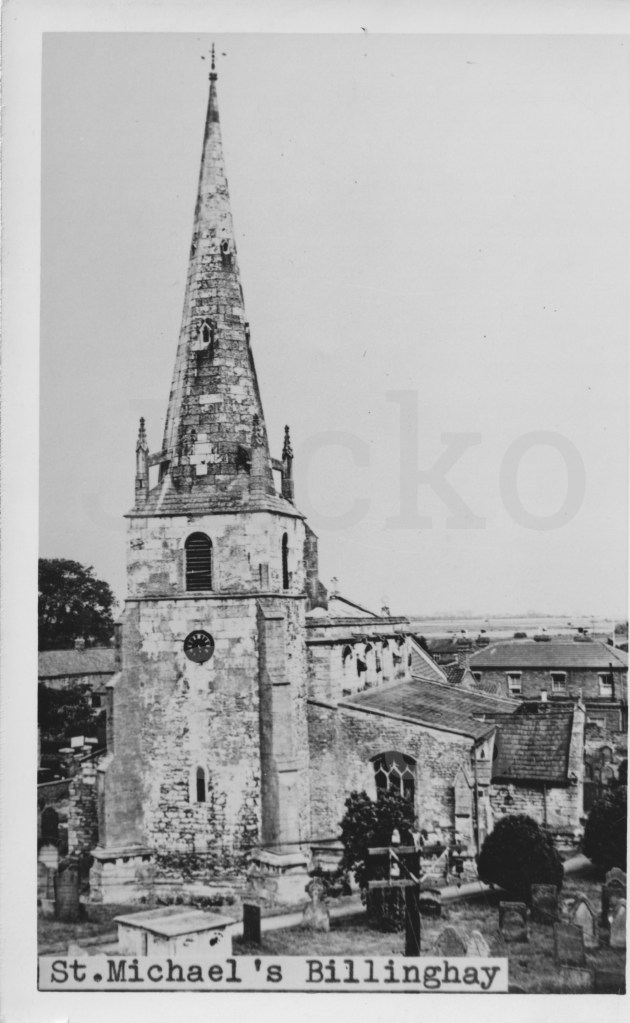
But during the first half of the nineteenth century, St Michael’s was no longer the only choice.
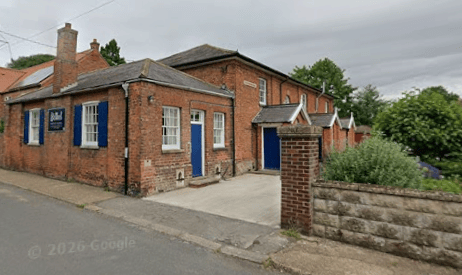
The growth of Methodism brought another form of worship to Billinghay. The village’s Wesleyan Methodists established their first chapel in 1817, which was replaced by a new chapel in King Street in 1832. By the time of the Religious Census nineteen years later, Wesleyan Methodism was firmly embedded in village life. The King Street chapel was later superseded by a new chapel in Victoria Street, built in 1867, which was itself demolished and replaced by the present chapel in Victoria Street in 1869.
Then came Bethel.
Opened in 1846, only five years before the census, Bethel belonged to the Strict Calvinist, or Particular Baptist, tradition.
It was the newcomer among Billinghay’s places of worship.
Yet its congregation was anything but small.
By 1851, therefore, one Lincolnshire village supported three distinct religious communities: Anglican, Wesleyan Methodist and Particular Baptist.
The Religious Census allows us to glimpse, for one remarkable Sunday at least, the relative strength of their congregations.
A Tale Told in Numbers?
The morning figures are particularly useful because an attendance was recorded for all three places of worship.
At St Michael & All Angels, 99 people attended morning worship.
At the Wesleyan Methodist Chapel, the recorded morning attendance was 118.
At Bethel, it was 200.
That last figure is particularly striking.
Despite Bethel having opened only five years earlier, its morning service attracted more than twice the attendance recorded at the ancient parish church.
Altogether, 417 attendances were recorded across Billinghay’s three places of worship that morning.
Of those, 318 were at the two Nonconformist chapels.
Put another way, just over 76% of the recorded morning attendances were at Nonconformist places of worship, compared with just under 24% at the established Church of England.
That does not mean that 76% of Billinghay’s population were Nonconformists.
The Religious Census recorded attendances, not the personal religious affiliation of every inhabitant. Nor does it tell us how many people stayed at home or did not practise any religion at all.
What it does provide is a snapshot of where people actually went to worship on that particular Sunday.
And on the morning of 30 March 1851, the balance was strikingly in favour of the chapels.
And the Day Was Not Over Yet.
The later services provide another glimpse into the strength of Nonconformist worship.
At the Wesleyan Methodist Chapel, 171 attendances were recorded later in the day.
At Bethel, the figure rose to an extraordinary 270.
Unfortunately, no corresponding later attendance figure was recorded for St Michael & All Angels, so we cannot make the same three way comparison that is possible for the morning.
We also need to remember that these were attendances rather than individual people. Someone attending chapel in the morning and returning later could be counted on both occasions.
Nevertheless, the size of the congregations is significant.
Between them, the two Nonconformist chapels recorded 441 attendances at their later services.
Bethel alone recorded 270 equivalent to around 12% of the entire population of Billinghay parish attending that one service.
For a chapel that had opened only five years earlier, its growth appears remarkable.
But statistics can only take us so far.
The population census taken that same year allows us to put names to some of the people behind those congregations.
Who Led Billinghay’s Congregations?
The three places of worship may all have gathered their congregations on the same Sunday, but they were organised in quite different ways.
At St Michael & All Angels was the Reverend Edward C. F. Jenkins, aged 44, who lived with his wife Susan and their large family at the Vicarage in Church Street.
Jenkins was no newcomer to Billinghay. A notice recording his death in March 1881 stated that he had been Vicar of Billinghay-cum-Walcot for 48 years, placing the beginning of his incumbency at around 1833.

His long ministry therefore spanned a remarkable period of change in the religious life of the village. When Jenkins became vicar, Billinghay’s Wesleyan chapel had only recently been built.
Thirteen years later, in 1846, Bethel opened its doors under the ministry of John Skipworth.
Skipworth, too, would become a remarkably enduring figure. At his death in 1873 he was described as having been minister of Billinghay’s Baptist Church for 27 years, taking his ministry back to around 1846, the very year Bethel opened.
So the two men whose congregations were counted in 1851 were not simply passing ministers. Jenkins and Skipworth would between them shape religious life in Billinghay for decades.
And for Jenkins in particular, the Religious Census must have reflected a considerable change. After some eighteen years as the village’s Anglican vicar, his church recorded 99 morning attendances, while the relatively new Bethel Chapel recorded 200.
Across Billinghay’s religious divide, Bethel had its own resident minister, John Skipworth.
The 1851 census records the 50-year-old Skipworth quite specifically as “Particular Baptist Minister of Bethel Chapel.”Born at Halton Holegate in Lincolnshire, he lived in Billinghay with his wife Ann and their adult son Edwin, an agricultural labourer.
But Skipworth’s connection with Bethel was much deeper than the census alone reveals.
When he died at his home in Billinghay in November 1873, aged 73, the Sleaford Gazette described him as having been “for 27 years the respected minister of the Baptist Church” in the village. That places the beginning of his ministry at around 1846 the same year Bethel opened.

A newspaper report from 1855 also records Skipworth conducting a marriage at the Baptist Chapel, further confirming his continuing ministry there.

It therefore seems likely that John Skipworth had been associated with Bethel from its earliest days and remained at the heart of its congregation for the rest of his life.
Seen in that context, the attendance figures of 1851 become even more interesting. Only five years into Skipworth’s ministry, 200 people attended Bethel that Sunday morning and 270 later in the day.
The Wesleyans operated rather differently again.
A Chapel Without a Resident Minister.
In 1851, Billinghay did not have its own resident Wesleyan minister.
Instead, the chapel formed part of the Sleaford Wesleyan Methodist Circuit.
The circuit system was an important feature of Methodism. Rather than every chapel necessarily having its own resident minister, ministers and local preachers travelled around a group of chapels, conducting services according to an organised preaching plan.
Billinghay’s Wesleyans were therefore part of a religious network extending beyond the boundaries of the village itself.
And yet the absence of a resident minister certainly does not appear to have weakened the local congregation.
The Billinghay Wesleyan Chapel recorded 118 attendances in the morning and 171 later in the day.
Methodism had clearly established a substantial following in the village.
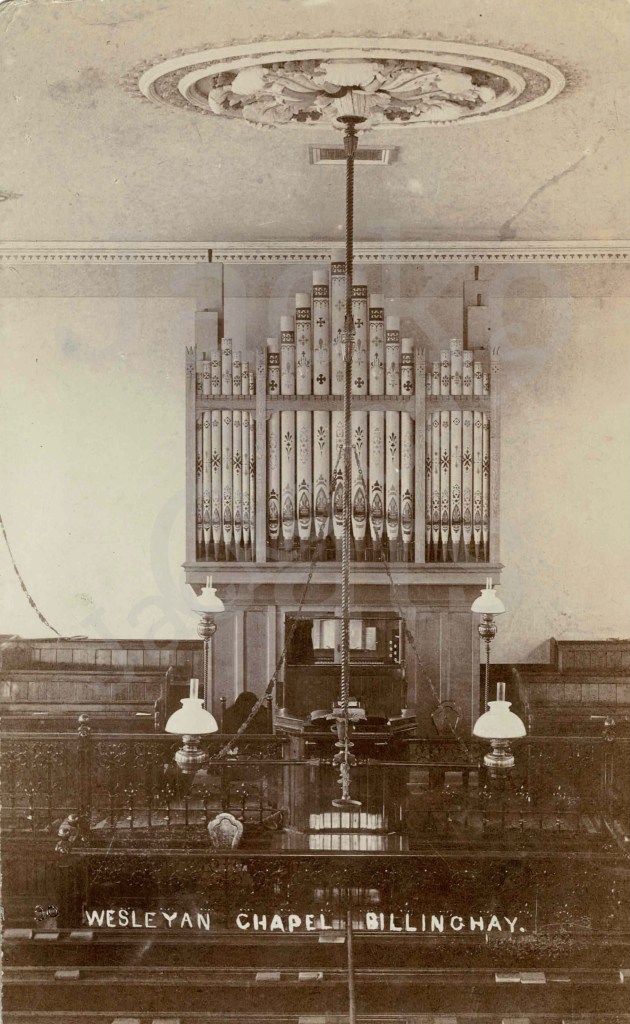
This photograph was taken no later than 1905, inside Billinghay’s Wesleyan Chapel. A remarkable glimpse of the chapel in which generations of Billinghay Wesleyans worshipped. The organ, pulpit, pews and lighting can all be clearly seen.
Why Chapel?
All of this leaves an intriguing question: Why had Nonconformity become such a huge part of life in Billinghay?
Billinghay was not unique. Across England, Methodism and other traditions were exploding. The Church of England was still the state church, but it was no longer the only game in town.
Chapels offered something completely different.
Methodism brought powerful preaching, passionate hymn singing, and a personal focus on faith. Because they used travelling ministers and local lay preachers, they could easily set up shop anywhere. The Particular Baptists were different again, but they shared that same fierce independence from the established Church.
These chapels became true communities. Between Sunday schools, weekly meetings, and social events, they formed a tight-knit web for their members.
Exactly what persuaded a specific Billinghay family to choose St Michael’s, the Wesleyans, or Bethel is hard to say. We can’t let the census numbers do all the talking.
But the figures do prove one thing. By 1851, the ancient parish church was no longer the sole focus of village life. It was sharing Billinghay with two thriving, energetic rivals.
One Sunday, One Village.
The Religious Census gives us only a snapshot.
It records one Sunday, 30 March 1851, and we cannot know whether attendance that day was typical, unusually high or unusually low.
Nor can we use it to divide Billinghay’s 2,247 inhabitants neatly into Anglicans, Wesleyans and Baptists.
Religion and religious observance were more complicated than that.
But for one day, nearly 175 years ago, the census opened the doors of Billinghay’s church and chapels and allowed us to look inside.
Perhaps the most surprising thing the census reveals is not that Nonconformity existed in Billinghay we already knew that from the chapels themselves.
It is just how significant it had become.
Within a generation, the religious landscape of the village had changed. St Michael & All Angels remained the ancient parish church at the heart of Billinghay, but it was now only one part of a much broader religious community.
On that Sunday in 1851, at least, Billinghay was very much a village of church and chapel.

As always, if you can share any old photos or stories about Anwick or Billinghay. I would love to hear from you.
Please comment here or email jackocats2@gmail.com

