The Human story behind a 1932 document from rural Lincolnshire.
Since I began writing my blogs about Billinghay and Anwick, much of my research has centred around old postcards, the people who sent and received them, and, of course, the wonderful photographs that offer us a glimpse into village life many years ago.
But every now and again, something rather different comes along.
Last week, while searching for items connected with our two villages, my friend Lynn came across a document listed on eBay with the rather startling title “Bastardy Arrears.”
Well, that certainly caught my attention!
It got me thinking about how people’s lives were recorded in the nineteenth and early twentieth centuries, and particularly the language used to describe circumstances that today we would regard very differently.
But what struck me even more was the shame and social stigma attached to a woman having a child outside marriage. I mean we always knew it existed, but this document makes it more startlingly real.
As I explored in one of my recent blogs, Anwick and Billinghay were villages with strong religious traditions, where moral values and respectability were an important part of everyday life. In such a small, close knit communities, where everyone knew everyone else’s business, I can only imagine how difficult life might have been for an unmarried mother.
There was little opportunity to conceal a pregnancy, and with it came the possibility of gossip, judgement and damage to a woman’s reputation. The shame was often borne not just by the mother, but by her family too.
What of the father?
While the woman carried the visible evidence of their relationship, and potentially the lifelong stigma of having a child outside marriage, the man was often spared the same degree of public scrutiny and condemnation.
He might be required by law to contribute financially towards the child’s upbringing, but the social consequences for him were not necessarily the same.
Two people had brought a child into the world, yet it was so often the woman who was expected to carry the shame.
And that, perhaps more than anything else, is what struck me about this document.
So, I placed a bid and was successful!
A Conscious Decision.
Before I continue, I should explain that I have made a conscious decision to obscure the names of the parents recorded in this document.
Although we are approaching the 100 year mark often associated with the protection of historical records, I feel there is a more important consideration here.
I have researched both individuals and established that they subsequently had other children, albeit with different partners. There are therefore likely to be descendants still living in the area, and I do not feel it is my place to revisit and publicly identify what was undoubtedly a very personal chapter in their family history.
My purpose in sharing this document is not to expose the individuals involved, but to examine what it tells us about society at the time, the language used in official records and, perhaps most importantly, the potentially devastating consequences for those whose lives were recorded within them.
What makes this particular case even more poignant is that it was also reported in the local press.
Just imagine that for a moment.
Not only had this woman’s private circumstances become a matter for the courts, but details of the case were now available for the wider community to read.
Almost a century later, I have no wish to add to that exposure by identifying those involved.
Their names are not important to the story I want to tell. What matters is what this document reveals about the attitudes of the time, and particularly the unequal burden of shame so often placed upon unmarried mothers.
So, with the identities deliberately concealed, let me share the document that prompted this rather different journey into Anwick’s past.
The Document.
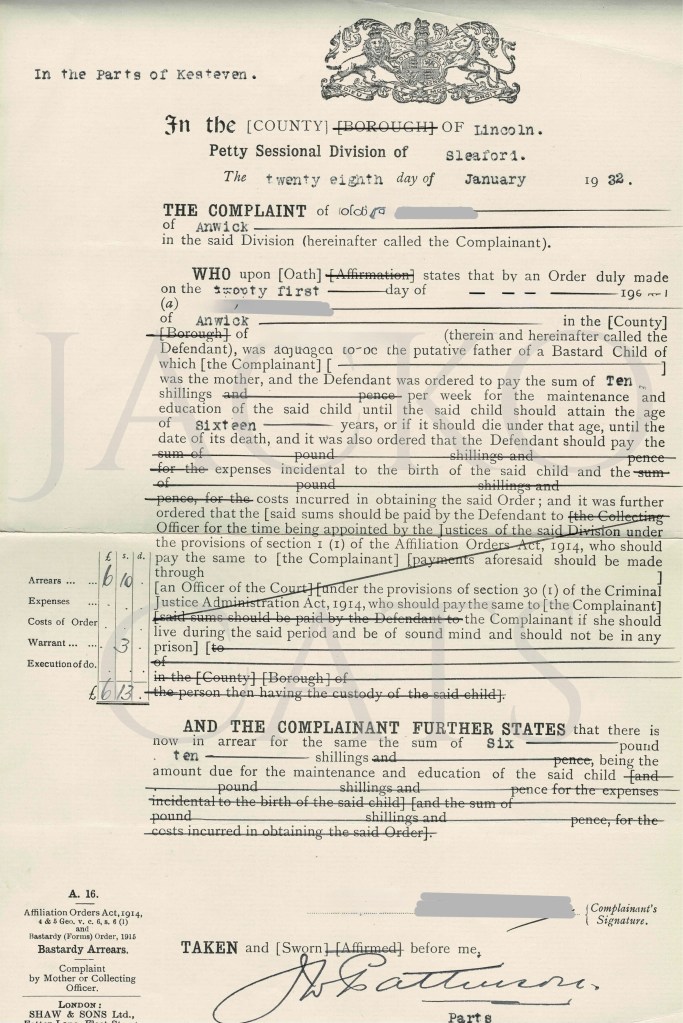
The document itself dates from 28 January 1932 and relates to a case heard in the Petty Sessional Division of Sleaford, in the Parts of Kesteven, Lincolnshire.
It refers to an earlier court order made in September 1928, requiring a man to contribute ten shillings a week towards the maintenance of a child born outside marriage.
By January 1932, arrears amounting to £6 10s had accumulated, and the mother was once again seeking payment through the courts.
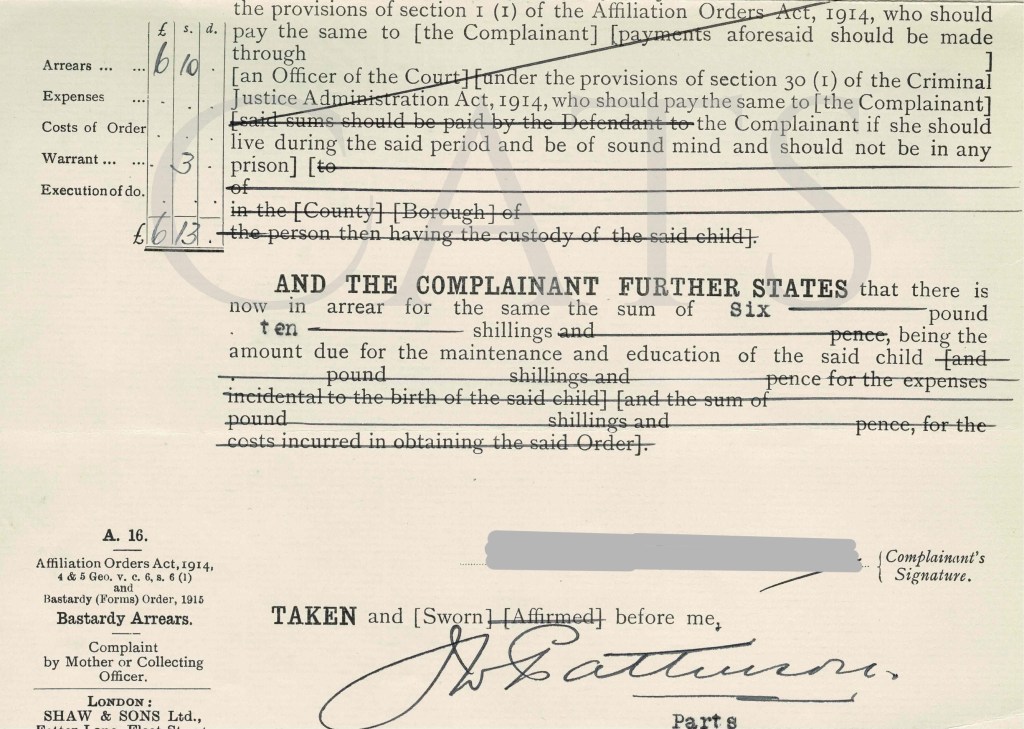
Behind the formal language, the legal terminology and the figures carefully entered onto the page was a mother trying to secure financial support for her child.
The original order required the father to pay ten shillings a week. By today’s standards, that might sound a modest amount, but it represented a meaningful financial obligation at the time.
To put that 10 shillings into context, it is worth in today’s money circa £45.
The mother had to make a formal complaint, swear to its contents, and place the matter before the magistrates.
This was no longer simply a private matter between two people. Their personal circumstances had become a matter of official record.
And what particularly struck me was the terminology.
The word bastard was not merely an insult in those days; it was also an established legal description of a child born outside marriage. Legislation governing such maintenance proceedings included the Affiliation Orders Act 1914.
It seems extraordinary to us now that such language was still appearing on official documents as recently as 1932.
A Different World, But Not So Very Long Ago.
We tend to associate the harshest attitudes towards illegitimacy with Victorian England, yet this document reminds us that the social stigma attached to unmarried motherhood continued well into the twentieth century.
By the 1920s, the law provided a means of requiring fathers to contribute towards the upbringing of children born outside marriage. Mothers could apply to the courts when those payments were not forthcoming.
But legal recognition and social acceptance were two very different things.
For many unmarried mothers, life could be exceptionally difficult. Employment opportunities might be limited, financial independence was far from guaranteed, and the judgement of neighbours, employers and even family members could be harsh.
In small rural communities, where families had often known one another for generations, keeping such personal matters private could be particularly difficult.
Of course, we should not imagine that every unmarried mother was cast out or abandoned. Some received considerable support from their families and communities, while others faced secrecy, hardship and rejection.
Every family’s circumstances were different.
But what remains striking is the inequality between the parents.
A father might face financial obligations and public criticism, but it was the mother whose pregnancy could not easily be concealed, whose reputation was more likely to suffer, and who was left to navigate the consequences of society’s judgement.
And we should not forget the child, entirely innocent of the circumstances of their birth, who could also carry the stigma of being labelled illegitimate.
The People Behind the Paper.
There is another aspect of this document that I find particularly moving.
Here was a woman who had already obtained a maintenance order in 1928, yet more than three years later she was still having to pursue money that had been ordered for her child’s upkeep.
Whatever her personal circumstances, she was taking steps to secure financial support for her child.
There is something quietly determined about that.
And I find myself wondering about the child.
Did they grow up knowing about these court proceedings? Were they aware of the difficulties their mother may have faced? Or was this simply another family matter that was never discussed?
We cannot know from this document what the mother felt, how the father viewed his responsibilities, or what became of their child.
But these are the questions that make historical research so fascinating.
Almost a century later, this single sheet of paper has survived, eventually finding its way onto eBay and into my collection of local history.
And perhaps that is where I should leave the story.
I have no wish to repeat the public exposure these individuals may have experienced all those years ago. Their names are not important to the point I am making.
What matters is what this document tells us about the society in which they lived.And whilst I have deliberately chosen not to reveal the identities of those involved, my research has allowed me to follow the story a little further.
I am pleased to say that, from what I have discovered, the child at the centre of these proceedings went on to do just fine in life.
And perhaps that is a fitting place to leave their personal story.
Their beginnings may have been recorded in the rather unforgiving language of the time, but those circumstances did not have to define the life that followed.
Almost a Century on, how times have changed.
Fast forward almost 100 years, today, children being born outside marriage is an accepted part of everyday life, as natural and unremarkable as night following day. The circumstances that once brought shame, embarrassment and public condemnation upon a mother are now, thankfully, viewed very differently.
And quite rightly so.
It is difficult to imagine today that something so commonplace could once have resulted in such public scrutiny, with a woman’s reputation potentially damaged simply because she had brought a child into the world without being married.
Yet this document reminds us that, within the lifetime of our parents and grandparents, attitudes were very different.
The child was no less loved, no less deserving, and certainly no less worthy because their parents were unmarried. It was society’s judgement that made the difference.
Finally!
For me, this is what makes social history so fascinating and, perhaps more importantly, so worth preserving.
When we look back at village life, it is easy to concentrate on the old buildings, the shops, the public houses, the churches and the wonderful photographs that capture a moment in time. But behind those images were real people, living real lives, with all the joys, worries, hardships and struggles that came with them.
Not everyone’s life was straightforward, and not every story had a happy ending. People faced financial difficulties, family problems, illness, loss and, as this document reminds us, the sometimes harsh judgement of the society in which they lived.
These were ordinary people, many of whom would never appear in a history book, yet their experiences are every bit as much a part of our villages’ history as the buildings and landmarks we work so hard to remember.
And perhaps that is why this particular document caught my attention. It is not simply a record of unpaid maintenance or a court proceeding. It is a small glimpse into someone’s life, a reminder that behind every official record there was a human story, even if we can never know all of it.
Because history isn’t just about the places we remember. It’s about the people who lived there, and the lives they led.

As always, if you can share any old photos or stories about Anwick or Billinghay. I would love to hear from you.
Please comment here or email jackocats2@gmail.com

